

BoosterHand Lab · simulation
Is a Casino Bonus Worth It? I Simulated 35x Wagering on 10,000 Players
Updated 2026-10-29 · By BoosterHand Lab · Method: Monte Carlo simulation (Python/NumPy, fixed seed)
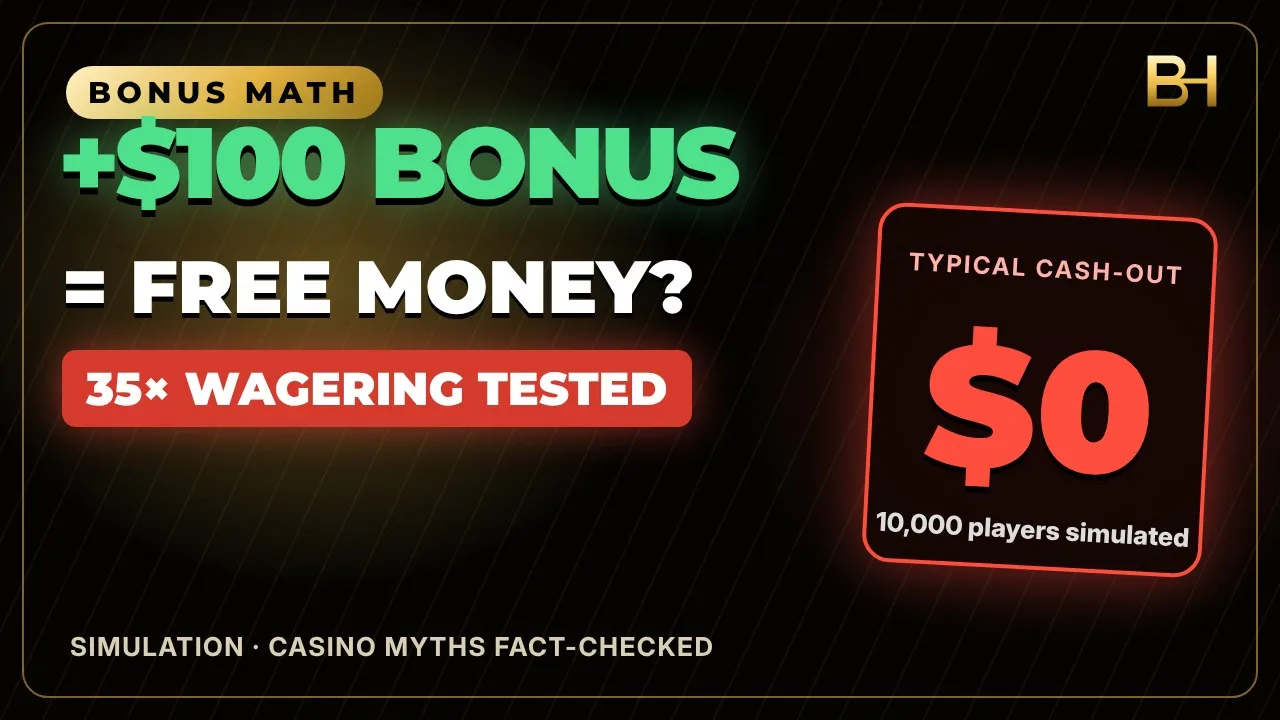
- 35x a $100 bonus means $3,500 of bets from a $200 balance.
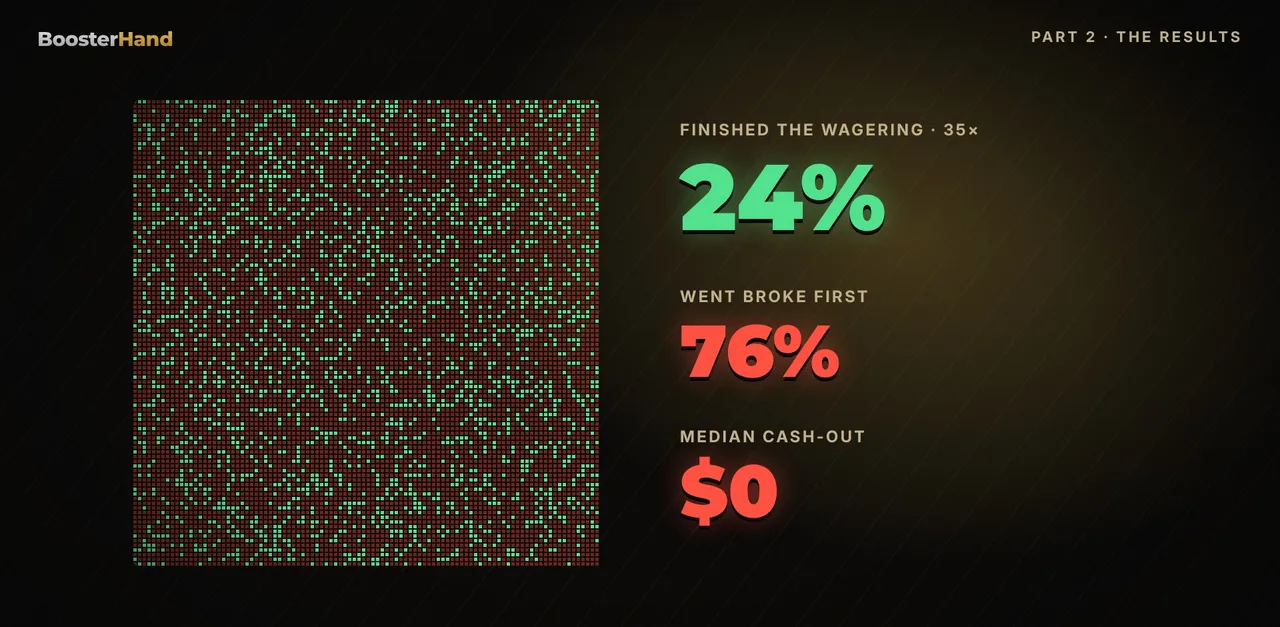
- Only 24% of 10,000 simulated players finished the wagering. The median player cashed out $0.
- Just 19% left with more than their original $100 deposit.
- The average gain fell from +$96 at 1x to +$14 at 50x wagering.
- 35x on deposit plus bonus ($7,000 of bets) left the average player $2 down, and a 94% RTP game left them $4 down.
- Quick check: $3,500 × 4% house edge = $140 expected loss, more than the $100 bonus.
Deposit $100, get a $100 bonus, double your money. Is a casino bonus worth it, or is “free cash” the most expensive phrase in gambling? I gave that exact offer, with a standard 35x wagering requirement, to 10,000 simulated players, and the typical player walked away with exactly $0.
The reason is buried in two words of fine print: wagering requirements. If you want the full rules explained, read our casino bonus wagering guide. This article is the wagering requirements simulation: what actually happens to real-sized balances when you play the offer out.
What a wagering requirement really asks for
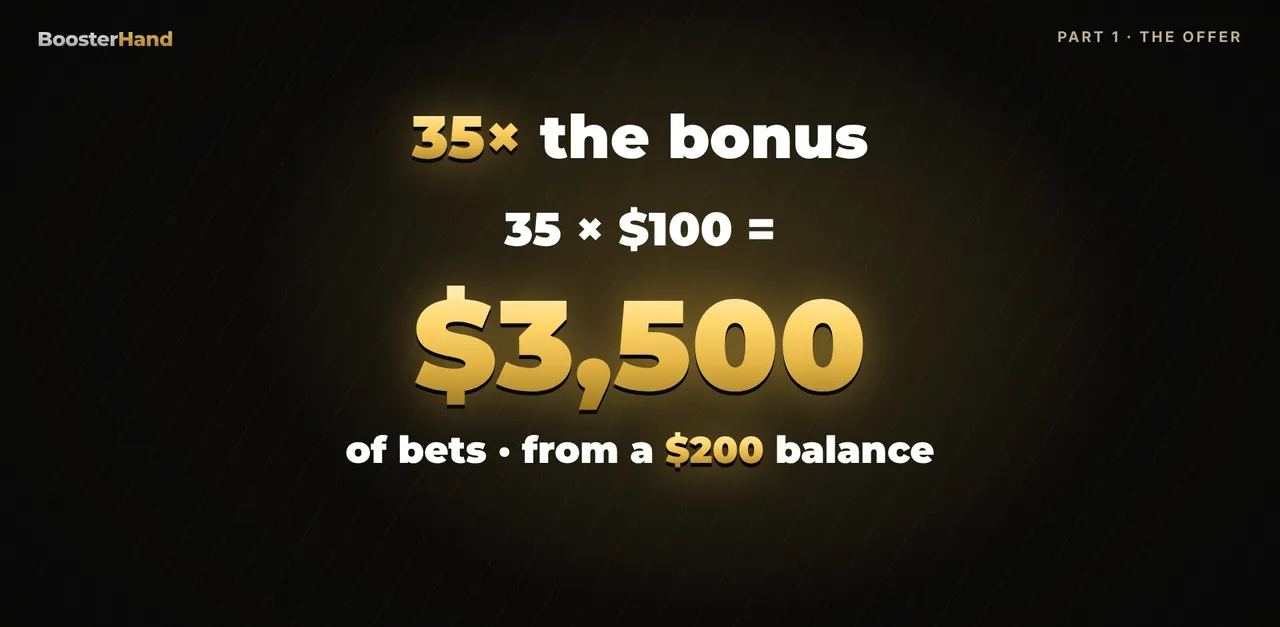
A wagering requirement tells you how much you must bet before you can withdraw anything. “35x the bonus” on a $100 bonus means 35 × $100 = $3,500 of bets.
You start with a $200 balance ($100 of your money plus $100 bonus). So you need to push your entire balance through the game many times over before the money is yours. Every one of those bets carries the house edge.
Before the results, a quick question: what’s the worst wagering requirement you’ve ever seen? 30x, 50x, or more? Leave the number in the comments.
How we ran the simulation
This is a generic model, not a copy of any specific casino’s offer. The setup:
- Players: 10,000, each run independently
- Offer: $100 deposit plus $100 bonus, so a $200 starting balance
- Game: a generic slot with 96% RTP (4% house edge)
- Bet: $1 per spin
- Wagering levels tested: 1x, 10x, 20x, 35x and 50x the bonus
- Stop rule: each player plays until the wagering is complete or the balance hits zero
- Method: Monte Carlo simulation in Python (NumPy), fixed random seed so the results are reproducible
We also tested two “fine print” versions: 35x applied to deposit plus bonus, and 35x on a 94% RTP game. Real offers add more rules on top, such as maximum bet sizes, game weighting and cash-out caps, and those usually make things worse for the player.
Is a casino bonus worth it at 35x? The results
At 35x, only 24% of players finished the wagering. The other 76% went broke first. Their deposit and the bonus were both gone before they ever reached the withdrawal button.
The median player cashed out $0. Only 19% left with more than the $100 they deposited.
Here’s the odd part. The average player still came out about $21 ahead of their deposit. How can the average be positive when the median is zero? Because a small group of lucky players finished with big balances, and they pull the average up. Most people don’t experience the average. They experience the median, and the median was nothing.
Wagering requirements simulation: 1x to 50x
The real story shows up when you change the requirement. Same players, same slot, same $1 spins. Only the wagering multiplier moves.
| Wagering | Bets required | Finished wagering | Median cash-out | Left with more than $100 | Average gain vs deposit |
|---|---|---|---|---|---|
| 1x | $100 | 100% | $182.50 | 100% | +$96 |
| 10x | $1,000 | 82% | $105.50 | 52% | +$64 |
| 20x | $2,000 | 44% | $0 | 32% | +$35 |
| 35x | $3,500 | 24% | $0 | 19% | +$21 |
| 50x | $5,000 | 16% | $0 | 14% | +$14 |
At 1x, everyone finishes and the bonus is worth about $96, almost its full face value. At 10x it’s still decent: 82% finish and the average gain is $64. By 20x, the median player is already at $0. At 50x, only 16% finish and the average gain shrinks to $14.
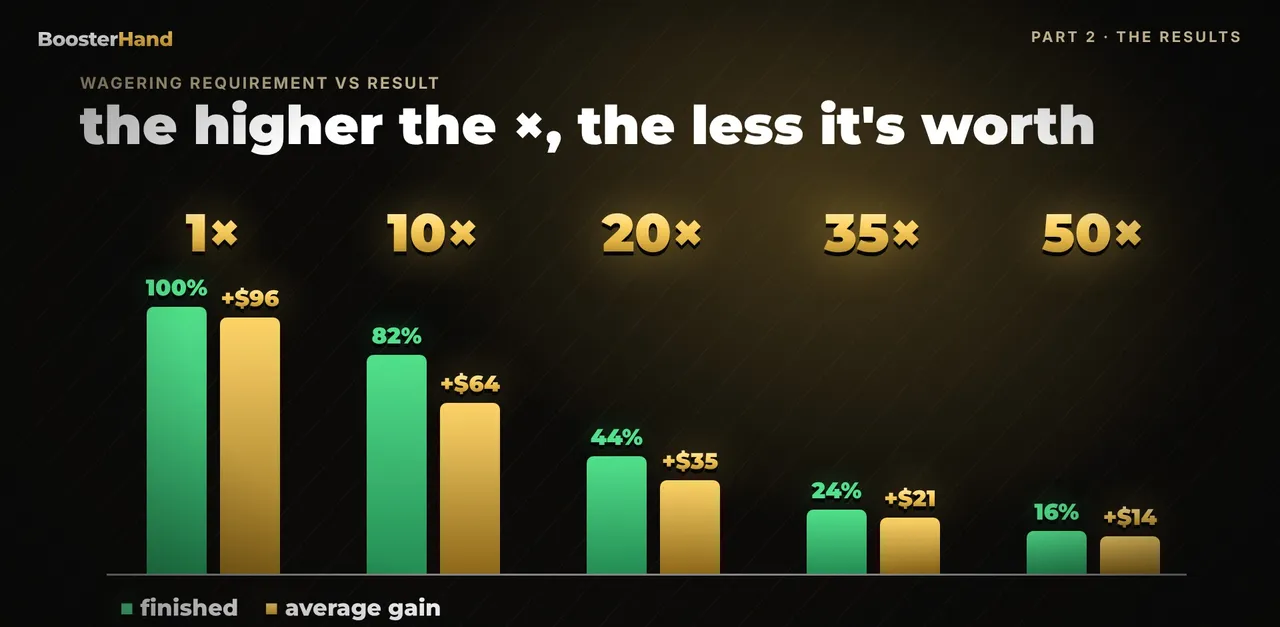
Now look at the “left with more than $100” column, because it’s the most honest one in the table. At 10x, 52% of players walked away with more than they deposited, roughly a coin flip. At 20x it fell to 32%, at 35x to 19%, and at 50x to just 14%. At the wagering levels many offers actually use, around four out of five players ended up with no more than the $100 they would have had by never depositing at all.
The median column tells the same story more bluntly. At 1x the typical player left with $182.50, and at 10x with $105.50. From 20x upward, the typical player left with nothing. The bonus didn’t fail for a few unlucky people. It failed for most people.
The fine print makes it worse
The table above is the friendly version. Two small details in the terms flip the result.
Wagering on deposit plus bonus
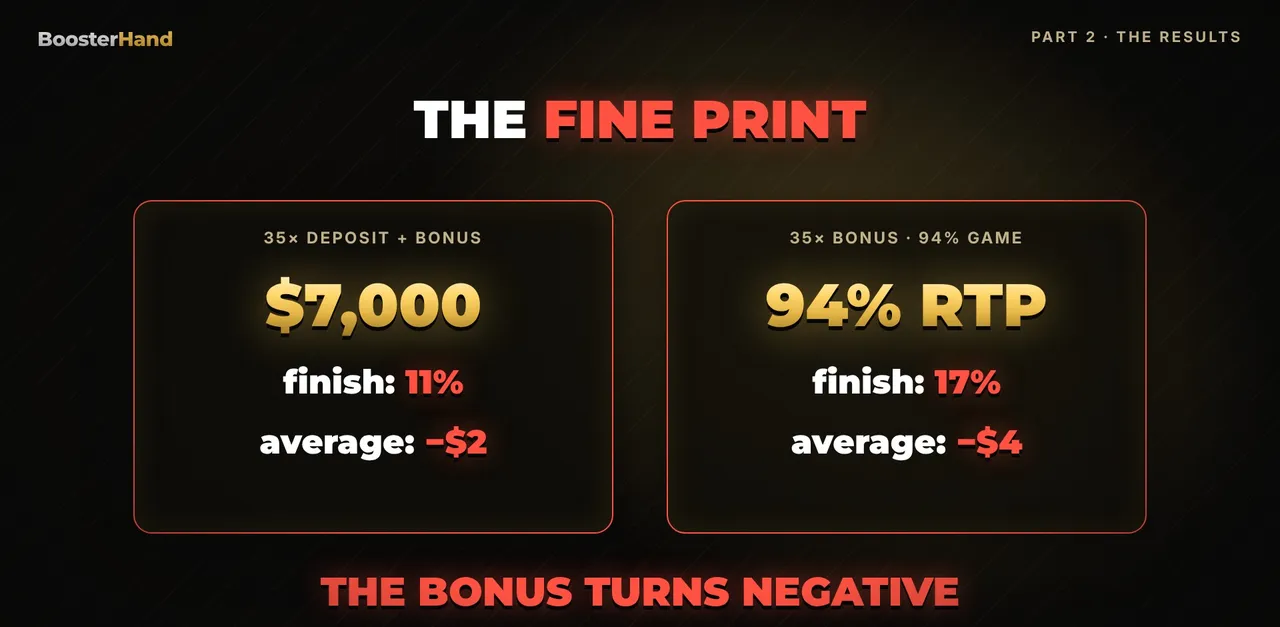
Some offers apply the multiplier to your deposit and the bonus together. 35x on $200 means $7,000 of bets. In the simulation, only 11% of players finished, and the average player ended up about $2 down. The bonus was worth less than nothing.
A lower RTP game
Keep 35x on the bonus only, but play a 94% RTP game instead of 96%. Only 17% finished, and the average player ended about $4 down. Two points of RTP turned a small average gain into a loss.
| Scenario | Bets required | Finished wagering | Average gain vs deposit |
|---|---|---|---|
| 35x bonus, 96% RTP | $3,500 | 24% | +$21 |
| 35x deposit plus bonus, 96% RTP | $7,000 | 11% | -$2 |
| 35x bonus, 94% RTP | $3,500 | 17% | -$4 |
If you want to see how much a few RTP points cost in general, our RTP simulation breaks it down per hour of play.
Notice how fragile the “positive” result was. In the base case, the average gain at 35x was only about $21. One extra rule in the terms (wagering on the deposit too) or a slightly worse game (94% instead of 96%) was enough to wipe it out. Real offers often stack several of these rules at once.
The one-line bonus formula
You don’t need to run 10,000 players to sanity-check an offer. Use this:
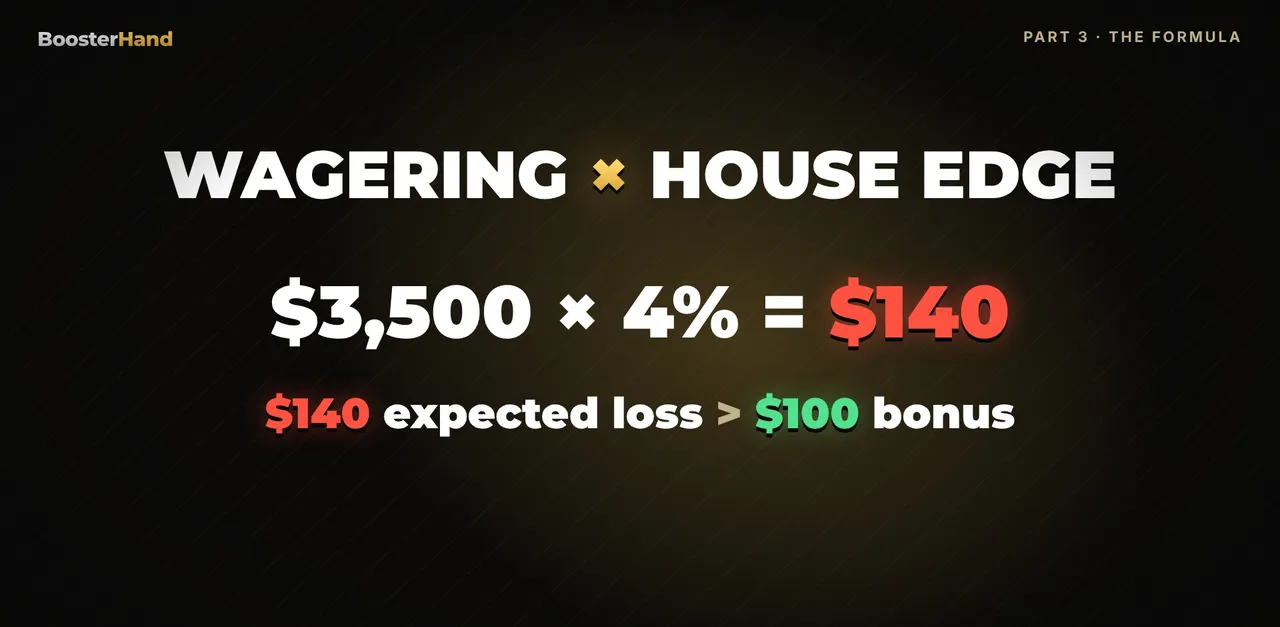
Expected loss = total wagering × house edge
For the 35x offer: $3,500 × 4% = $140 of expected losses. That’s more than the $100 bonus.
| Wagering | Bets required | Expected loss at 4% edge | vs $100 bonus |
|---|---|---|---|
| 1x | $100 | $4 | Bonus wins |
| 10x | $1,000 | $40 | Bonus wins |
| 20x | $2,000 | $80 | Bonus wins, barely |
| 35x | $3,500 | $140 | Loss is bigger |
| 50x | $5,000 | $200 | Loss is bigger |
So why did the simulated average at 35x still look slightly positive? Because most players went broke early and stopped betting. A player who busts after $800 of bets never pays the full $140 of expected losses. They just lose their $200 and leave. The formula assumes you complete the wagering, and the simulation shows most people don’t. Either way, the typical result is the same: $0.
Our wagering calculator runs this formula for any bonus size, multiplier and RTP, so you can check an offer in a few seconds.
What this means for you
A bonus isn’t free money. It’s a deal where you agree to bet a set amount in exchange for extra balance. Whether that deal is worth it is pure math, and you can check it before you accept.
Three things to check before taking any bonus:
- Bonus only, or deposit plus bonus? The second version can double the required betting, and in our model it turned the bonus negative.
- Do the math. Wagering × house edge versus the bonus amount. If the expected loss is bigger than the bonus, you’re paying for it.
- Is your own deposit locked? On many offers, you can’t withdraw your own money until the wagering is done. Read the terms first, and watch for max bet rules and cash-out caps.
It also helps to think in time, not just money. $3,500 of $1 spins is 3,500 spins of play before you can withdraw a cent. That is a long session, and the longer it runs, the more the house edge has to work with. Decide in advance whether you actually want to play that much.
You’re also free to decline a bonus. Playing with no bonus means no wagering, no locked deposit and no surprise terms. Aggressive bonus terms are one of the classic crypto casino red flags.
And if a bonus is pushing you to deposit more than you planned, that’s a signal to stop. Set a budget you can afford to lose, and visit our responsible gambling page if gambling stops being fun.
Next in the Lab: is red ever “due”? We spun a roulette wheel a million times to test the gambler’s fallacy.
FAQ
Is a casino bonus worth it?
It depends almost entirely on the wagering requirement. In our simulation, a $100 bonus with 1x wagering was worth about $96 on average, but at 35x the median player cashed out nothing and only 24% finished the wagering.
What does 35x wagering mean?
It means you must bet 35 times the bonus amount before you can withdraw. For a $100 bonus, that is $3,500 of total bets.
How do I calculate if a bonus is worth it?
Multiply the total wagering by the game's house edge to get the expected loss, then compare it with the bonus. If $3,500 of bets on a 96% RTP game costs $140 on average, that is more than a $100 bonus.
What is a good wagering requirement?
Lower is always better. In our model, 10x still had 82% of players finishing with an average gain of $64, while 35x and 50x left most players with $0.
Does wagering apply to my deposit too?
On some offers, yes. If 35x applies to deposit plus bonus, a $100 plus $100 offer needs $7,000 of bets, and in our simulation only 11% of players finished.
Related
Simulations use generic models, not any real game or casino. Results show long-run math, not predictions for one session. 18+ only. If gambling stops being fun, take a break: responsible gambling.
Next experiment: Gambler's Fallacy Tested: Is Red Ever Due? 1,000,000 Roulette Spins