

BoosterHand Lab · simulation
Gambler's Fallacy Tested: Is Red Ever Due? 1,000,000 Roulette Spins
Updated 2026-10-29 · By BoosterHand Lab · Method: Monte Carlo simulation (Python/NumPy, fixed seed)
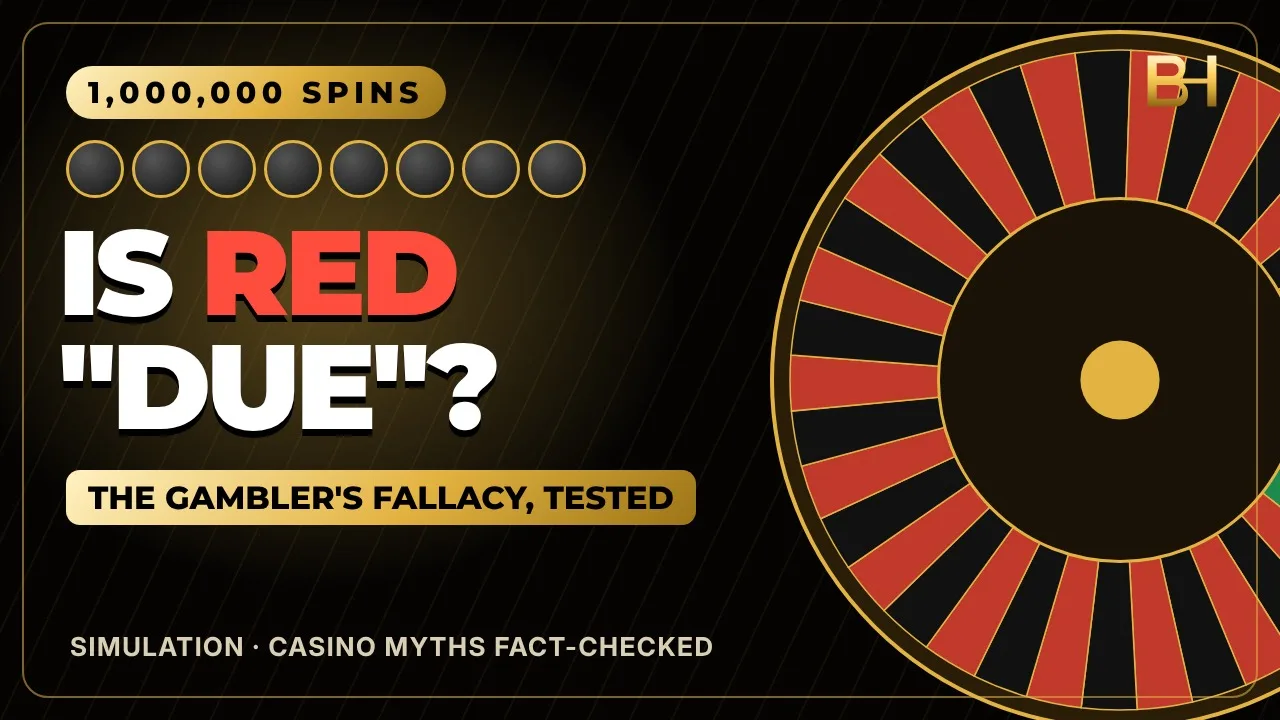
- In 1,000,000 simulated European roulette spins, red came up 48.6%, black 48.7% and green 2.7%.
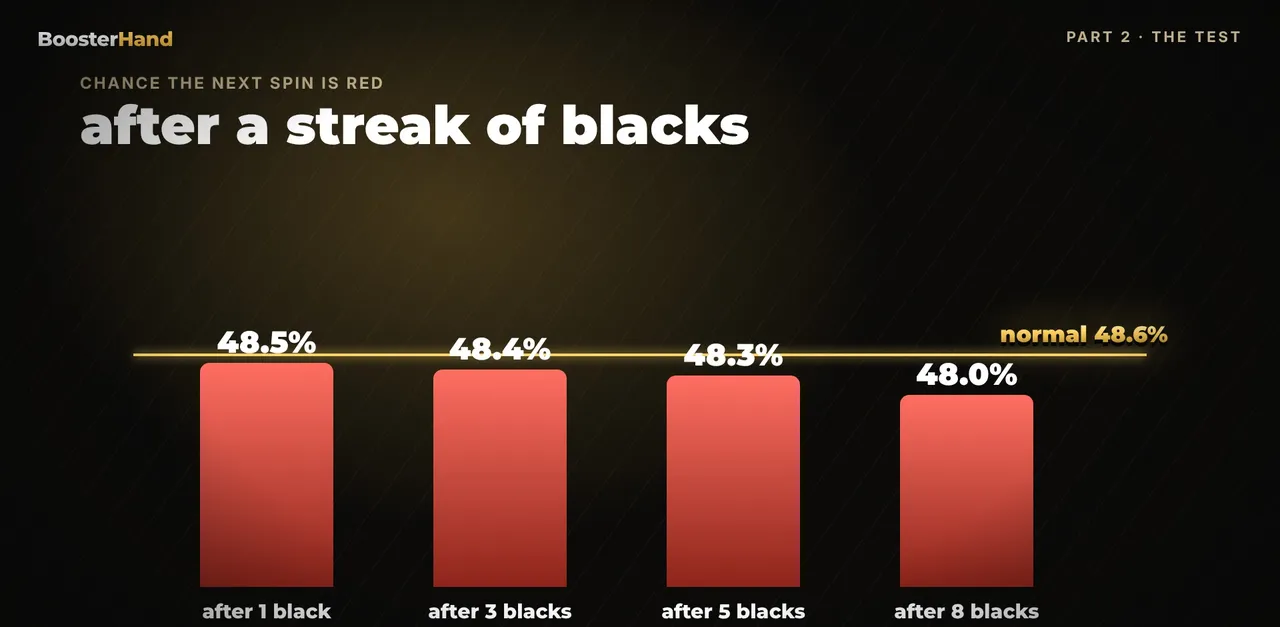
- After 1 black, red followed 48.5% of the time. After 8 blacks in a row: 48.0%. Red was never due.
- The longest run of one color was 18 in a row.
- Doubling a $10 bet through that streak would have needed $2,621,430.
- "Wait for 5 blacks, then bet red" returned 96.6 cents per dollar vs 97.2 cents betting red every spin. Both lose.
Black. Black. Black. Black. Black. Five in a row, so red has to come next, right? That gut feeling has a name, the gambler’s fallacy, and to put it to the test I spun a simulated roulette wheel 1,000,000 times and checked what actually happened after every streak.
Spoiler: the wheel doesn’t care what it did last time. But the numbers are worth seeing, because the feeling is incredibly convincing.
Roulette odds: what “fair” looks like
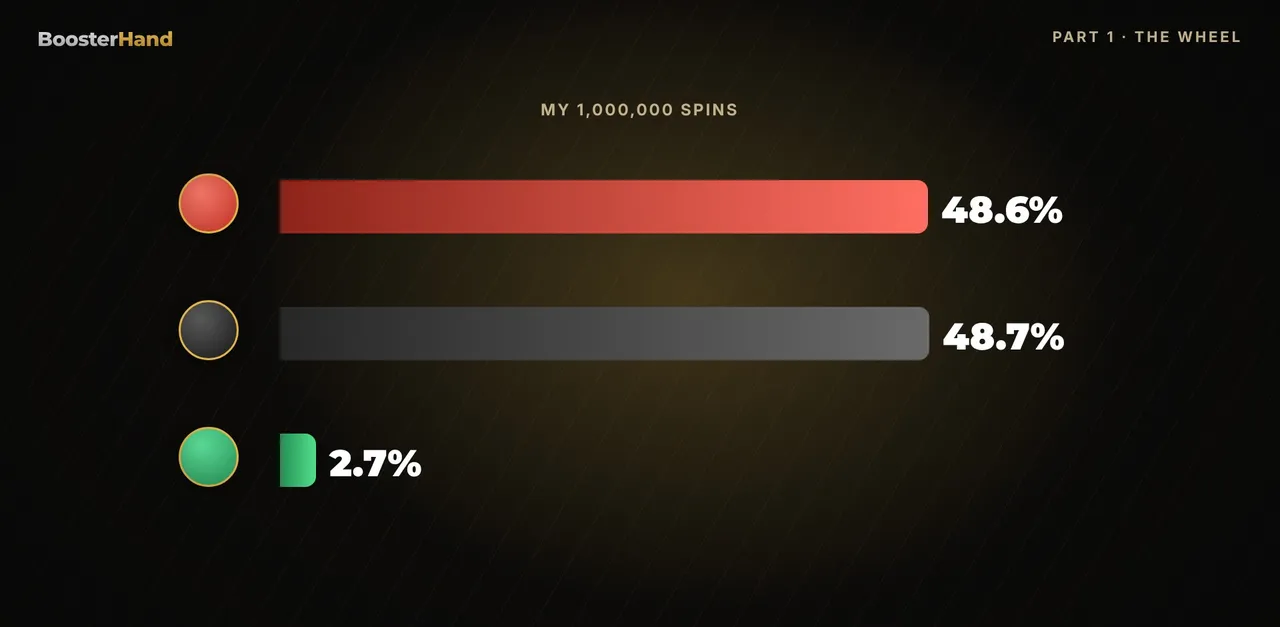
A European roulette wheel has 37 pockets: 18 red, 18 black and 1 green zero. So red should win 18 out of 37 spins, which is 48.6%. Black has the same chance. Green takes the rest, and that green pocket is where the house edge comes from.
Here’s what 1,000,000 spins of a fair simulated wheel produced:
| Color | Expected | 1,000,000 simulated spins |
|---|---|---|
| Red | 48.6% | 48.6% |
| Black | 48.6% | 48.7% |
| Green | 2.7% | 2.7% |
Over a million spins, the results land almost exactly on the math. That’s the law of large numbers doing its job.
That little 2.7% slice of green matters. Whenever the zero lands, every bet on red and every bet on black loses. It’s why betting red on every spin returned 97.2 cents per dollar in this test instead of a full dollar, and it’s why no pattern of red and black bets can escape the edge.
Now your turn, before you see the streak data: red has missed eight times in a row. What do you bet on next, and why? Write your answer in the comments, then keep reading.
How we ran the simulation
This is a generic model of a fair wheel, not data from any real casino. The setup:
- Wheel: European layout, 18 red, 18 black, 1 green zero, every pocket equally likely
- Spins: 1,000,000 in a single continuous sequence
- Streak test: find every point where black had just come up 1, 3, 5, 8 or 10 times in a row, and record the color of the very next spin
- Strategy test: compare “wait for 5 blacks, then bet red” with “bet red on every spin”, both at even money
- Method: Monte Carlo simulation in Python (NumPy), fixed random seed for reproducibility
A fair simulated wheel is the best-case version of roulette. Real wheels should behave the same way unless they’re broken or biased, which is rare and not something you could spot from a few dozen spins.
The gambler’s fallacy, tested: what happens after a streak
Here’s the core test. Every time black came up several times in a row, I checked the next spin. If red were ever “due”, the red percentage should climb as the black streak gets longer.
| Black streak before the spin | Times it happened | Red on the next spin |
|---|---|---|
| 1 black | 486,619 | 48.5% |
| 3 blacks in a row | 115,917 | 48.4% |
| 5 blacks in a row | 27,712 | 48.3% |
| 8 blacks in a row | 3,317 | 48.0% |
| 10 blacks in a row | 820 | 46.3% |
Red never got more likely. After 8 blacks, red came up 48.0% of the time, a hair below its normal 48.6%. After 10 blacks it was 46.3%, but that’s from only 820 cases, so it’s mostly random noise from a small sample. It certainly isn’t red catching up.
The wheel has no memory. Each spin is a fresh draw from the same 37 pockets. The ball doesn’t know there were eight blacks before it.
Why the gambler’s fallacy feels so right
If the math is that clear, why does almost everyone feel the pull? Because our brains expect short runs to look balanced. Psychologists call this the gambler’s fallacy: the belief that a random process will “correct” itself over a short stretch.
We know red and black should come out roughly equal, so a run of five blacks feels like a debt that red has to repay. But that balance only appears over huge numbers of spins, like the million in this test. And even then, it’s not because red catches up. It’s because the old streak gets diluted.
Think of it this way. Five blacks in a row at the start of a million spins is a big deal after 10 spins. After 1,000,000 spins it’s a rounding error. The percentages drift back toward 48.6% not because the wheel compensates, but because the streak is swamped by everything that comes after.
Streaks are normal, not a signal
Long streaks feel rare, so they feel meaningful. They’re not rare at all. In my 1,000,000 spins, the longest run of a single color was 18 in a row.
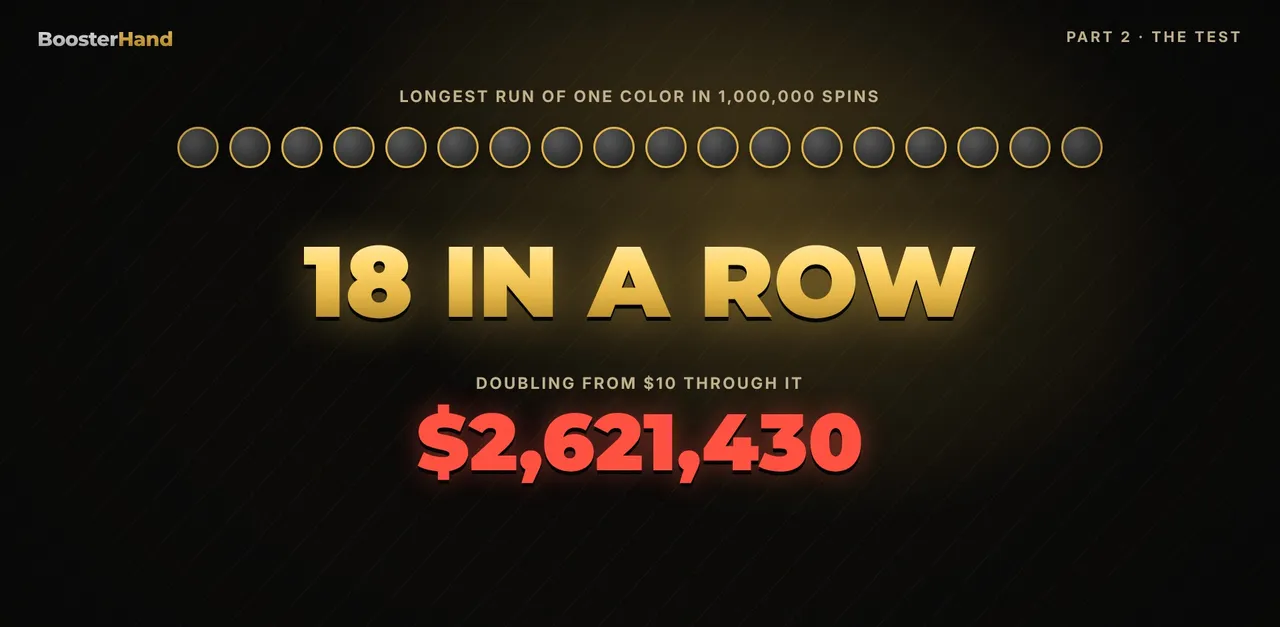
That streak is also a warning for anyone using a doubling system. If you had started with a $10 bet on red and doubled it after every black, getting through that streak would have needed $2,621,430 in total bets. No player bankroll and no table limit survives that. We tested this exact idea at scale in our Martingale simulation of 10,000 players, and you can check your own bankroll’s limit with the Martingale calculator.
The “hot color” trap is the same mistake
The gambler’s fallacy has a mirror image: betting black because black is “hot”. It feels like the opposite idea, but it rests on the same false belief that past spins steer future ones. The same independence that stops red from being due also stops black from being hot. After 8 blacks in a row, red still showed up 48.0% of the time, close to its normal rate, so neither color gained any special pull from the streak.
The same goes for “hot” and “cold” numbers. On a fair wheel, a number that hasn’t hit for 100 spins has exactly the same chance on the next spin as one that just hit three times. Any pattern you see in the history is a description of the past, nothing more.
Does waiting for a streak help?
The classic gambler’s fallacy system goes like this: don’t bet until black hits five times in a row, then bet red. The logic is that you’re only betting when red is “due”.
Here’s how it compared with simply betting red on every spin:
| Strategy | Number of bets | Red win rate | Return per $1 bet |
|---|---|---|---|
| Wait for 5 blacks, then bet red | 27,712 | 48.3% | 96.6 cents |
| Bet red on every spin | 1,000,000 | 48.6% | 97.2 cents |
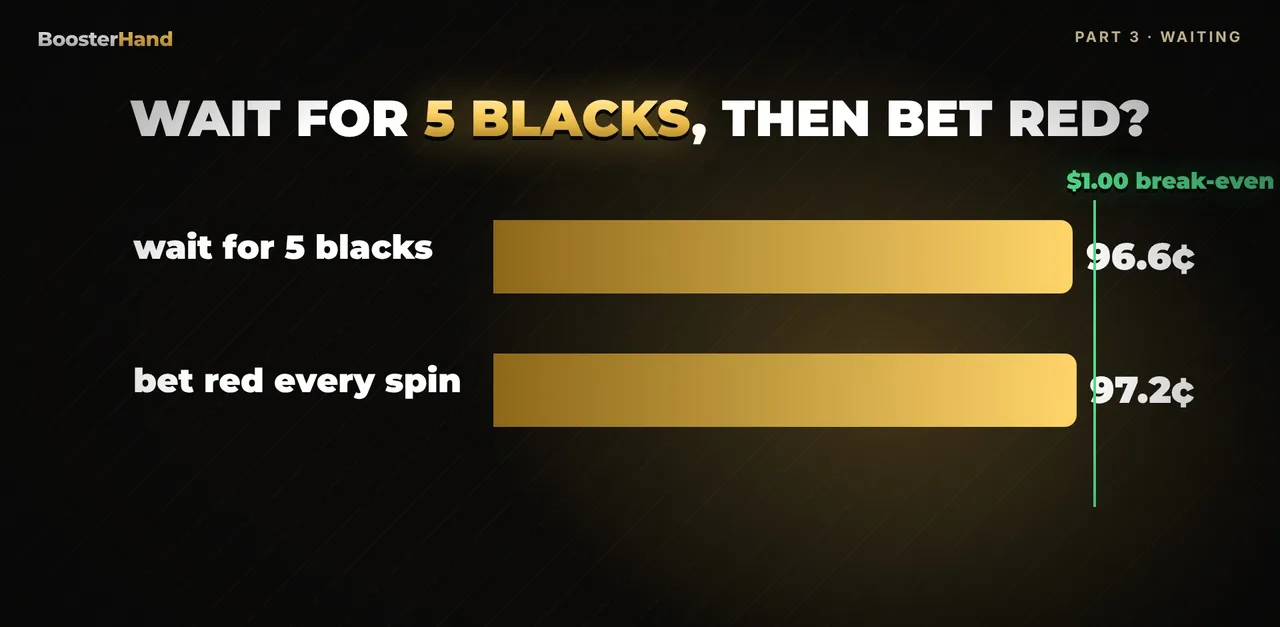
The two results are basically the same, and both lose. The small gap between 96.6 and 97.2 cents is just random variation in a smaller sample of bets. Waiting doesn’t change the odds. It only changes how often you bet. Fewer bets means slower losses, not better ones.
This holds for every pattern-based approach. Our test of 7 betting systems on 70,000 players found the same thing: the system changes the shape of your results, but the house edge stays exactly where it is.
What this means for you
The gambler’s fallacy is one of the most natural mistakes in gambling, and casinos don’t do much to discourage it. Here’s what the million spins say:
- Every spin is independent. The wheel doesn’t remember the last spin, the last ten or the last hundred. Red’s chance is 48.6% every single time on a European wheel.
- Long streaks are normal. Runs of 10, 15 or even 18 of one color happen naturally over enough spins. They aren’t a signal to bet bigger or switch colors.
- Be skeptical of history boards. The screens showing recent results make streaks look meaningful. They’re not. They show what happened, not what will happen.
None of this means roulette is rigged against streak-watchers in particular. It means the edge is the same for everyone: the 2.7% green pocket applies whether you bet on a hunch, a pattern or at random, and the history board can’t change that.
If you notice yourself thinking “it has to change soon”, treat that thought as a cue to pause, not to bet. Chasing a streak is one of the fastest ways to bet more than you planned. Set a budget before you play, and if gambling stops being fun, see our responsible gambling page for tools and support.
Next in the Lab: same RTP, different pain. We compared low and high slot volatility with 10,000 players on each machine.
FAQ
What is the gambler's fallacy?
It's the belief that a random outcome becomes more likely because it hasn't happened for a while, like thinking red is due after several blacks. In our 1,000,000-spin test, red never became more likely after a streak.
Is red more likely after 5 blacks in roulette?
No. In our simulation, red came up 48.3% of the time after 5 blacks in a row, essentially the same as its normal 48.6%. Each spin is independent of the last.
What is the longest streak of one color in roulette?
There's no fixed limit. In our 1,000,000 simulated spins, the longest run of a single color was 18 in a row.
Does waiting for a streak before betting help?
No. Waiting for 5 blacks and then betting red returned 96.6 cents per dollar in our test, while betting red on every spin returned 97.2 cents. Waiting only changes how often you bet, not the odds.
Why does the gambler's fallacy feel true?
Our brains expect short sequences to look balanced, so a long streak feels like it must reverse. Balance only shows up over huge numbers of spins, and it comes from dilution, not from red catching up.
Related
Simulations use generic models, not any real game or casino. Results show long-run math, not predictions for one session. 18+ only. If gambling stops being fun, take a break: responsible gambling.
Next experiment: Slot Volatility Explained: Low vs High at the Same 96% RTP