

BoosterHand Lab · simulation
RTP Explained: What 96% RTP Really Means for Your $100
Updated 2026-10-29 · By BoosterHand Lab · Method: Monte Carlo simulation (Python/NumPy, fixed seed)
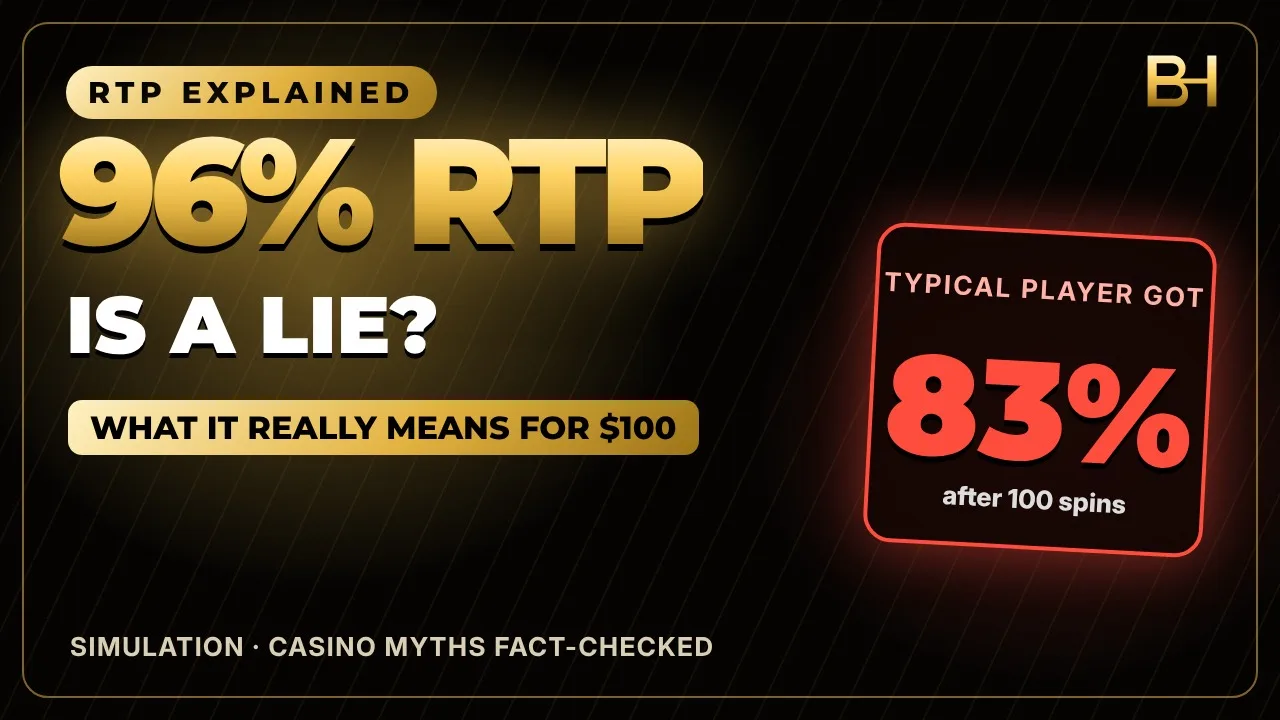
- RTP is the share of all money bet that's paid back over a huge number of spins, not your deposit and not your session.
- On a 96% slot, the typical player's $100 lasted 691 spins: about $700 of bets, then it was gone.
- After 100 spins, the typical player got back only 83%, and 27% were ahead.
- After 1,000,000 spins, every session landed between 94% and 98% and nobody was ahead.
- At $1 a spin and 600 spins an hour: 96% RTP costs about $24/hour, 88% RTP costs $72/hour.
- $100 lasted 691 spins at 96% RTP but only 429 spins at 88%.
96% RTP. Most people read that and think: bet $100, get $96 back. That’s not what happens. Get RTP explained properly and the number turns out to be a promise about the machine, not about you: in our simulation, after 100 spins the typical player got back only 83%.
So what does RTP really mean for your money? We ran the numbers on 10,000 simulated sessions.
What RTP means (return to player)
RTP stands for return to player. It’s the share of all the money bet on a game that gets paid back, averaged over a huge number of spins. The rest is the house edge: on a 96% game, that’s 4%.
Two phrases in that definition do all the work:
- All the money bet, not the money you deposit.
- A huge number of spins, not your session.
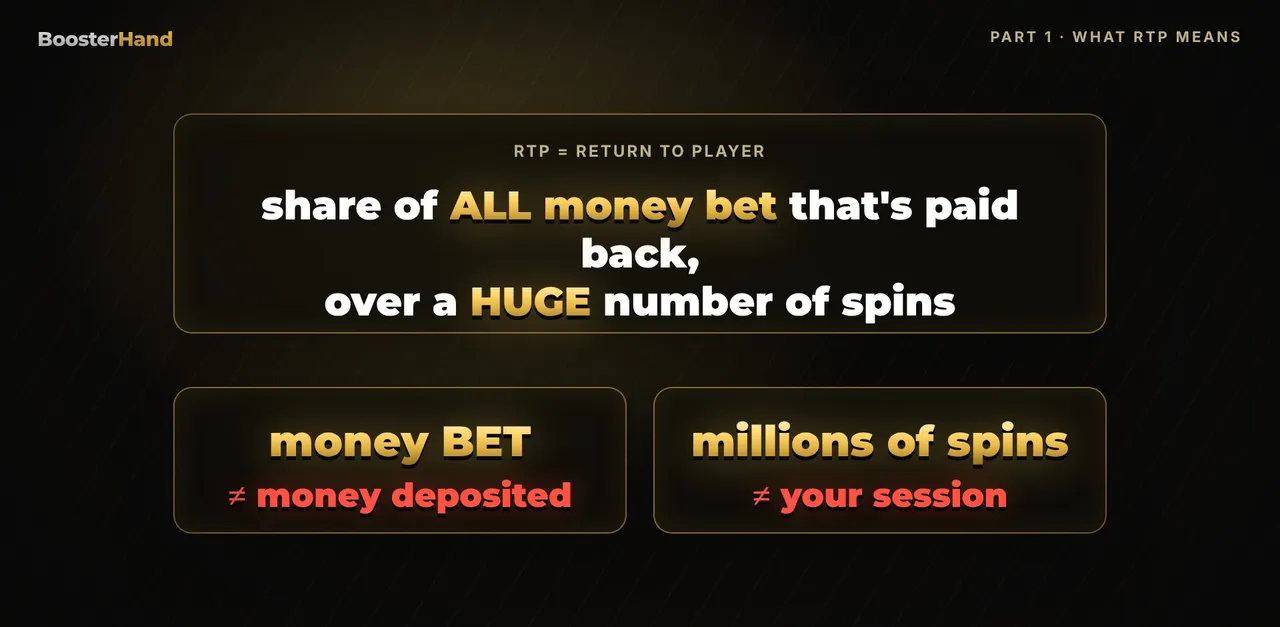
Most misunderstandings about RTP come from skipping one of those two phrases. Let’s take them one at a time.
It also helps to know what RTP is not. It isn’t a payout schedule, so a machine doesn’t “owe” you a win after a cold streak. It isn’t a timer that resets each session. And it isn’t a guarantee for any single player. Every spin is an independent random draw, and RTP is simply what those draws add up to when you average them over an enormous sample. RTP and house edge are two sides of the same number: 96% paid back means 4% kept. When you compare games, comparing RTP is the same as comparing the price you pay to play.
How we ran the simulation
This is a Monte Carlo simulation in Python with NumPy and a fixed seed. The slot is a generic, high-volatility model we built in code. It isn’t based on any real game, and real games vary, but the math works the same way.
- RTP: 96% for the main test, plus versions at 94%, 92% and 88%
- Volatility: high (part of the RTP is paid as rare, large wins)
- Bet: $1 per spin
- Bankroll: $100 for the “how long does it last” test
- Sessions: 10,000 simulated sessions at lengths from 100 spins to 1,000,000 spins
- Speed: 600 spins per hour for the cost-per-hour figures
Our methodology page covers how we build and validate these models.
Why your $100 gets bet about 7 times
Here’s why “money bet, not money deposited” matters. You deposit $100 and bet $1 a spin. You don’t bet that $100 once. Wins go back into your balance, and you bet them again.
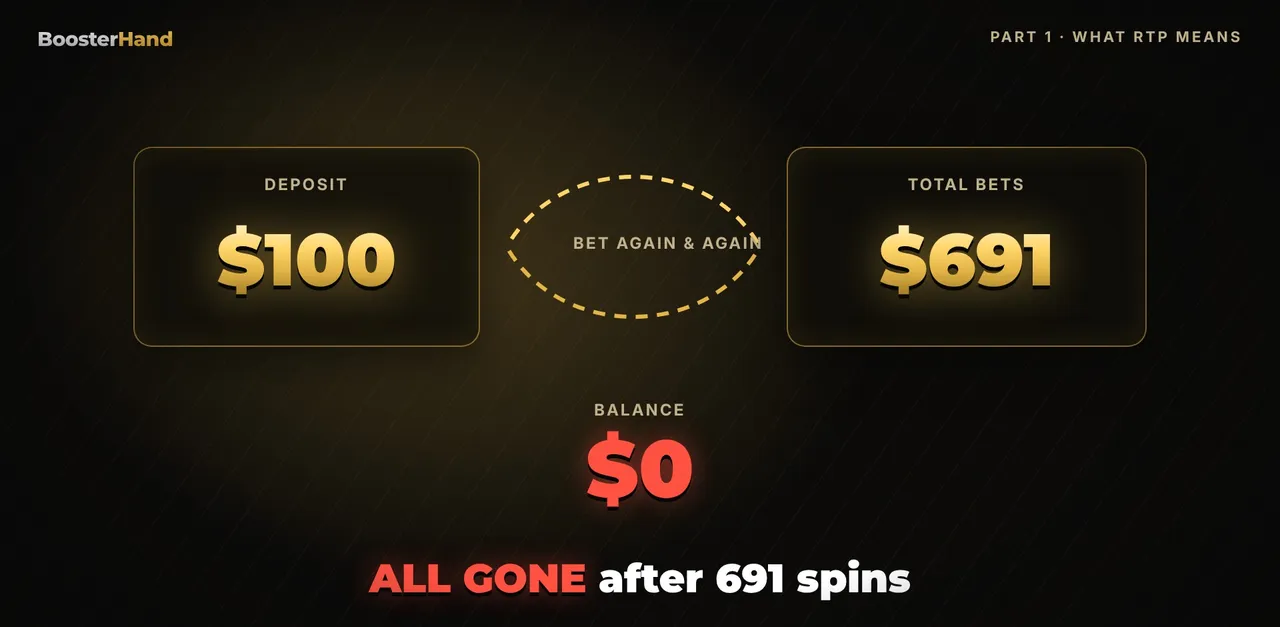
In our simulation, the typical player’s $100 lasted 691 spins. That’s almost $700 of bets from a $100 deposit, and at the end, all of it was gone. The 4% edge doesn’t take $4 from your $100. It takes a slice of every dollar that passes through the machine, again and again. We saw the same effect at scale in our 1,000,000 slot spin simulation, where $1,000,000 in deposits became more than $12,000,000 in bets.
Quick guess before the next chart: on a 96% slot, what percentage of players do you think got back more than they bet after 100 spins?
RTP explained by session length: your session vs the math
We ran 10,000 sessions of different lengths on the same 96% slot. Here’s what share of their bets players got back:
| Session length | Bottom 5% got back | Typical (median) | Top 5% got back | Players ahead |
|---|---|---|---|---|
| 100 spins | 54.5% | 83% | 167.5% | 26.9% |
| 1,000 spins | 75.5% | 90.6% | 121.6% | 24.8% |
| 10,000 spins | 86.7% | 93.6% | 109.8% | 19.4% |
| 100,000 spins | 91.7% | 95.2% | 102.4% | 12.5% |
| 1,000,000 spins | 94.3% | 96% | 97.7% | 0% |
After 100 spins, results are all over the place. The middle 90% of players got back anywhere from about 55% to 168%, and 27% were ahead. (That’s the answer to the guess. Did you go higher or lower?)
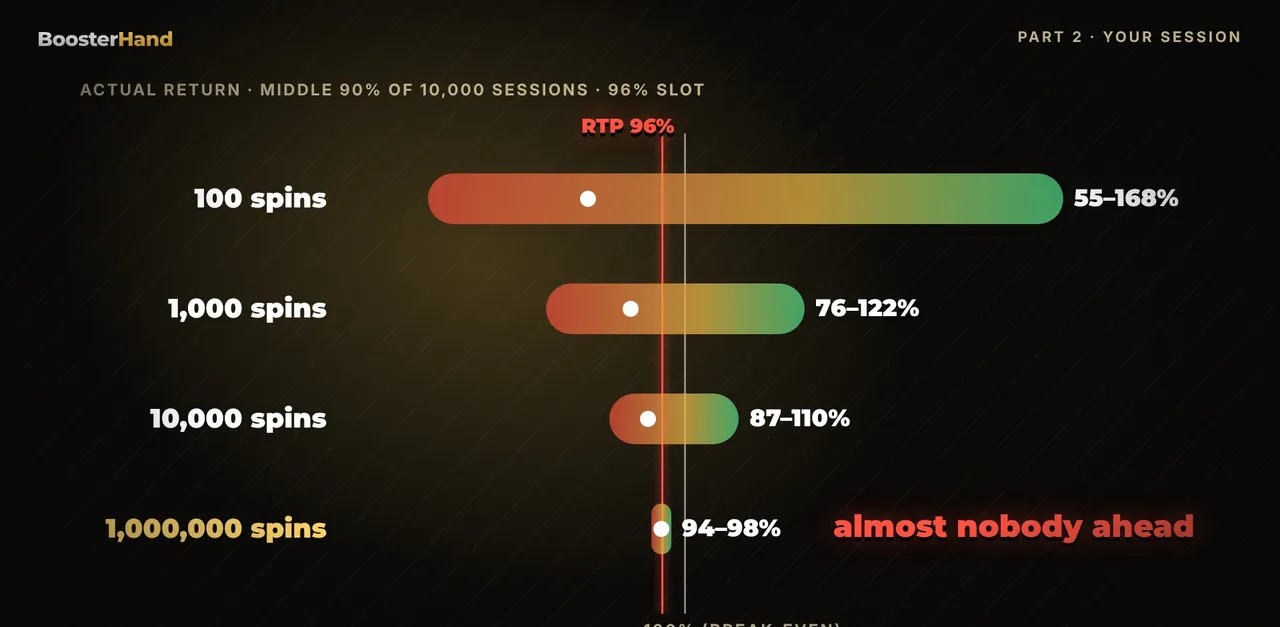
After 1,000 spins, the range shrinks to about 76% to 122%. After 10,000 spins, 87% to 110%. And after 1,000,000 spins, everyone lands between 94% and 98%. Nobody is ahead anymore.
That’s the second phrase in action. RTP only describes your result when “your session” is the size of millions of spins. Over a short session, luck dominates. Over a long one, the edge does.
Why the typical player gets less than 96%
So why was the typical 100-spin session only 83%, not 96%?
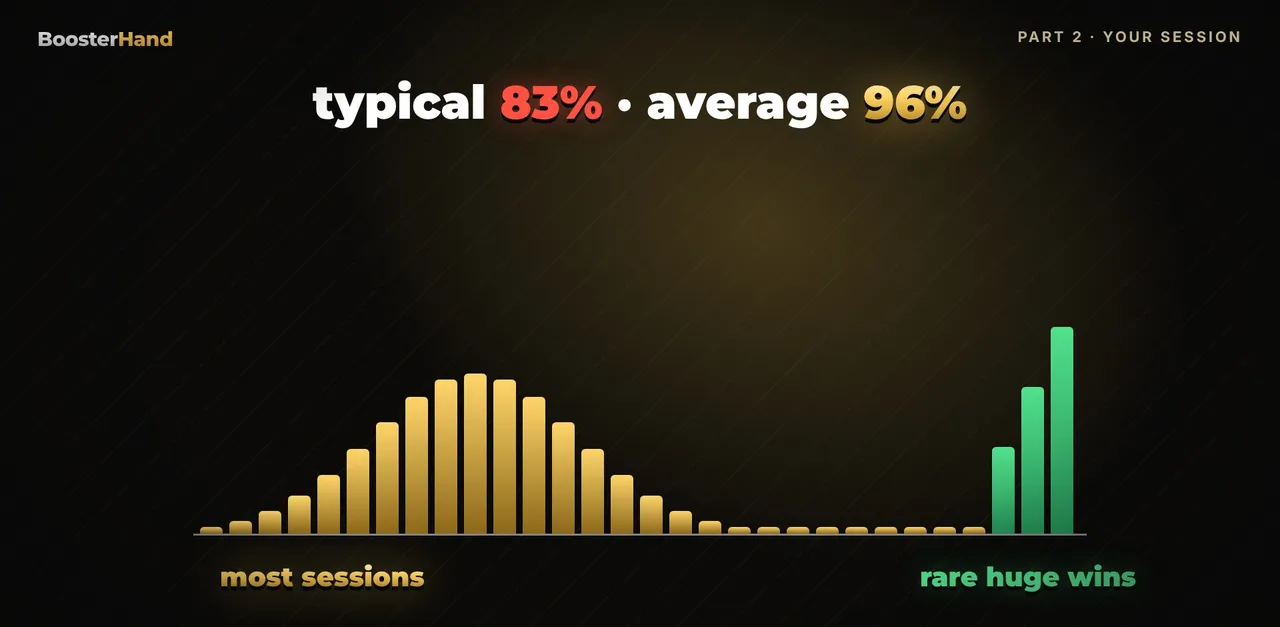
Because part of that 96% is paid out as rare, huge wins. They pull the average up, but most players never hit them. The average is real, it’s just carried by a small group of lucky sessions. The median, the player in the middle, gets less. Even after 10,000 spins, the median was still only 93.6%.
This is why high-volatility games feel so different from their RTP. If you want to see how low and high volatility compare on the same budget, read our slot volatility simulation.
RTP is a promise about the machine. It’s not a promise about you.
96% vs 94% vs 92% vs 88% RTP
Now the part that hits your wallet. Many slot games are offered in several RTP versions, and the casino chooses which one to run. Same game, same graphics, different math.
| RTP | House edge | Average cost per hour* | Typical spins from $100 |
|---|---|---|---|
| 96% | 4% | $24 | 691 |
| 94% | 6% | $36 | 603 |
| 92% | 8% | $48 | 520 |
| 88% | 12% | $72 | 429 |
*At $1 a spin and 600 spins an hour.
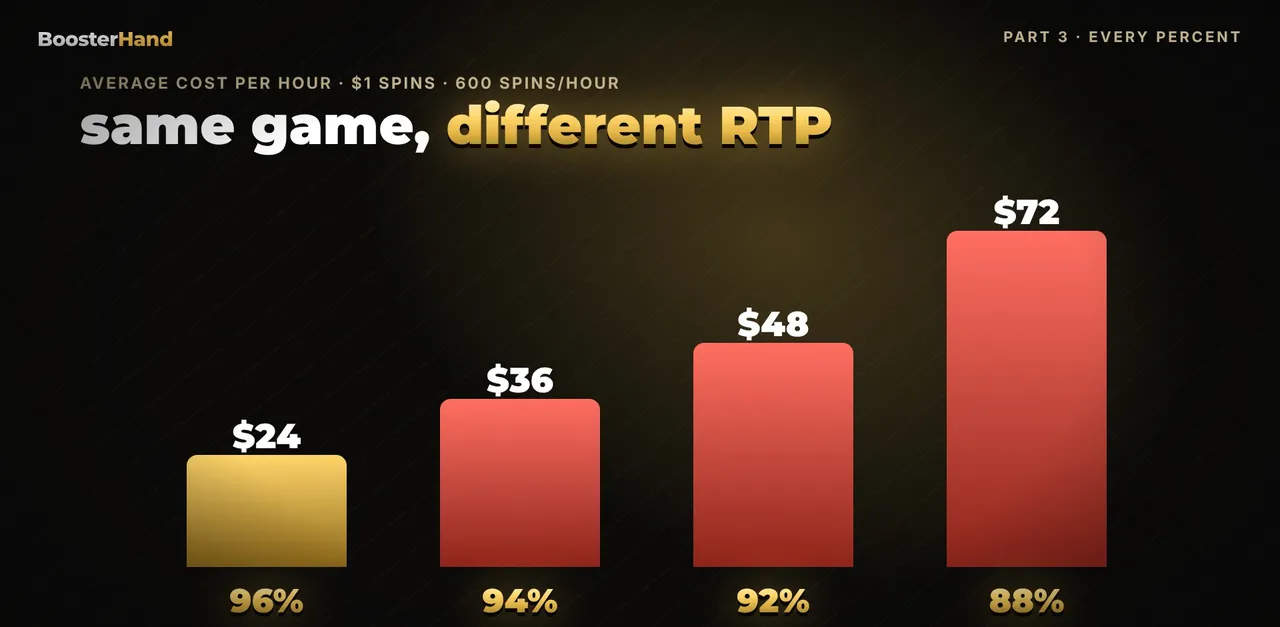
At 96%, the game costs you about $24 an hour on average. At 88%, it’s $72 an hour: three times as much, for the exact same game. The formula is simple: cost per hour = bet x spins per hour x house edge. Our bankroll calculator runs it for your own bet size and speed.
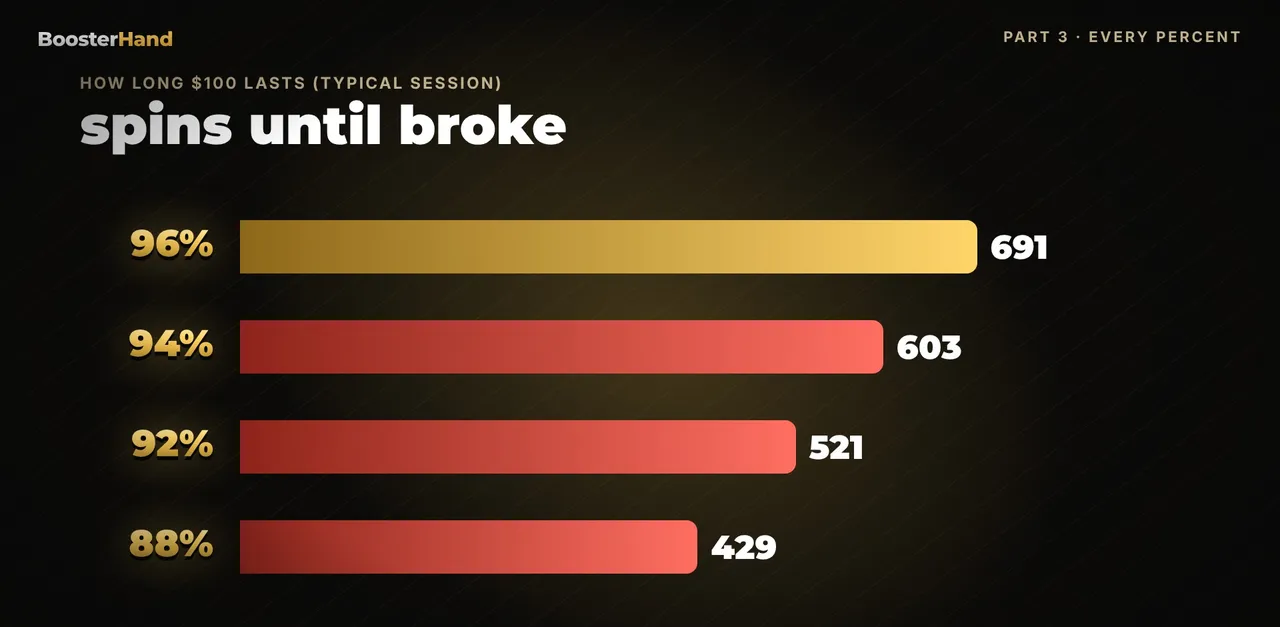
And your $100? At 96%, the typical session lasted 691 spins. At 88%, only 429. Every percent matters. The same logic drives bonus math, where wagering requirements multiply the edge, which our casino bonus wagering simulation works through.
Where to find a game’s RTP
Most games show their RTP in the info or rules screen. Check it before you play. If you can’t find it, assume it’s not the high version.
What this means for you
Three things to remember from 10,000 simulated sessions:
- RTP is measured over millions of spins, on all money bet. It doesn’t describe your session or your deposit. Over 100 spins, the typical player got 83%, not 96%.
- Every percent matters. A lower RTP means your money disappears faster: 429 spins instead of 691.
- Know your real cost. Your average cost per hour is your bet, times spins per hour, times the house edge. Treat it as the price of entertainment, and set a budget and a time limit before you start.
Now be honest: did you know RTP is measured over millions of spins? Yes or no, tell us in the comments under the video.
You must be 18+ to gamble. If it stops being fun, take a break, and visit our responsible gambling page for tools and support.
FAQ
What does 96% RTP mean?
It means that over a huge number of spins, the game pays back about $96 for every $100 bet, keeping a 4% house edge. It does not mean you get $96 back from a $100 deposit in one session.
Is a higher RTP better?
Yes, a higher RTP means a lower average cost. In our simulation at $1 a spin and 600 spins an hour, a 96% game cost about $24 an hour on average, while an 88% version cost about $72.
Why do I get back less than the RTP?
Part of the RTP is paid out as rare, large wins that most players never hit. In our 96% simulation, the typical player got back only 83% after 100 spins.
How long does $100 last on a slot?
In our simulation at $1 a spin, the typical player's $100 lasted 691 spins on a 96% RTP slot and 429 spins on an 88% RTP version of the same game.
Where can I find a slot's RTP?
Most games show their RTP in the info or rules screen. If you can't find it, assume the game is not running its highest RTP setting.
Related
Simulations use generic models, not any real game or casino. Results show long-run math, not predictions for one session. 18+ only. If gambling stops being fun, take a break: responsible gambling.
Next experiment: Can Crypto Casinos Cheat? I Built a Provably Fair Game to Find Out