

BoosterHand Lab · simulation
Casino Cashback vs Rakeback: Does 10% Back Beat the House?
Updated 2026-10-31 · By BoosterHand Lab · Method: Monte Carlo simulation (Python/NumPy, fixed seed)
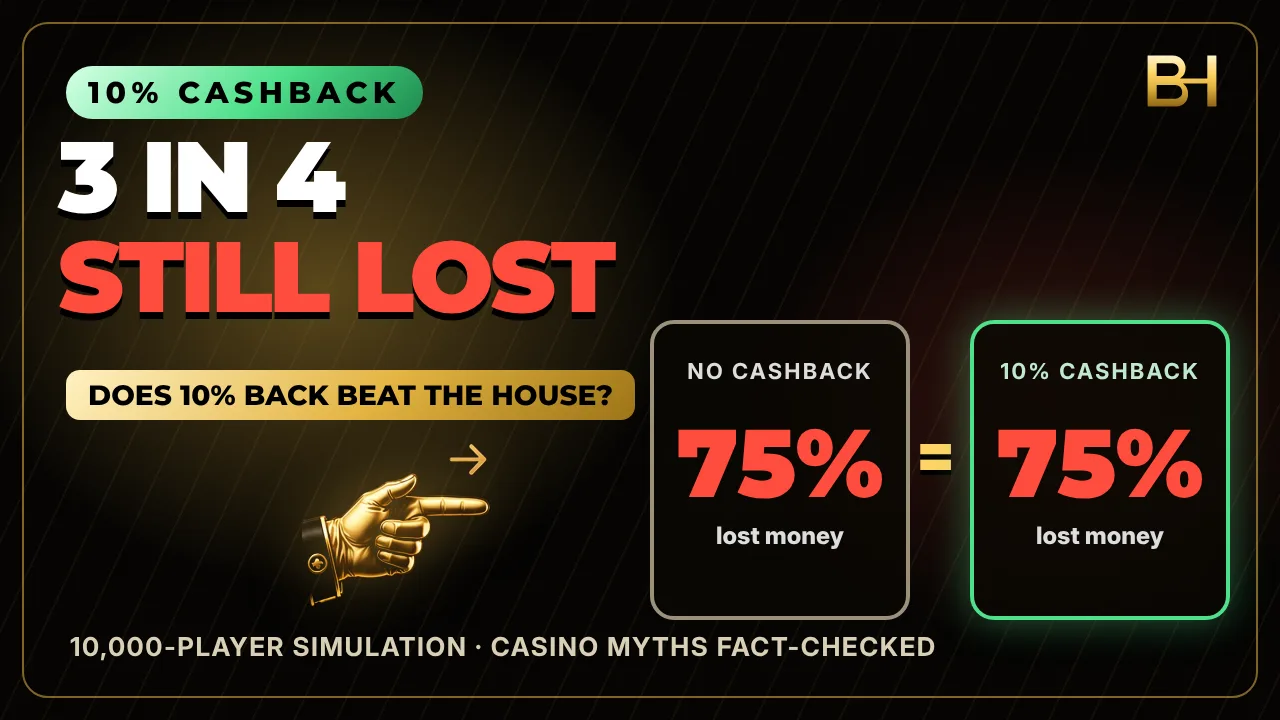
- On a 96% RTP slot, the average player lost $32 with no reward, $29 with 10% rakeback and $26 with 10% cashback.
- 10% cashback paid about 2x more than 10% rakeback in this setup: $6.37 vs $3.07 per player.
- Effective RTP rose to 96.4% (10% rakeback), 97.0% (25% VIP rakeback) and about 97.7% (20% cashback). Every deal stayed below 100%.
- 75% of players lost money with no reward, and still 75% with 10% or 20% cashback. Cashback can't flip a loss.
- Earning $1 of 10% rakeback means wagering $250, which costs about $10 on average.
Ten thousand players, and every one of them got 10% cashback on their losses. Three out of four still lost money, exactly as many as with no cashback at all. So in the battle of casino cashback vs rakeback, does either deal actually beat the house, or do they just make losing a little slower?
Cashback and rakeback are the two loyalty rewards you see most often, especially on crypto sites. Both promise “money back”. They pay in very different ways, and those differences show up clearly once you run the numbers on thousands of players.
Rakeback explained: two deals that sound alike
Cashback pays back a slice of your net loss. Lose $100 at 10% cashback and you get $10 back. Win, or break even, and you get nothing. It’s a refund that only triggers when things go badly.
Rakeback is trickier, because there is no single definition. Operators define rakeback differently: some tie it to the edge on each bet, some to a share of turnover, some to a points system, and many mix it with VIP tiers. So for this article we need to be precise. Our definition: rakeback is a share of the house edge on every bet you place, win or lose.
The slot in our test keeps 4 cents of every dollar on average (a 4% house edge, which is what a 96% RTP means). So 10% rakeback pays 10% of 4 cents, which is 0.4 cents per $1 wagered. Bet $100, get 40 cents back, whatever the result of those bets.
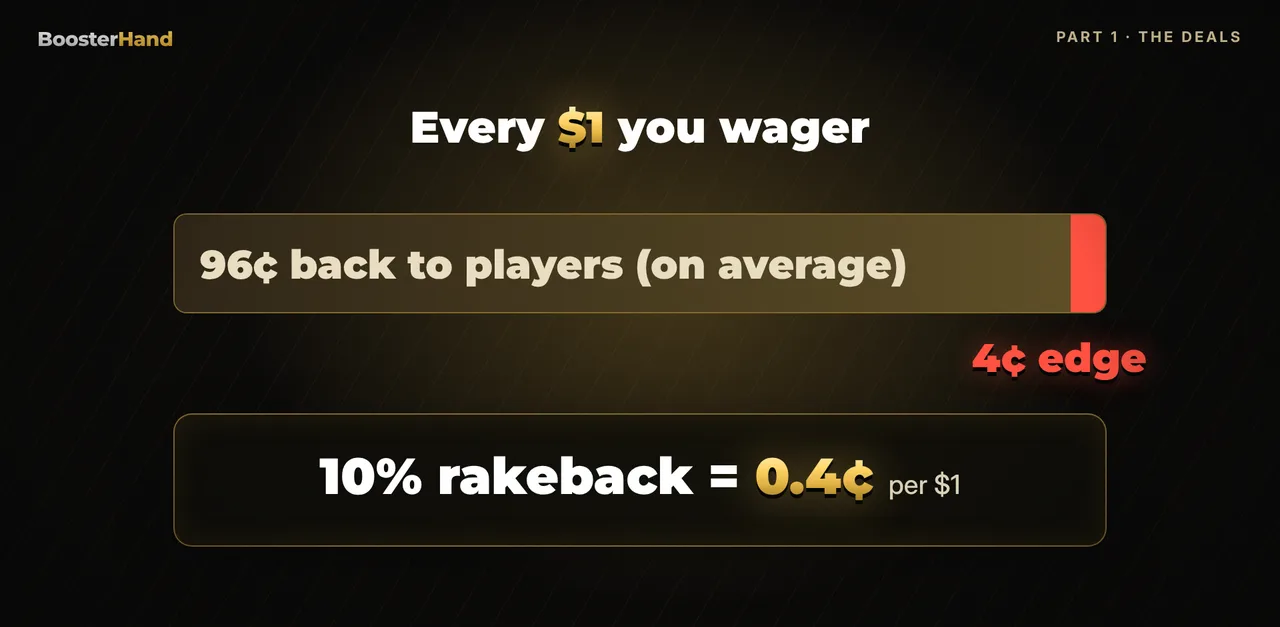
That’s the key structural difference. Cashback is paid on what you lose. Rakeback is paid on what you bet. One rewards bad sessions, the other rewards volume. If you want a refresher on what RTP and house edge actually mean in practice, our RTP simulation walks through it.
How we ran the simulation
This is a generic model, not a copy of any real casino’s program. The setup:
- Players: 10,000, each with a $100 deposit
- Game: a generic medium-volatility slot with 96% RTP (4% house edge), a hit rate of about 38% and a top win of 500x
- Bet: $1 per spin
- Session: up to 1,000 spins, or until the balance drops below $1
- Rewards: paid once, at the end of the session
- Method: Monte Carlo simulation in Python (NumPy), fixed random seed so the results are reproducible
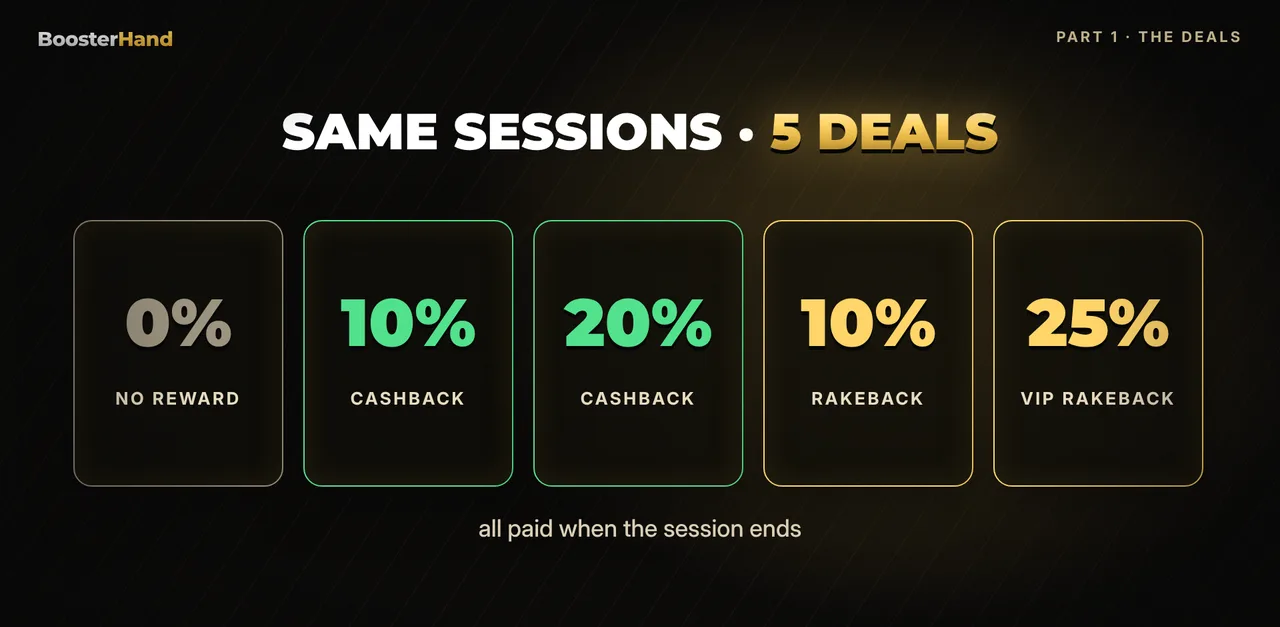
Every player played the exact same spins under all five deals. Only the reward changed:
- No reward
- 10% cashback on net loss
- 20% cashback on net loss
- 10% rakeback (10% of the house edge on every bet)
- 25% VIP rakeback (25% of the house edge on every bet)
The sessions themselves were rough. About 54% of players went broke before reaching 1,000 spins, and 46% made it to the end. The average player wagered $768 in total, and the median player wagered $913.
Real deals are more complicated. They add caps, minimum loss thresholds, wagering requirements on the reward itself, and their own definitions of what counts. Treat this as the clean, best-case version.
Before you scroll to the results: would you pick 10% cashback or 10% rakeback? Why? Make your guess now, then see if the numbers agree.
Casino cashback vs rakeback: the results
With no reward, the average player lost $32. Here’s how each deal changed that:
| Deal | Avg reward per player | Avg net loss | Effective RTP | Players still losing |
|---|---|---|---|---|
| No reward | $0 | $32 | 96% | 75% |
| 10% rakeback | $3.07 | $29 | 96.4% | 74% |
| 10% cashback | $6.37 | $26 | ~96.8% | 75% |
| 25% VIP rakeback | $7.68 | $24 | 97.0% | 73% |
| 20% cashback | $12.74 | $19 | ~97.7% | 75% |
At the same headline number, cashback won clearly. 10% cashback paid about twice as much as 10% rakeback: $6.37 vs $3.07 per player.
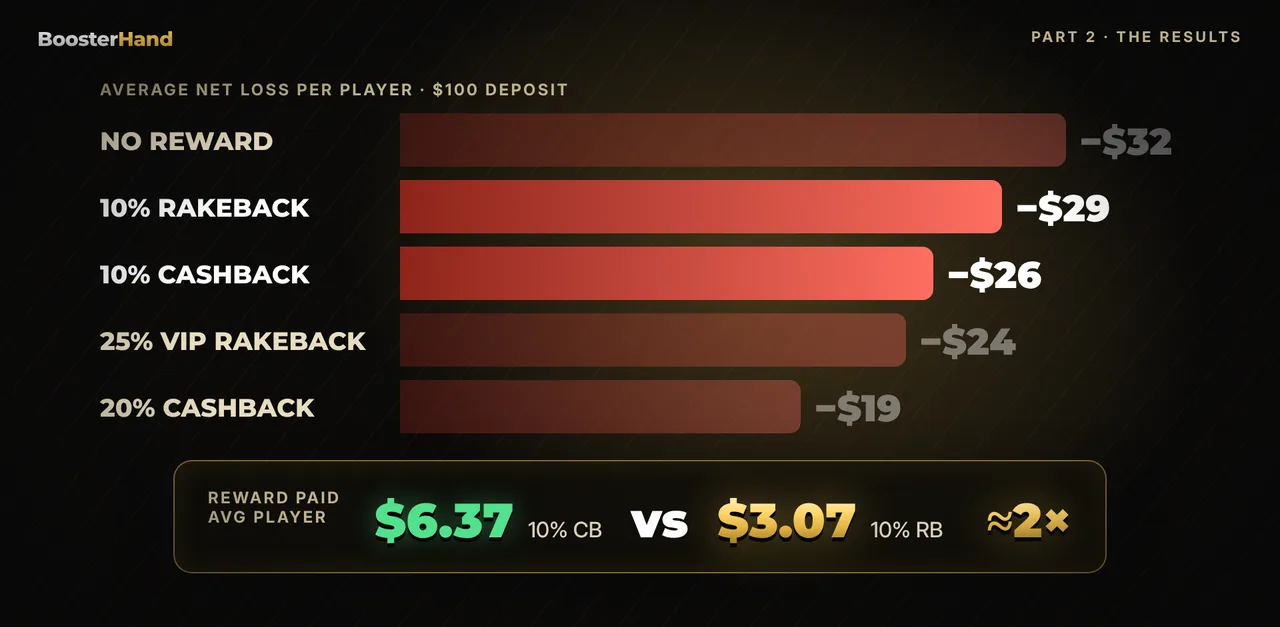
Why the gap? Rakeback at 10% is really 10% of 4%, so 0.4% of everything you bet. With $768 wagered on average, that’s about $3. Cashback is 10% of the whole loss, and on a slot session the losses are big: losing players lost about $85 on average. Ten percent of a big number beats 0.4% of a medium one.
Even the 25% VIP rakeback deal, which sounds far more generous, paid only $7.68 per player. That’s barely more than plain 10% cashback, and well short of 20% cashback.
Effective RTP: the honest scorecard
The cleanest way to compare rewards is effective RTP: what share of every dollar wagered comes back once the reward is added.
- 10% rakeback lifts 96% to 96.4%
- 25% VIP rakeback lifts it to 97.0%
- 10% cashback lifts it to about 96.8%
- 20% cashback lifts it to about 97.7%
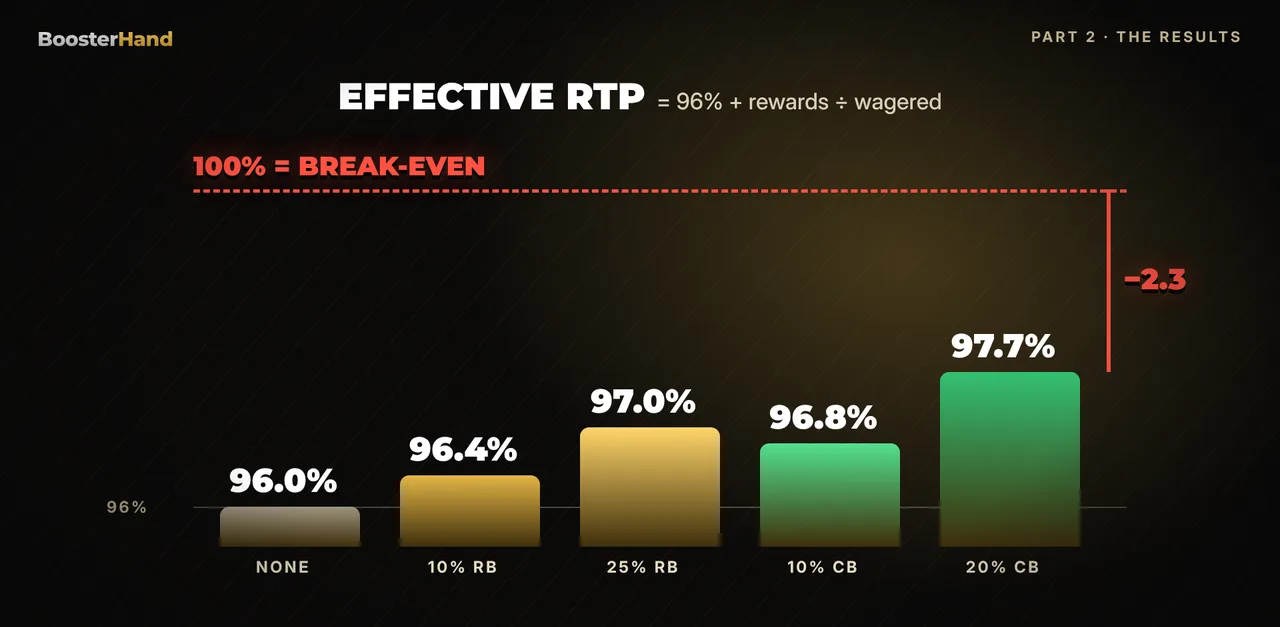
Every single deal stayed below 100%. A reward makes the game cheaper to play. It doesn’t make it a game you’re expected to win.
The number that matters: how many players still lost
Average losses are useful, but they hide the question most players actually care about: did I end up ahead or behind?
With no reward, 75% of players lost money. With 10% cashback, still 75%. With 20% cashback, still 75%. Not one losing player became a winner.
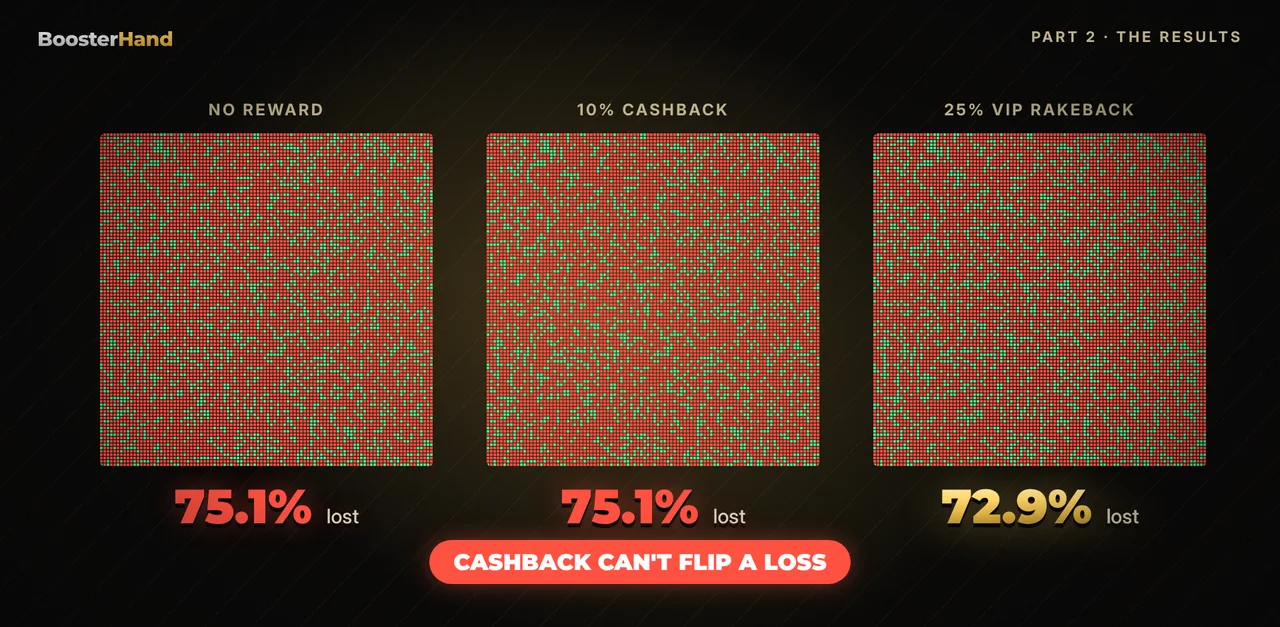
That isn’t a quirk of the simulation. It’s how cashback works. If you lose $50 and get 10% back, you’ve lost $45. If you get 20% back, you’ve lost $40. Any cashback under 100% leaves a losing session as a losing session, just a smaller one.
Rakeback behaves slightly differently because it’s paid on every bet, including bets in sessions that ended almost flat. A player who finished a few dollars down after hundreds of spins can get pushed just above zero. That’s why 10% rakeback moved the losing share to 74%, and 25% VIP rakeback to 73%. A couple of percentage points, and only for players who were already close to even.
The median player tells the same story. With no reward, the median result was a loss of $99.50, meaning the typical player lost almost the whole deposit. With 20% cashback, the median was still a $79.60 loss.
The catch: what it would take to beat the house
So what reward would actually flip the math?
Rakeback would need to refund 100% of the house edge. At that point you’re playing a game with a 0% edge, which is no longer a casino game at all, just a coin flip with extra steps.
Cashback would need to be 100% for a losing player to stop losing, because anything less still leaves part of the loss on the table. Even for the average player to break even in our model, cashback would need to be about 50%.
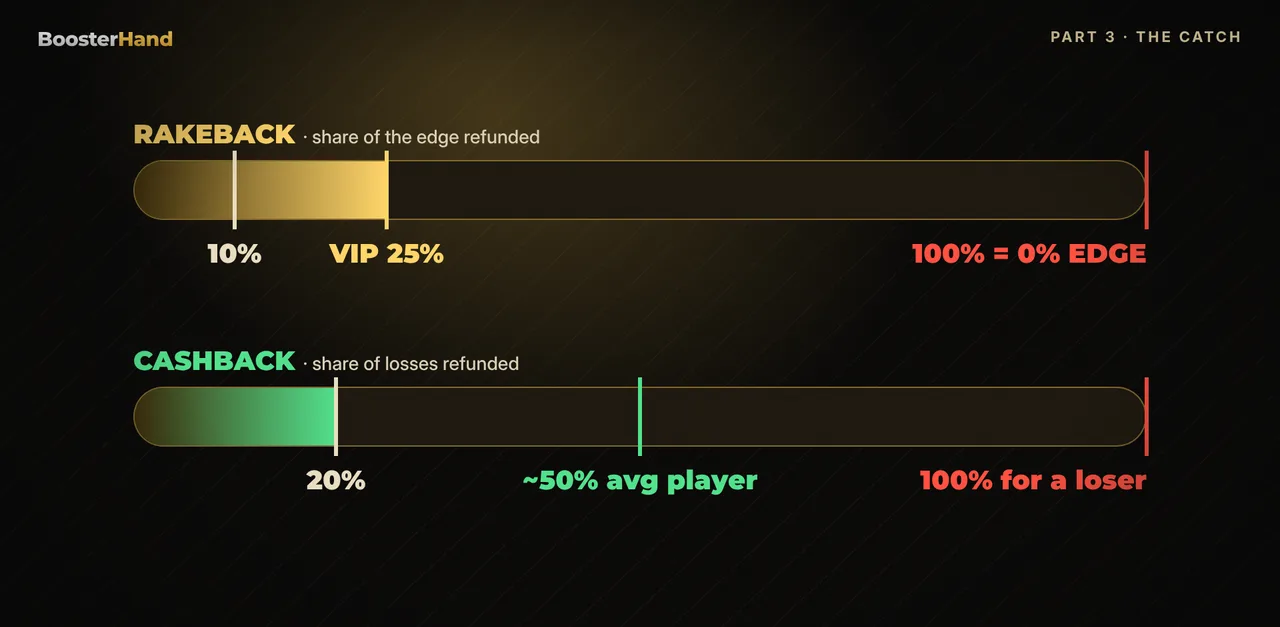
Compare that with the 10% and 20% figures in our test. The gap between “nice reward” and “break even” is huge.
Crypto casino rakeback and the volume trap
The second catch is volume. Under our definition, rakeback grows with how much you bet, and that changes the incentive.
To earn $1 of 10% rakeback, you have to wager $250 (because each dollar returns 0.4 cents). At a 4% house edge, $250 of bets costs about $10 on average. You pay $10 to receive $1.
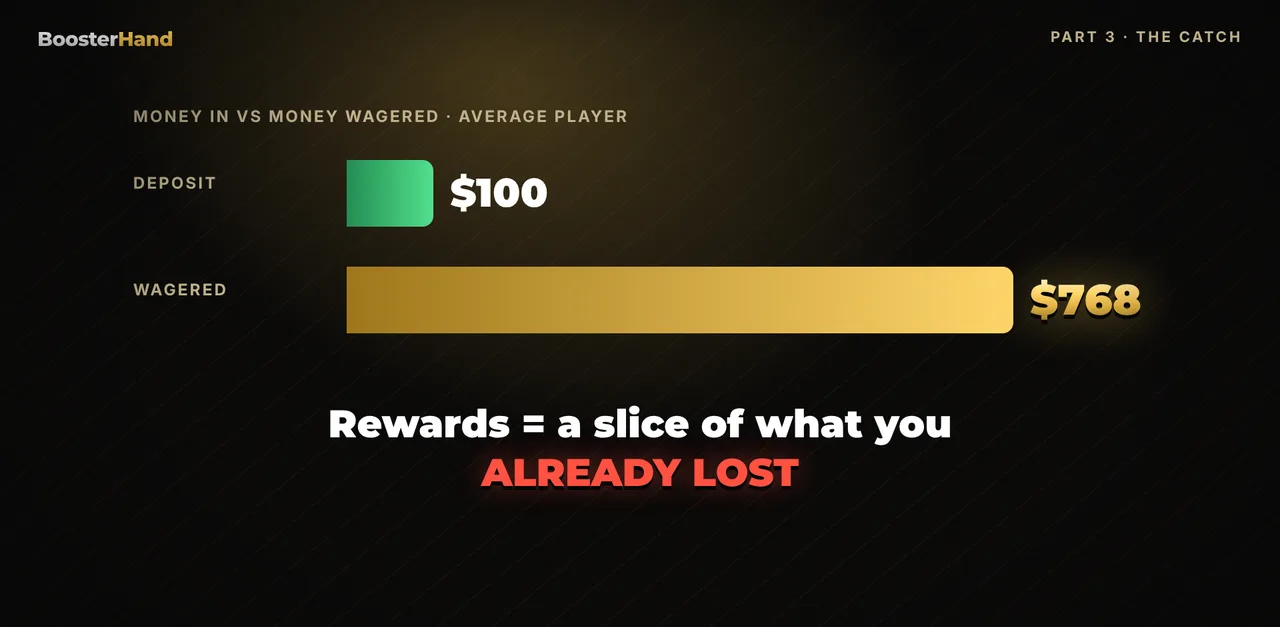
Our players turned a $100 deposit into $768 of total bets, simply by spinning the same money around. That’s where rakeback comes from: you recycle your balance through the game, the house edge takes its cut each time, and a fraction of that cut comes back. The reward is a slice of what you already lost.
This is the same trap as wagering requirements on a bonus. More betting always means more expected loss. Our casino bonus wagering simulation shows how quickly that adds up, and the casino bonus wagering guide covers the rules in full. Many real cashback and rakeback offers also come with their own wagering terms, which cut the value further.
What this means for you
Rewards aren’t scams. They do reduce your expected loss, and in our model 20% cashback cut the average loss from $32 to $19. That’s real money. But it’s a discount on losing, not a path to winning.
Three takeaways:
- Rewards slow your losses, they don’t reverse them. Every deal in our test stayed below 100% effective RTP.
- Cashback never turns a losing session into a winning one. It only softens it. 75% of players lost with or without it.
- Rakeback rewards volume, and volume costs money. Never bet more just to earn a reward. $1 of 10% rakeback costs about $10 in expected losses.
When you compare offers, check the definition first (share of edge, share of turnover, or share of net loss), then look for caps, minimum thresholds and wagering on the reward. A headline percentage means nothing until you know what it’s a percentage of.
The best way to control what you lose is still the size and length of your sessions, not the reward attached to them. Our bankroll calculator shows how long a budget lasts at a given RTP and bet size. Set a limit you can afford to lose, and if gambling stops being fun, take a break and visit our responsible gambling page. 18+ only.
So, which would you pick: 10% cashback or 10% rakeback? Why? Tell us in the comments below.
Next in the Lab: does bet sizing change the outcome? See our bankroll management simulation.
FAQ
What is the difference between casino cashback and rakeback?
Cashback refunds a percentage of your net loss over a period, so you only get it if you lose. Rakeback, as we define it, returns a share of the house edge on every bet you place, win or lose, so it grows with how much you wager.
Is cashback or rakeback better?
In our simulation of a 96% RTP slot, 10% cashback paid about $6.37 per player and 10% rakeback about $3.07, so cashback paid roughly twice as much. The answer can change with the exact terms, caps and definitions each operator uses.
How is crypto casino rakeback calculated?
Operators define it differently. In our model, rakeback is a share of the house edge on every bet: on a slot with a 4% edge, 10% rakeback pays 0.4 cents per $1 wagered, so $250 of bets earns $1.
Can cashback make gambling profitable?
Not on its own. In our test, 75% of players lost money with no reward and exactly 75% still lost with 10% or 20% cashback, because cashback only refunds part of a loss and never turns it into a win.
What cashback percentage would beat the house?
A losing player would need 100% cashback to stop losing. In our model, even the average player needed about 50% cashback just to break even.
Related
Simulations use generic models, not any real game or casino. Results show long-run math, not predictions for one session. 18+ only. If gambling stops being fun, take a break: responsible gambling.
Next experiment: Bankroll Management Gambling Test: Does Bet Sizing Change the Outcome?