

BoosterHand Lab · simulation
Bankroll Management Gambling Test: Does Bet Sizing Change the Outcome?
Updated 2026-10-31 · By BoosterHand Lab · Method: Monte Carlo simulation (Python/NumPy, fixed seed)
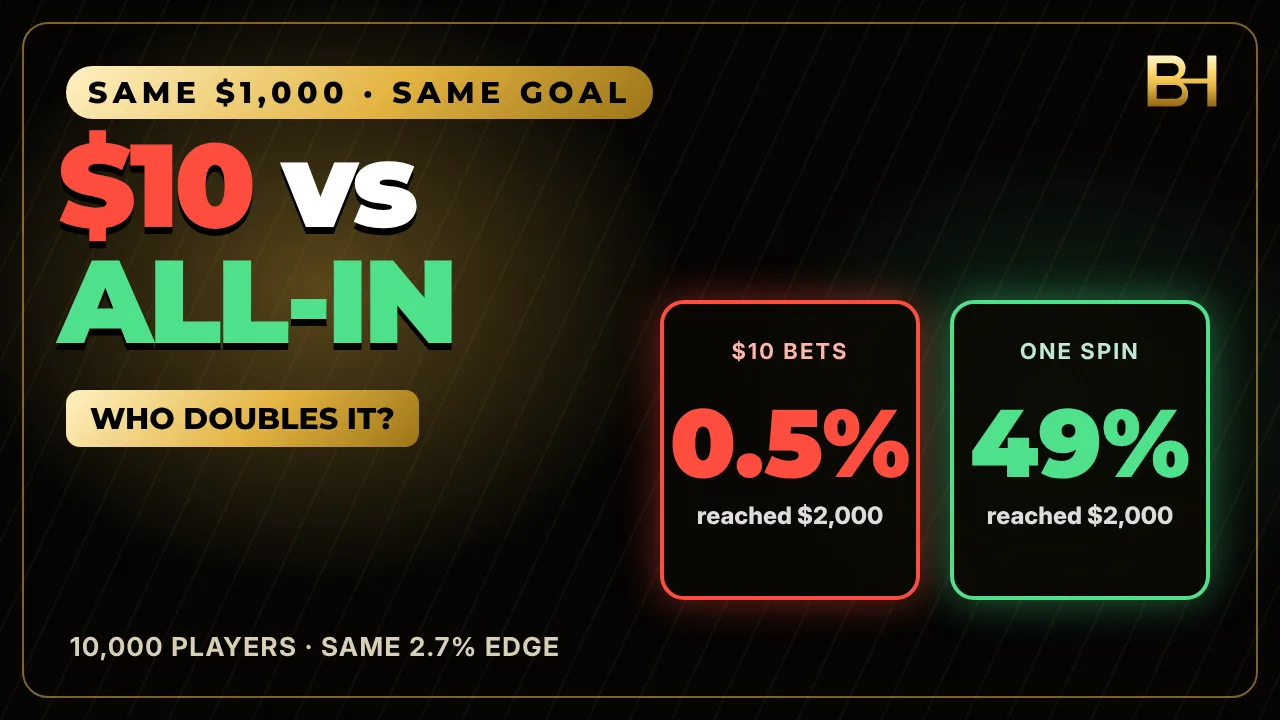
- Trying to turn $1,000 into $2,000 with flat $10 bets worked for just 0.5% of 10,000 players.
- Bigger bets reached the goal more often: flat $50 26%, flat $200 43%, one all-in spin 49%.
- The average $10 player made 3,676 bets and wagered $36,758 before the run ended.
- Every strategy lost between 2.6% and 2.8% of what it bet: the 2.7% house edge, every time.
- Even with bold play, 51% of players lost the whole $1,000 on a single spin.
Same roulette table, same $1,000, same goal: double it. Betting $10 at a time, only about 1 in 200 players got there. Betting it all on one spin, almost half did. That sounds like the ultimate bankroll management gambling tip, until you look at what the house kept, which was the same in every case.
Before you read the results, decide on your answer: does bet sizing change the long-run result? Yes or no? Keep it in mind, then tell us in the comments under the video.
What bankroll management in gambling claims to do
“Manage your bankroll” is the most repeated advice in gambling. Usually it comes with a rule about bet sizing: never bet more than 1% of your bankroll, or 2%, or 5%. The idea is that the right answer to “how much to bet” will somehow protect you, or even improve your results.
There’s a real question hiding in there. If you walk in with a fixed amount and a fixed goal, does the size of your bets change what happens? We tested it the only way that gives a clear answer: by running the same game thousands of times with five different sizing rules and counting.
How we ran the simulation
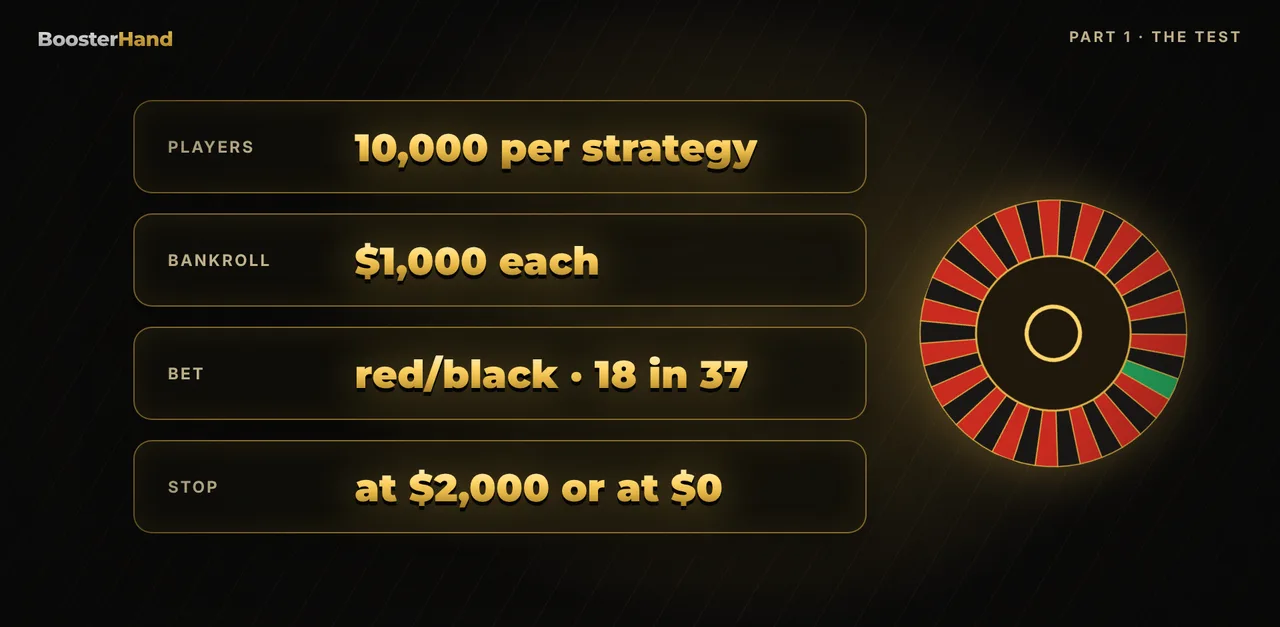
This is a Monte Carlo simulation in Python with NumPy and a fixed random seed. It is a generic model of even-money roulette bets, not a test of any specific casino or game.
- Game: European roulette, betting red or black. The bet wins 18 times out of 37 (48.6%).
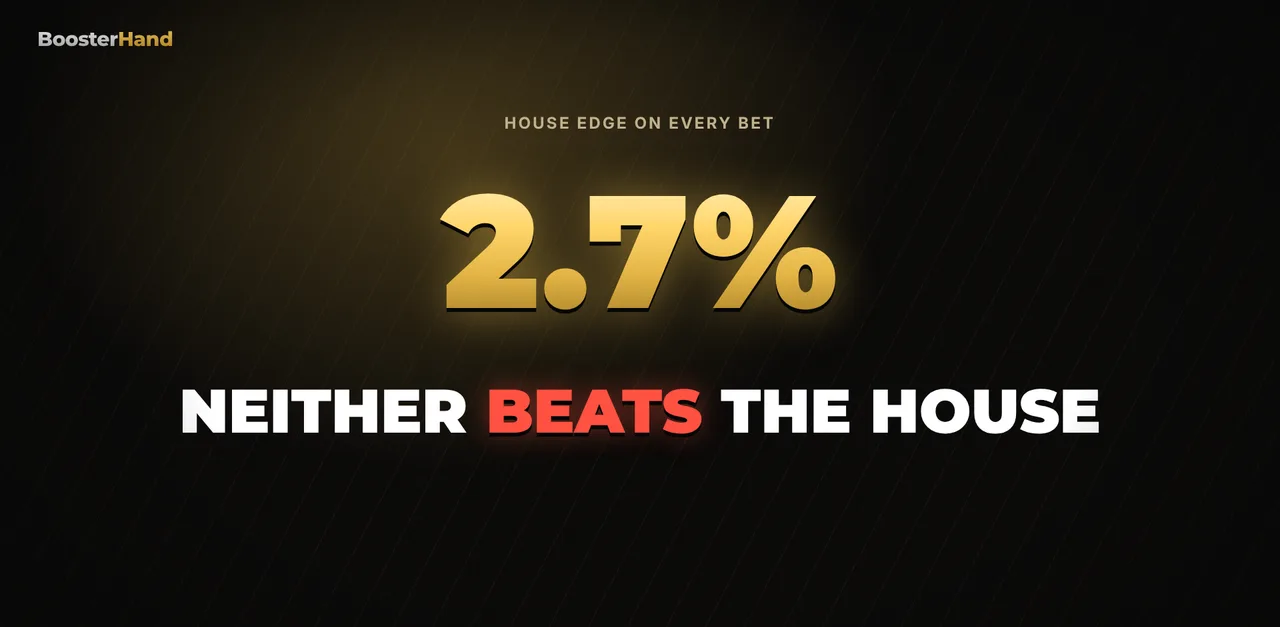
- House edge: about 2.7%
- Bankroll: $1,000 per player
- Goal: stop at $2,000 (doubled) or at $0 (broke). Nobody quits early.
- Players: 10,000 per strategy. Bold play ran with 1,000,000 players, because from $1,000 it is a single spin and needs a bigger sample.
- Limits: one fixed goal, no table limits. Proportional bets have a $5 minimum.
Every player finished the run: either they hit $2,000 or they hit zero. Our methodology page explains how we build and check these models.
Five ways to decide how much to bet
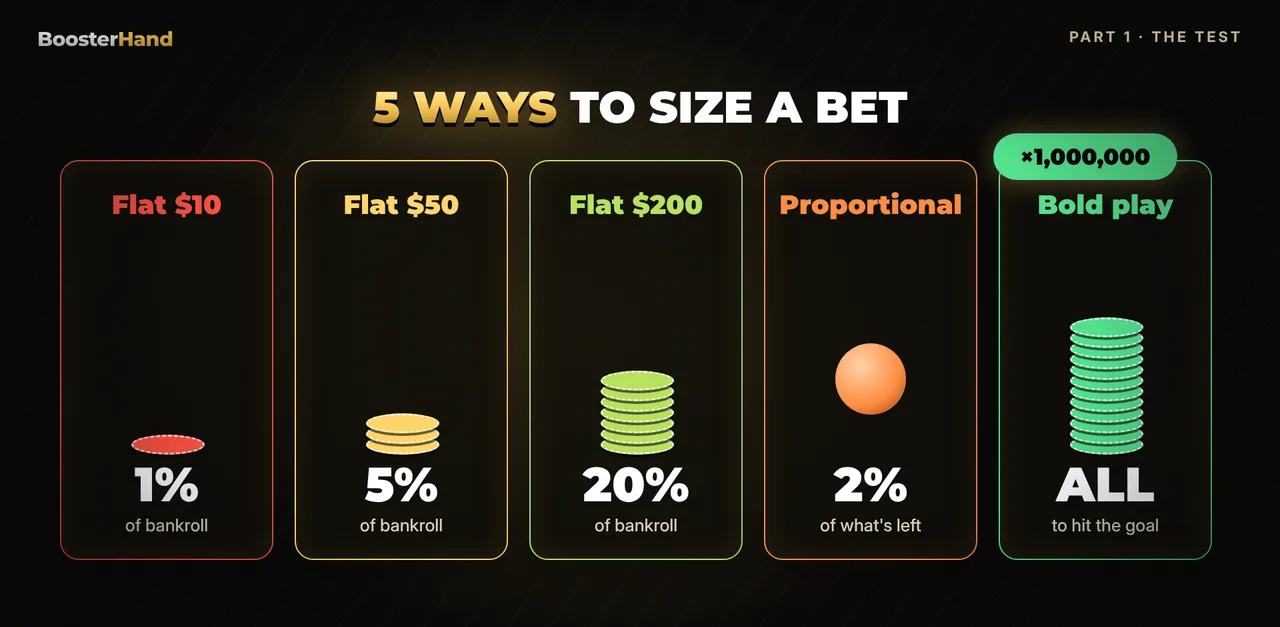
We tested five bet sizing rules, from very cautious to as aggressive as it gets:
- Flat $10: 1% of the starting bankroll, every bet.
- Flat $50: 5% of the starting bankroll.
- Flat $200: 20% of the starting bankroll.
- Proportional 2%: always bet 2% of whatever is left, so bets shrink as you lose and grow as you win.
- Bold play: bet exactly what you need to reach the goal, or everything if you have less than that.
From $1,000 with a $2,000 target, bold play is one all-in spin. You either double up or you’re done.
Results: chance of doubling $1,000
Here’s how often each strategy turned $1,000 into $2,000:
| Strategy | Reached $2,000 | Went broke | Average bets | Average wagered |
|---|---|---|---|---|
| Flat $10 (1%) | 0.5% | 99.5% | 3,676 | $36,758 |
| Proportional 2% | 7.6% | 92.4% | 3,206 | $31,284 |
| Flat $50 (5%) | 26.3% | 73.7% | 367 | $18,374 |
| Flat $200 (20%) | 43.1% | 56.9% | 25 | $4,968 |
| Bold play (all-in) | 49% | 51% | 1 | $1,000 |
The pattern is clear. The smaller the bet, the worse the chance of reaching the goal. Flat $10 got there for just 0.48% of players: almost nobody. The proportional 2% rule did better at 7.6%, then flat $50 at 26% and flat $200 at 43%. Bold play landed at 49%. The math for a single red bet says 48.6%, and the million-player run matched it.
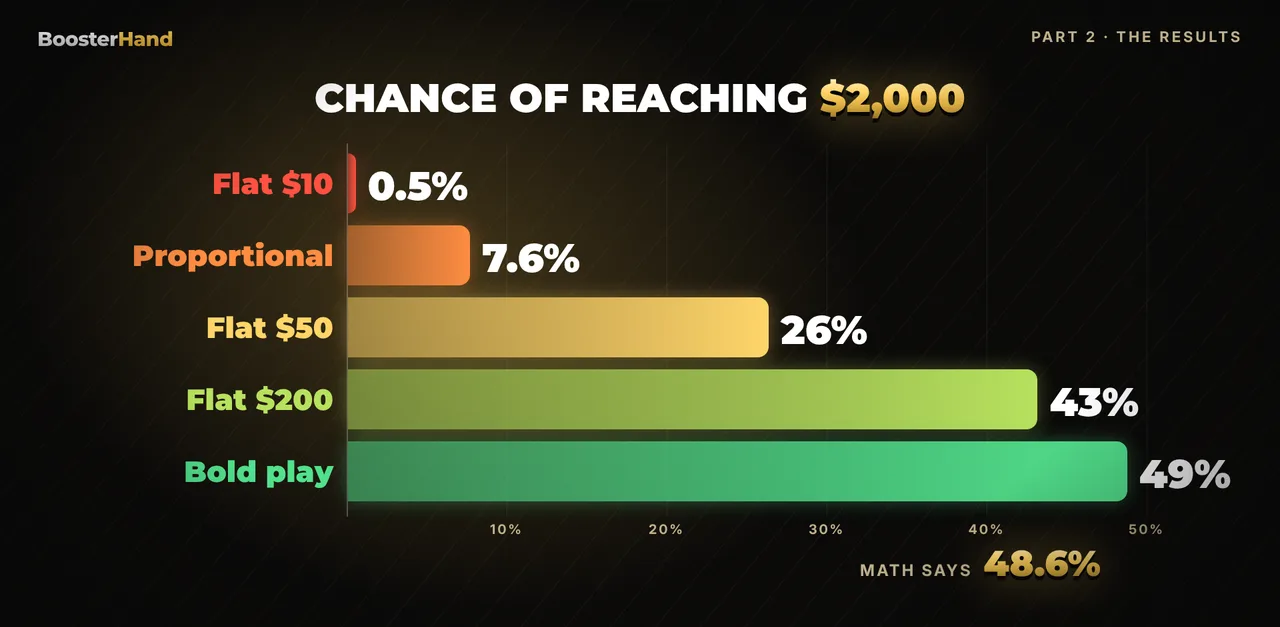
Notice the proportional rule. It sounds like the safest kind of bankroll management, and it never technically “runs out” fast, because the bet shrinks as the bankroll shrinks. But in practice it still ended at zero for 92% of players, after an average of 3,206 bets.
Why small bets get ground down
Every single bet hands the house about 2.7% of the amount on the table, on average. One bet barely registers. Thousands of bets add up.
The average flat $10 player made 3,676 bets (the median was 3,145) and pushed $36,758 across the table, starting from $1,000. That’s more than 36 times their bankroll. With that much action, the edge has all the time it needs, and the random swings that could carry you to $2,000 get smoothed out by sheer volume.
The bold player made one bet, with $1,000 wagered in total. The edge only got one shot at them.
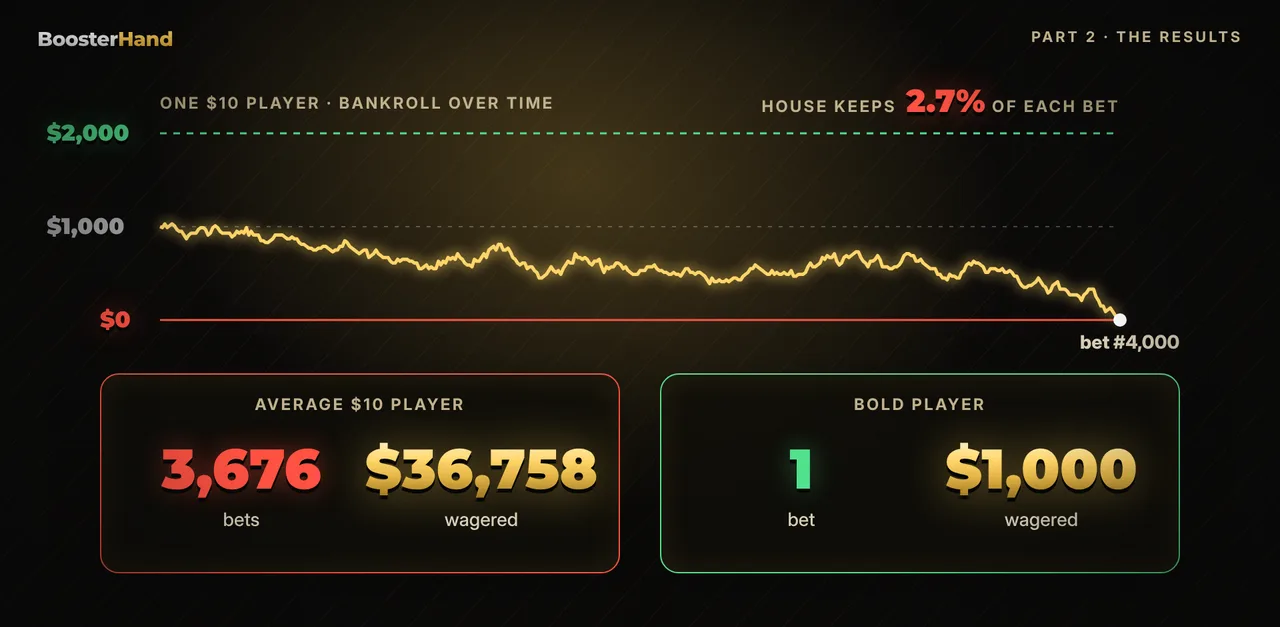
If you want to see how long a bankroll lasts at your own bet size, the bankroll calculator works it out from the RTP, bet and spins per hour.
The catch: the house edge doesn’t care about bet size
So should you bet big? No. The chance of hitting a target is the wrong number to look at. The right one is how much of every dollar bet the house kept.
| Strategy | Average loss per player | Loss per $ wagered |
|---|---|---|
| Flat $10 | $990 | 2.7% |
| Flat $50 | $475 | 2.6% |
| Flat $200 | $139 | 2.8% |
| Proportional 2% | $846 | 2.7% |
| Bold play (1,000,000 players) | $26 | 2.6% |
Look at the right-hand column: 2.7%, 2.6%, 2.8%, 2.7%, 2.6%. Every strategy lost the same share of what it bet. That’s the house edge of a European wheel, showing through no matter how the bets were sized. Small differences are just random noise around 2.7%.
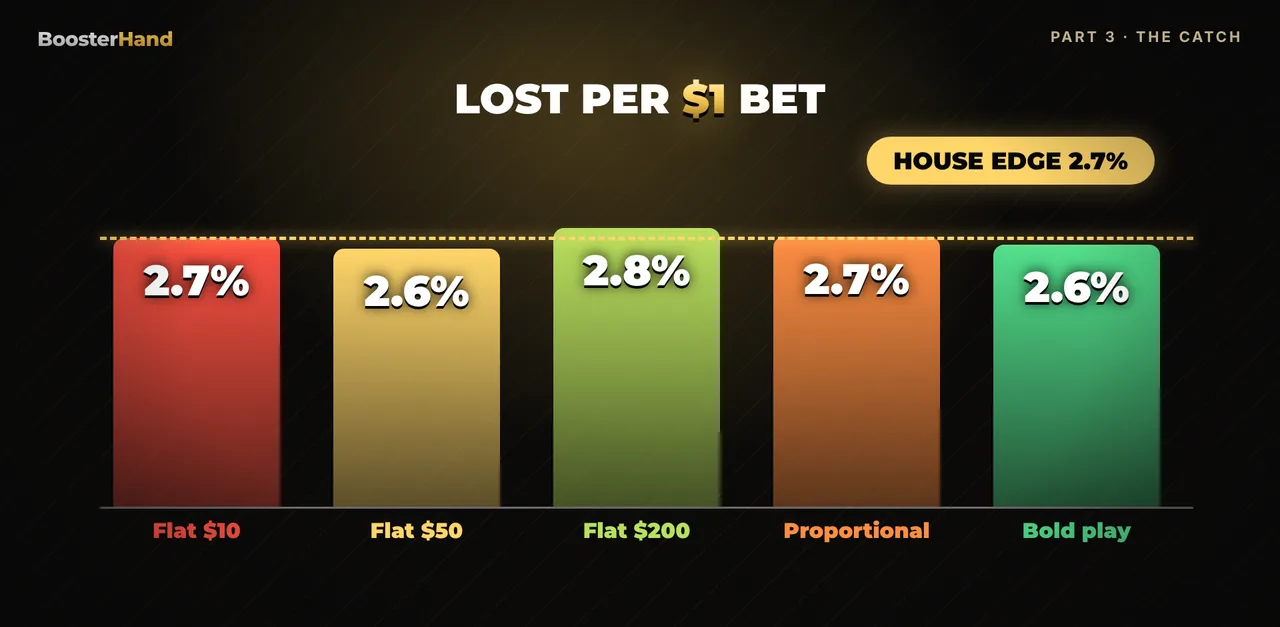
The average loss per player looks very different, but only because the amount wagered was very different. Flat $10 players lost more dollars because they bet far more dollars, not because they bet badly. This is the same lesson our Martingale test found: a system can change the shape of the losses, but the average player still landed close to the 2.7% edge. Our comparison of seven betting systems ends in the same place.
Does bet sizing change the long-run result?
Here’s the honest answer. Even with bold play, the “best” strategy for doubling up, 51% of players lost the whole $1,000 on a single spin. That is not a safe outcome. That’s a coin flip, slightly tilted against you, for your entire budget.
Small bets don’t lose less per dollar. They lose slower. You’re buying time at the table, not better odds. Big bets don’t win more per dollar either. They just finish the story faster, in one direction or the other.
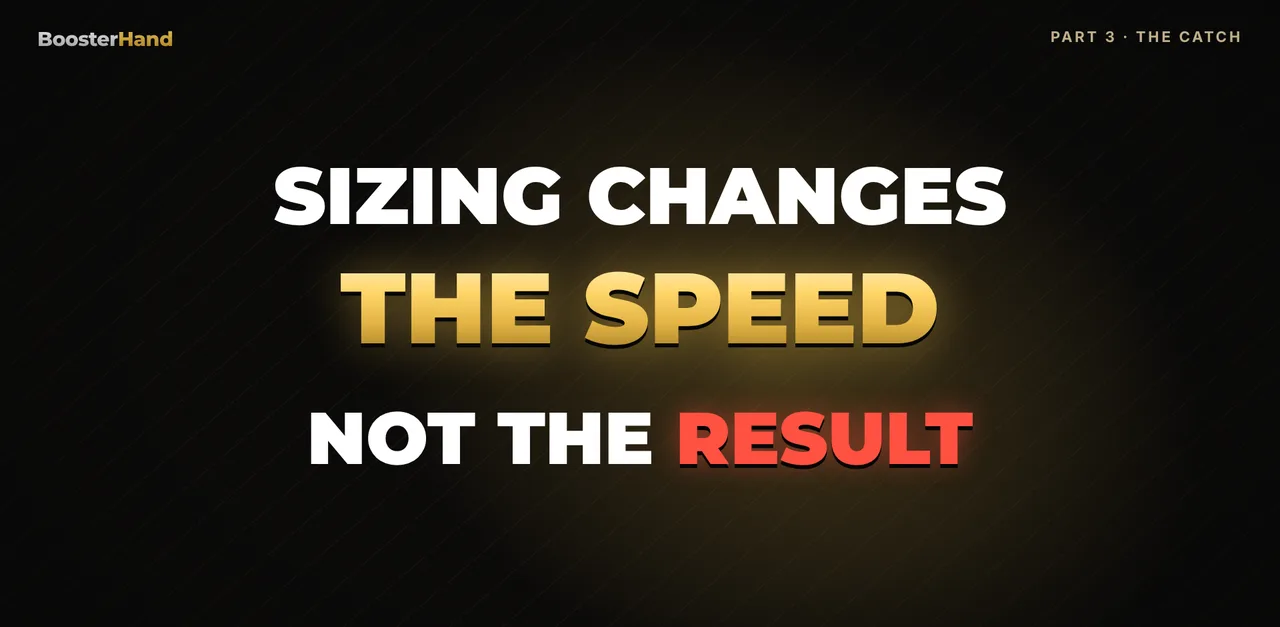
So the answer to the question: sizing changes how fast you get to the result. It doesn’t change the result.
A couple of caveats. This was one model with one fixed goal and no table limits. Change the goal, say stop at $1,200 instead of $2,000, and every chance in the first table changes. The loss per dollar bet doesn’t. And on an American wheel with a double zero, the edge is higher, as our European vs American roulette test shows, so every strategy would do worse.
What this means for you
This is not advice to bet big or go all-in. More than half of the all-in players lost everything in one spin, and the money they lost per dollar bet was the same as everyone else’s. Three takeaways:
- No bet size beats the house edge. Every strategy lost about 2.7% of every dollar bet. There’s no “how much to bet” answer that turns the math in your favor.
- Small bets buy time, not odds. If you play for entertainment, smaller bets make a session last longer. That’s their only benefit, and it’s a real one, as long as you see it as paying for time.
- The only bankroll rule that works: bring only money you can afford to lose, and set your stop before you start. Decide your budget and your time limit in advance, not at the table after a losing streak.
Real bankroll management in gambling isn’t a formula for winning. It’s a budget. If the money you bring is money you’d be fine never seeing again, the bet sizing question mostly answers itself.
You must be 18+ to gamble. If gambling stops being fun, take a break. Our responsible gambling page lists tools for setting limits and places to get help.
FAQ
How much should I bet per hand or spin?
No bet size changes the house edge. In our simulation every sizing strategy lost about 2.7% of what it bet. Smaller bets only make the money last longer, so pick a size that fits a budget you can afford to lose.
Does bankroll management improve your odds of winning?
No. Bankroll management controls how fast you lose and how long a session lasts, not the long-run result. Flat $10 bets and a single all-in bet both lost about 2.6% to 2.7% of every dollar wagered.
Is it better to bet small or big in roulette?
To hit a fixed target like doubling your money, fewer, bigger bets reached it more often in our test (49% for one all-in spin vs 0.5% for $10 bets). But 51% of all-in players lost everything on one spin, and the loss per dollar bet was the same.
What is the 1% or 2% bankroll rule?
It means betting 1% or 2% of your bankroll per bet. In our simulation, betting 2% of whatever was left reached a $2,000 goal from $1,000 only 7.6% of the time, and still lost 2.7% of every dollar bet.
Why do small bets lose almost the whole bankroll?
Because they mean thousands of bets, and each one pays the house about 2.7%. The average $10 player wagered $36,758 from a $1,000 start, so the edge had plenty of room to work.
Related
Simulations use generic models, not any real game or casino. Results show long-run math, not predictions for one session. 18+ only. If gambling stops being fun, take a break: responsible gambling.
Next experiment: House Edge Explained: 1,000,000 Slot Spins, Where the Money Went