

BoosterHand Lab · simulation
Betting Systems Tested on 70,000 Players: Which One Fails Fastest?
Updated 2026-10-29 · By BoosterHand Lab · Method: Monte Carlo simulation (Python/NumPy, fixed seed)
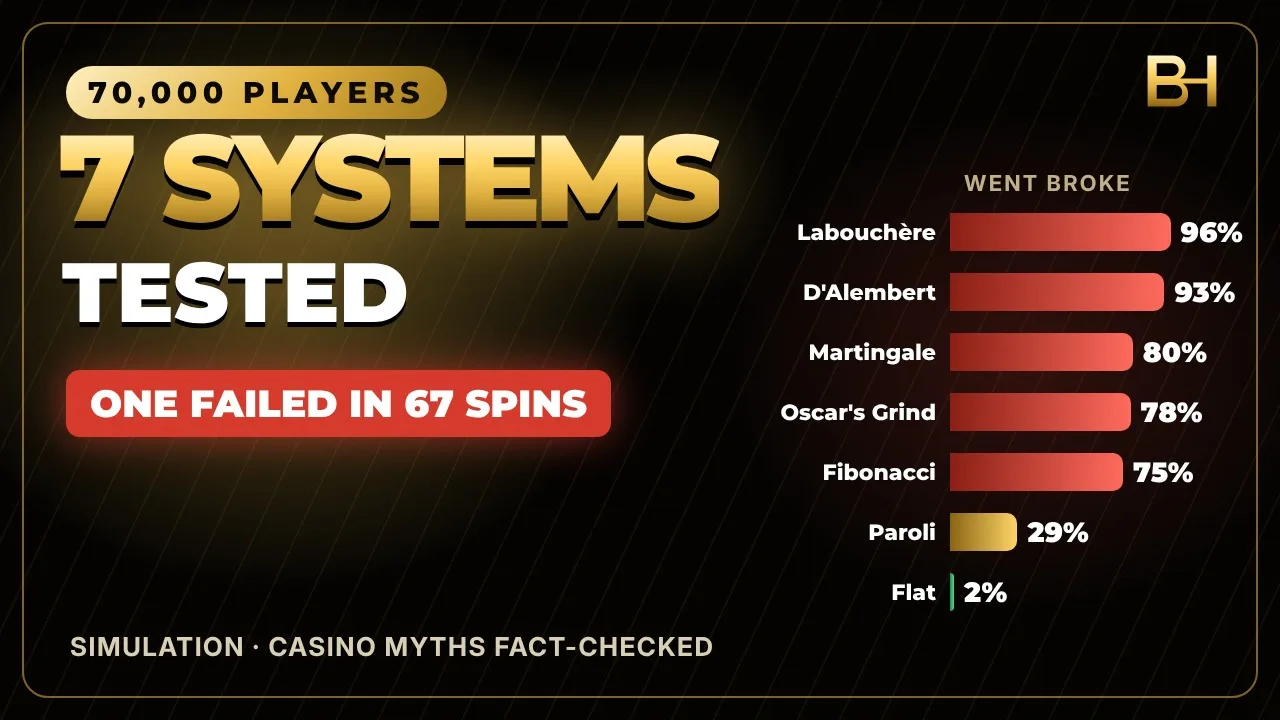
- 7 betting systems, 10,000 players each: 70,000 players on European roulette with a $1,000 bankroll.
- Fastest to fail: Labouchere, with 96% of players broke and the typical player out after 67 spins.
- Safest: flat betting, with only 1.8% broke after 1,000 spins.
- Most players ahead: Fibonacci at 24.5%, while flat betting had only 18.4%.
- Every system lost 2.5% to 2.8% of all money bet: the 2.7% house edge, unchanged.
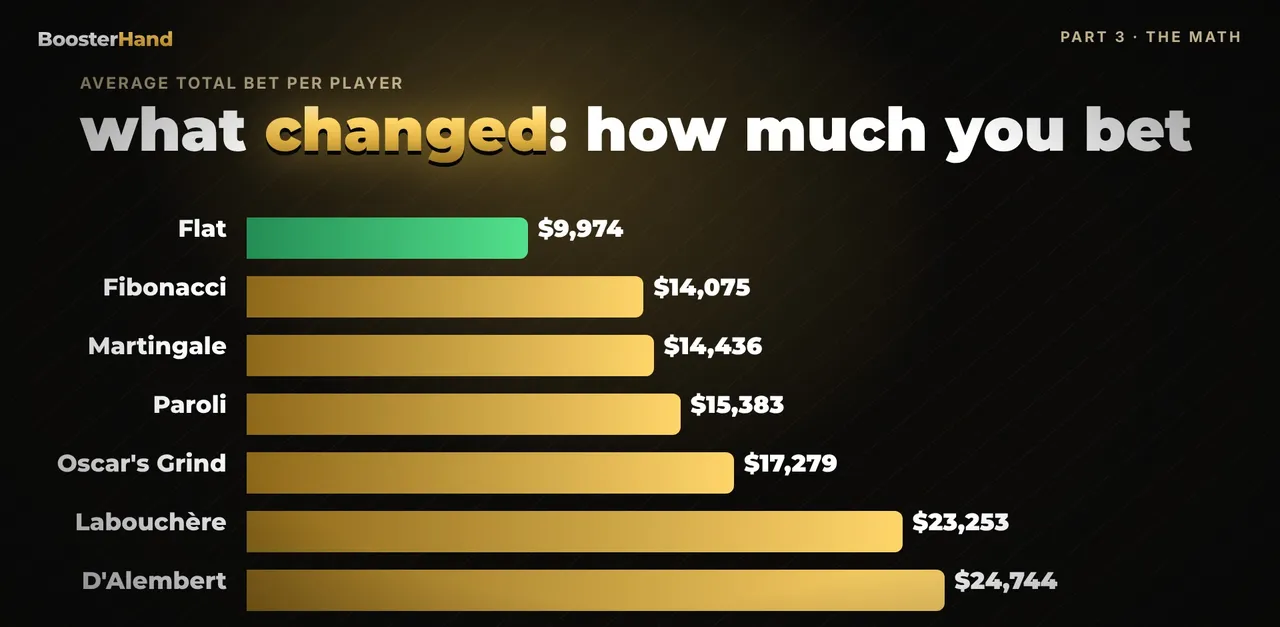
- Flat players bet about $10,000 and lost $272 on average. D'Alembert players bet about $25,000 and lost $685.
Martingale, Fibonacci, D’Alembert: every gambling forum has someone swearing that one of these betting systems works. So we gave each of seven systems to 10,000 simulated players, 70,000 players in total. One system broke the typical player in just 67 spins.
How we ran the simulation
Same rules for everyone, so the only thing that changes is the betting system. This is a Monte Carlo simulation in Python with NumPy and fixed seeds. It’s a generic model of even-money roulette bets, not a test of any specific casino.
- Game: European roulette, betting on red (18 winning pockets out of 37)
- House edge: 2.7%
- Bankroll: $1,000 per player
- Base bet: $10
- Table limit: $1,000
- Session: up to 1,000 spins, or until the player is broke
- Players: 10,000 per system, 70,000 total
Our methodology page explains how we build these models and what they can and can’t tell you.
The 7 betting systems explained
Here are the contenders:
- Flat betting: always $10, no matter what happens.
- Martingale: double your bet after every loss, go back to $10 after a win.
- Fibonacci: after a loss, move one step up the sequence 1, 1, 2, 3, 5, 8 and so on. After a win, move two steps back.
- D’Alembert: add $10 after a loss, remove $10 after a win.
- Labouchere: write down 1, 2, 3, 4. Bet the first plus the last number. Cross both out when you win, add the lost amount to the end when you lose.
- Paroli: the reverse of Martingale. Double after a win, up to three wins in a row, then reset.
- Oscar’s Grind: raise your bet after a win until the session is up one unit.

Before you scroll to the ranking, make your pick: which system do you think fails fastest? Hold that thought, we’ll ask again at the end.
Betting systems ranked: who went broke
Here’s the full result after up to 1,000 spins:
| Rank (fastest to fail) | System | Players broke | Players ahead | Typical bust spin* |
|---|---|---|---|---|
| 1 | Labouchere | 95.9% | 4.0% | 67 |
| 2 | D’Alembert | 93.2% | 6.6% | 167 |
| 3 | Martingale | 79.5% | 18.4% | 156 |
| 4 | Oscar’s Grind | 78.5% | 21.1% | 272 |
| 5 | Fibonacci | 75.2% | 24.5% | 253 |
| 6 | Paroli | 29.3% | 22.5% | 708 |
| 7 | Flat betting | 1.8% | 18.4% | 884 |
*Median spin at which players who went broke ran out of money.
In seventh place, the safest: flat betting, with only 1.8% broke. Sixth, Paroli at 29%. Paroli only grows the bet after wins, so losing streaks don’t snowball. Fifth, Fibonacci at 75%. Fourth, Oscar’s Grind at 78.5%. Third, Martingale at 79.5%, which lines up with our dedicated Martingale strategy test.
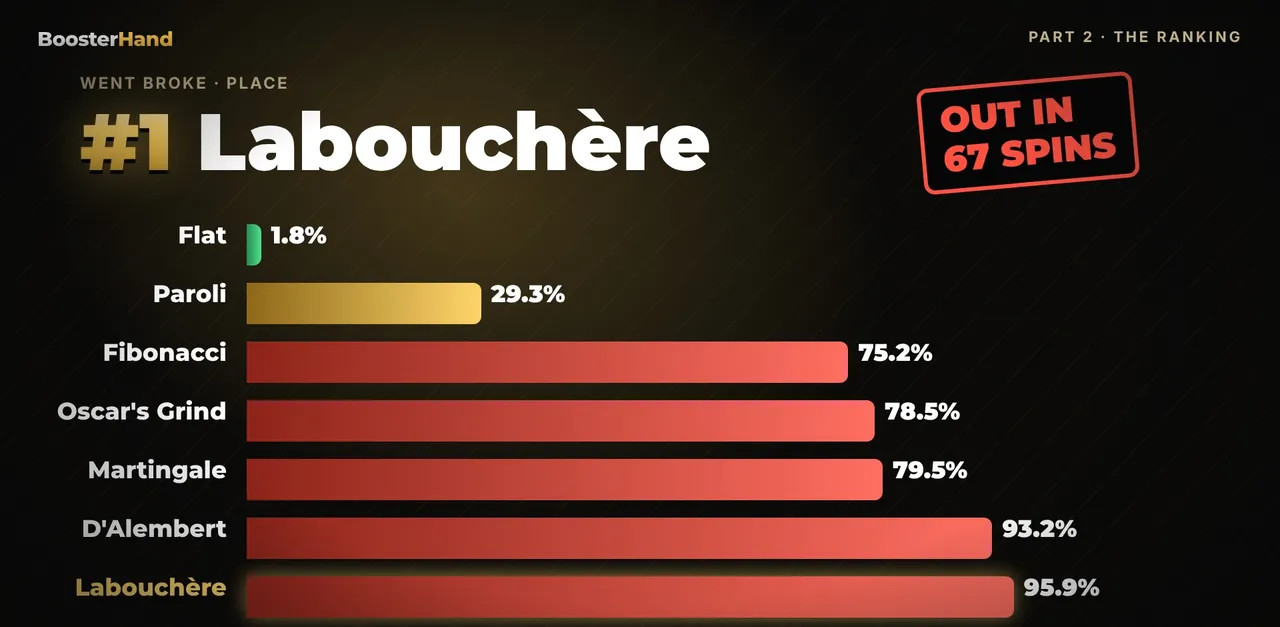
Second, D’Alembert at 93%. It sounds gentle (just $10 up or down), but in a game you lose slightly more often than you win, the bet drifts upward and stays there.
Why flat betting and Paroli survive longest
The two survivors have one thing in common: they never raise the bet after a loss. A flat bettor risks $10 every spin, so a bad run costs $10 at a time and a $1,000 bankroll has room to absorb it. Paroli only raises the stake with money it just won, then resets after three wins, so a losing streak is still a string of small bets. Every system that ranked worse does the opposite. It answers a loss with a bigger bet, which is exactly the moment the bankroll is weakest. That doesn’t make flat betting a winning plan (it still lost money on average), but it explains why it lasts.
And the system that fails fastest: Labouchere. 96% of players went broke, and the typical bust came after 67 spins. Every loss adds a bigger number to the list, so the bets grow quickly and the list rarely gets cleared.
The twist: Fibonacci had the most winners
Which system had the most players finish ahead? Not flat betting. Fibonacci, with 24.5%. Flat betting had only 18.4%.
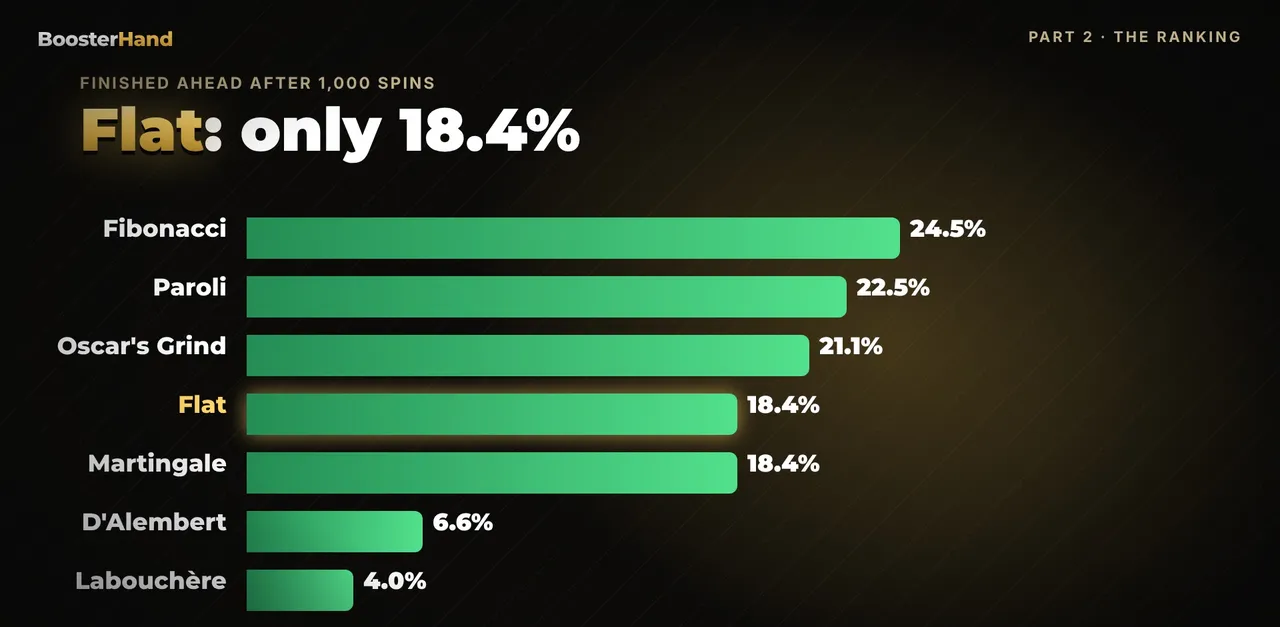
That is exactly how betting systems hook people. Every system creates some lucky winners, and those winners post about it. Just not most of them. Early on, the picture looked even better for the progressions:
| System | Ahead after 100 spins | Ahead after 1,000 spins |
|---|---|---|
| Fibonacci | 74.2% | 24.5% |
| Oscar’s Grind | 69.8% | 21.1% |
| Martingale | 61.0% | 18.4% |
| D’Alembert | 55.4% | 6.6% |
| Paroli | 38.2% | 22.5% |
| Labouchere | 37.9% | 4.0% |
| Flat betting | 35.2% | 18.4% |
After 100 spins, nearly three out of four Fibonacci players were ahead. Anyone who stopped there would swear it works. The longer the session, the more the edge shows up, which is the same lesson as our 1,000,000 slot spin simulation.
The house edge never changes
Here’s what all seven systems had in common: each one lost between 2.5% and 2.8% of all the money that was bet. That’s the house edge of European roulette, 2.7%. None of them changed it.
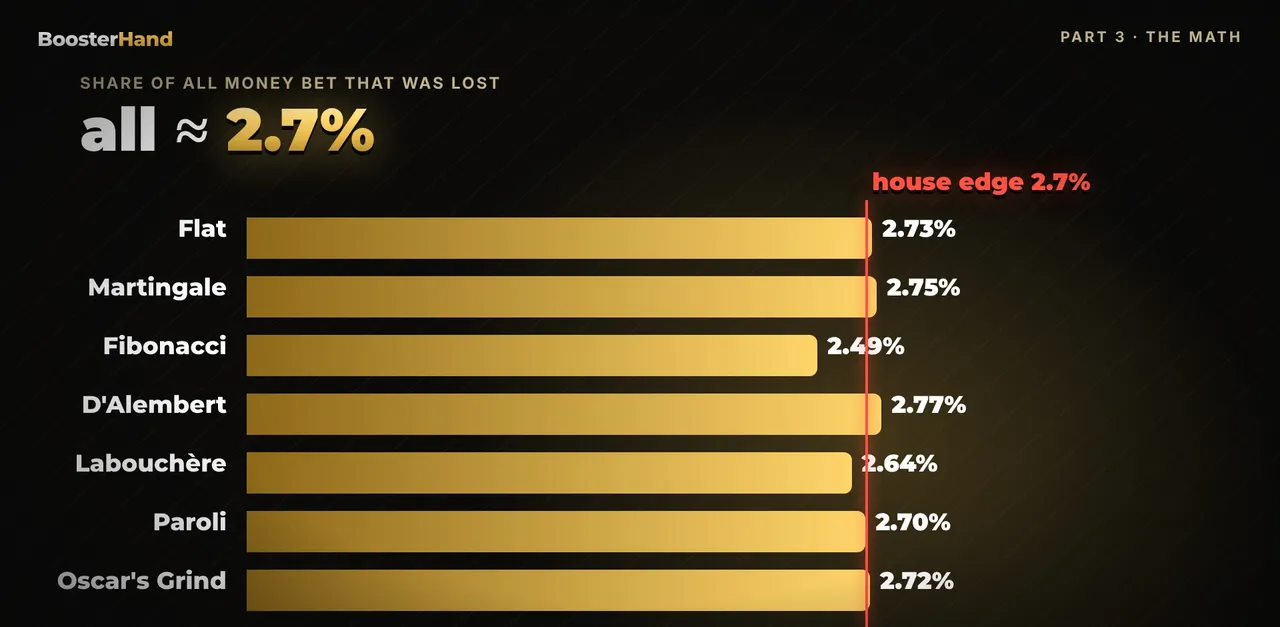
Betting systems change how much you bet
What the systems do change is the total amount you put through the wheel:
| System | Average total bet | Share of bets lost | Average loss |
|---|---|---|---|
| Flat betting | $9,974 | 2.73% | $272 |
| Fibonacci | $14,075 | 2.49% | $350 |
| Martingale | $14,436 | 2.75% | $396 |
| Paroli | $15,383 | 2.70% | $416 |
| Oscar’s Grind | $17,279 | 2.72% | $469 |
| Labouchere | $23,253 | 2.64% | $614 |
| D’Alembert | $24,744 | 2.77% | $685 |
Flat players bet about $10,000. D’Alembert players bet almost $25,000 from the same $1,000 bankroll.
And bigger bets times the same edge means bigger losses. Flat lost $272 on average. D’Alembert lost $685.
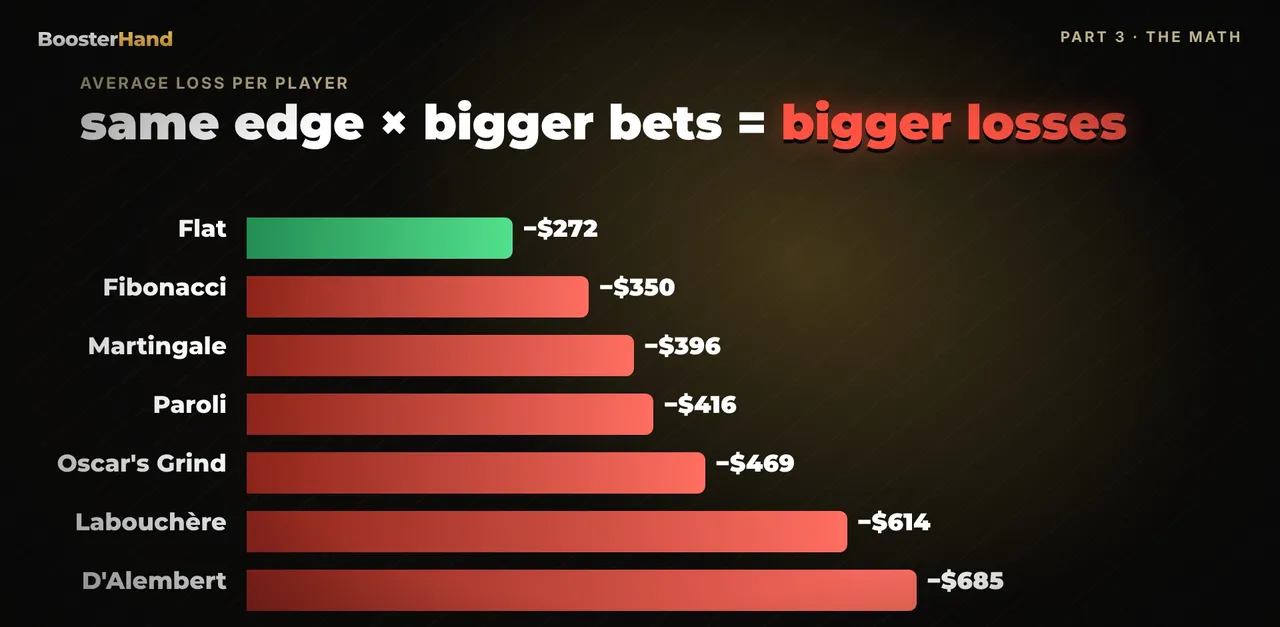
This is the core idea in one line: your expected loss is roughly the total amount you bet times the house edge. Any system that raises your bets after losses raises that total. If you want to see how fast a doubling progression hits its limit, try our Martingale calculator.
What this means for you
Three takeaways from 70,000 simulated players:
- No betting system beats a negative edge. Not one out of seven. The house kept about 2.7% of every dollar, whatever the pattern.
- Progressions make you bet more, and betting more is how you lose more. The worst systems cost more than twice as much as flat betting on average.
- If you play at all, keep it boring: small flat bets, a fixed budget and a time limit.
A note on the model: it’s a simulation, and real table limits vary. An American wheel with a double zero has a higher house edge and makes every system worse. Systems also lean on the belief that a streak is “due” to end, which our gambler’s fallacy simulation takes apart.
So, which of these systems have you tried, or seen someone swear by? And did you pick the one that fails fastest? Tell us in the comments under the video.
You must be 18+ to gamble. If it stops being fun, take a break, and see our responsible gambling page for tools and support.
FAQ
Do betting systems work in roulette?
No. In our simulation of 7 betting systems on 70,000 players, every system lost between 2.5% and 2.8% of all money bet, which is the 2.7% house edge of European roulette. Systems change how you win and lose, not how much the house keeps.
What is the safest roulette betting system?
Flat betting, meaning the same bet every spin. Only 1.8% of flat bettors went broke in 1,000 spins, compared with 79.5% for Martingale and 96% for Labouchere.
Which betting system loses money fastest?
In our test, Labouchere. 96% of players went broke, and the typical player who went broke was out after just 67 spins.
Is Fibonacci better than Martingale?
Fibonacci had the most players finishing ahead (24.5% vs 18.4% for Martingale), but 75% of Fibonacci players still went broke. Both lost about the house edge on every dollar bet.
Why do betting systems lose more than flat betting?
Progressions make you bet more in total. With the same 2.7% edge, flat players bet about $10,000 and lost $272 on average, while D'Alembert players bet about $25,000 and lost $685.
Related
Simulations use generic models, not any real game or casino. Results show long-run math, not predictions for one session. 18+ only. If gambling stops being fun, take a break: responsible gambling.
Next experiment: RTP Explained: What 96% RTP Really Means for Your $100