

BoosterHand Lab · simulation
Slot Volatility Explained: Low vs High at the Same 96% RTP
Updated 2026-10-29 · By BoosterHand Lab · Method: Monte Carlo simulation (Python/NumPy, fixed seed)
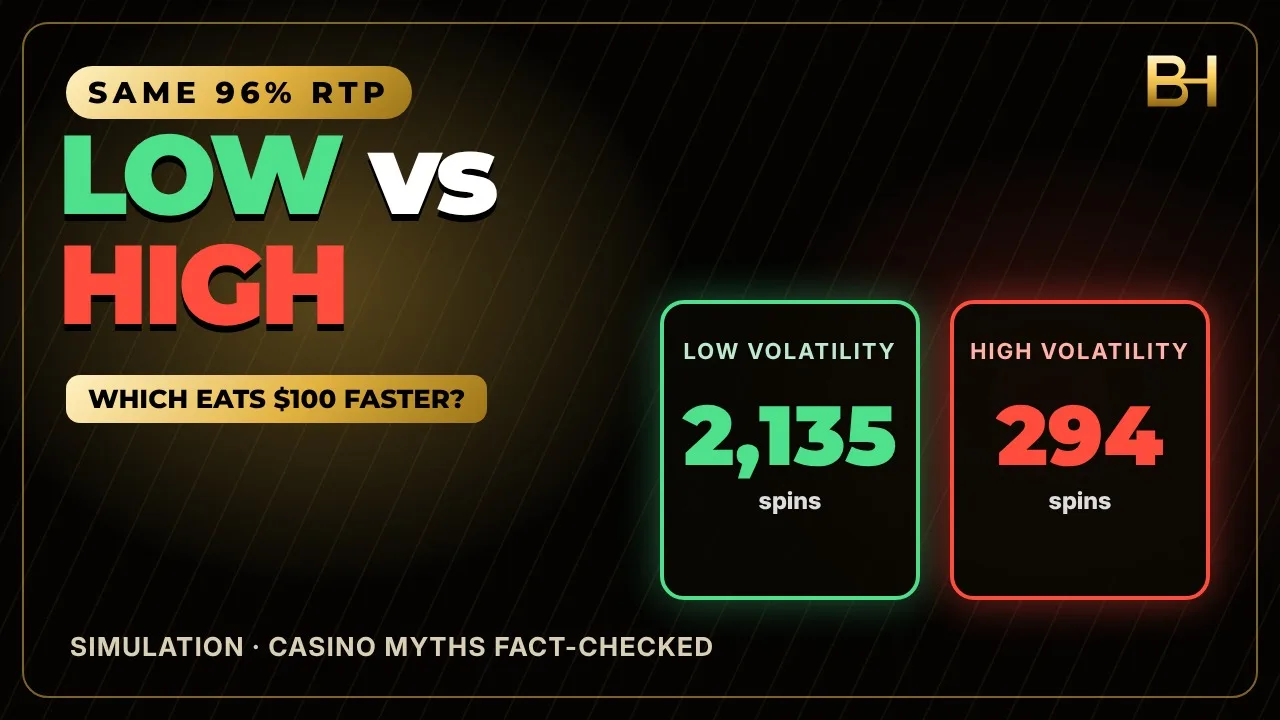
- Both slots pay 96% RTP. Low volatility hits on 90% of spins (top prize 20x), high volatility on 13% (top prize 10,000x).
- After 300 spins, high volatility had broken 51% of players. Low volatility: 0%.
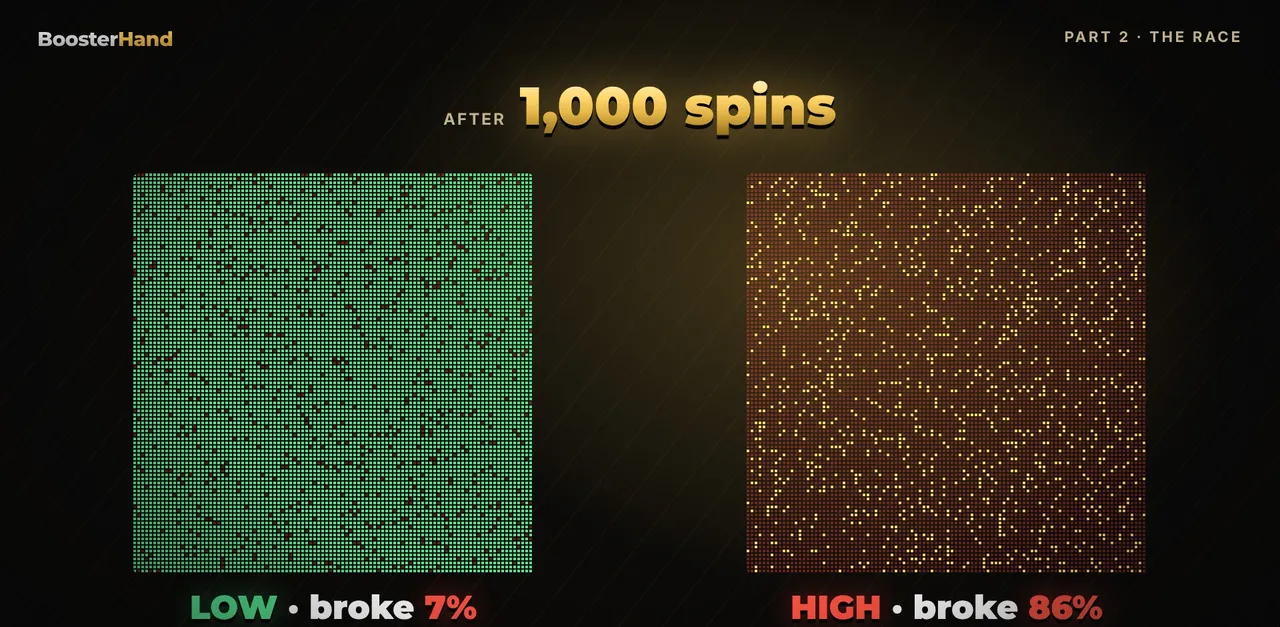
- After 1,000 spins: 86% broke on high volatility vs 7% on low.
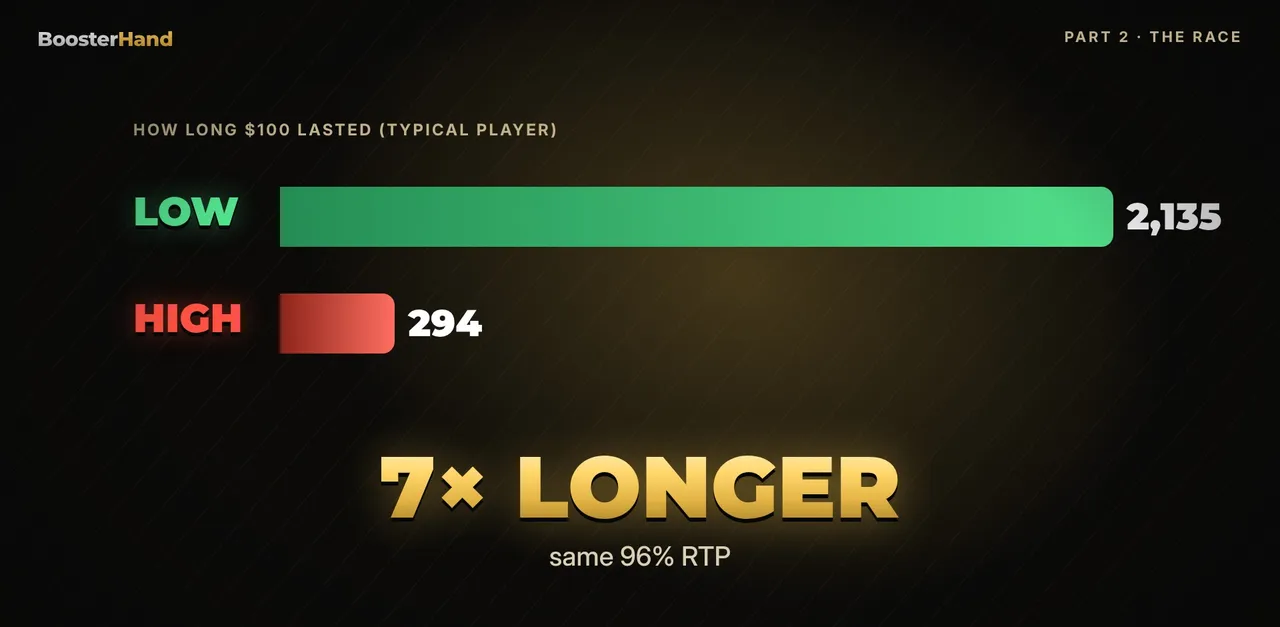
- The typical $100 lasted 2,135 spins on low volatility vs 294 on high, about 7x longer.
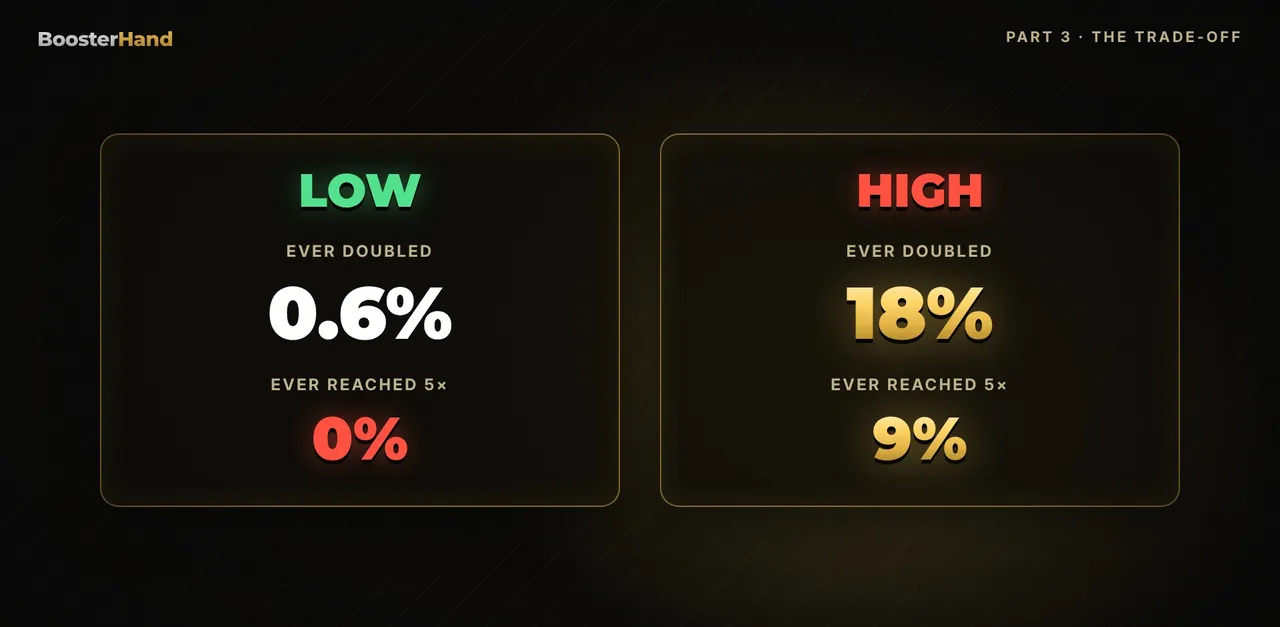
- But only 0.6% ever doubled on low volatility, vs 18% on high, where 9% reached 5x.
Two slot machines, both paying back 96%: same RTP, same house edge. On one, the typical $100 lasted more than 2,000 spins. On the other, it was gone in under 300. The difference comes down to slot volatility, and I ran 10,000 simulated players on each machine to see exactly how much it changes your session.
If you’ve read our RTP simulation, you know RTP tells you the long-run average. Volatility tells you what the road to that average feels like.
What slot volatility actually means
Volatility is how the 96% gets paid out. A slot can return 96 cents per dollar through lots of small wins, or through a few huge ones and long dry spells in between. Over millions of spins, both end up in the same place. Over a single session, they feel like completely different games.
For this test I built two generic slots:
| Feature | Low volatility slot | High volatility slot |
|---|---|---|
| RTP | 96% | 96% |
| House edge | 4% | 4% |
| Hit rate (spins with any win) | 90% | 13% |
| Top prize | 20x your bet | 10,000x your bet |
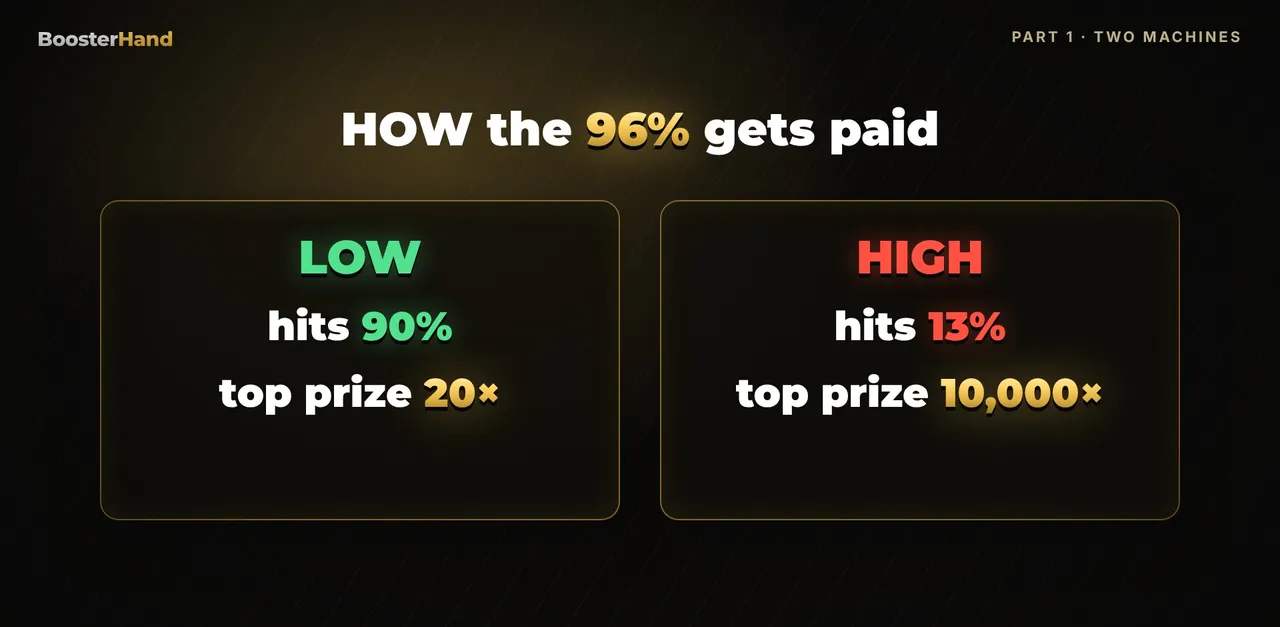
The low volatility slot pays something on 9 out of 10 spins, but the wins are small and the top prize is just 20x. The high volatility slot pays on only 13% of spins, but one lucky hit can be worth 10,000x your bet.
Before the results: which one do you think loses your money slower, low or high volatility? Comment your pick, then see if you were right.
How we ran the simulation
This is a generic model, not a copy of any real game. The setup:
- Machines: two slots, both 96% RTP. Low volatility: 90% hit rate, 20x top prize. High volatility: 13% hit rate, 10,000x top prize
- Players: 10,000 per machine, 20,000 in total
- Bankroll: $100 each
- Bet: $1 per spin
- Session length: up to 5,000 spins, or until the balance hit zero
- Snapshots: balances recorded after 100, 300 and 1,000 spins
- Method: Monte Carlo simulation in Python (NumPy), fixed random seed for reproducibility
Real games show volatility in many ways, with bonus rounds, multipliers and different pay tables. But the core trade-off between hit rate and prize size is the same.
The race: who goes broke first
Here’s what happened to the two groups of players over time.
| After | Broke (low) | Broke (high) | Median balance (low) | Median balance (high) | Ahead of $100 (low) | Ahead of $100 (high) |
|---|---|---|---|---|---|---|
| 100 spins | 0% | 0% | $95 | $64 | 32% | 24% |
| 300 spins | 0% | 51% | $86.50 | $0 | 26% | 20% |
| 1,000 spins | 7% | 86% | $59 | $0 | 14% | 11% |
After 100 spins, nobody was broke on either machine. But you can already see the split: the median low volatility player was at $95, while the median high volatility player had dropped to $64.
By 300 spins, the high volatility machine had broken 51% of its players. The low volatility machine? Zero. After 1,000 spins, 86% of high volatility players were broke, compared with just 7% on low volatility.
The “ahead” column is the sneaky one
Look at the share of players sitting above their starting $100. After 100 spins, 32% of low volatility players were ahead, versus 24% on high. By 1,000 spins, those numbers had shrunk to 14% and 11%. On both machines, the longer people played, the fewer were winning. That’s the 4% edge grinding away in the background, whatever the volatility.
The difference is what “ahead” looks like. A low volatility winner was up by small amounts: the best balance on that machine after 1,000 spins was $199. A high volatility winner could be sitting on thousands. A similar share of winners, but a completely different size of win, which is exactly why high volatility games feel exciting even though most players lose faster.
Also check the high volatility median after 300 spins: $0. More than half the players had already lost everything, while the top 10% still held $176 or more. Results on a high volatility slot are lopsided: a few big winners and a large crowd at zero.
How long $100 lasts on low vs high slot volatility
The cleanest way to see the difference is to ask how long the typical bankroll survived. On the low volatility slot, the median $100 lasted 2,135 spins. On the high volatility slot: 294 spins.
That’s roughly 7 times longer, on a game with exactly the same RTP and the same 4% house edge.
Why? On the high volatility slot, only 13% of spins pay anything at all. The money that “should” come back is locked up in rare big wins that most players never see before their balance runs out. On the low volatility slot, frequent small wins keep topping the balance up, so it drains slowly and steadily.
If you want to estimate how long your own budget might last at a given RTP and bet size, our bankroll calculator does the math.
The trade-off: big wins
So low volatility is simply better? Not exactly. Look at the other side of the table.
| Outcome | Low volatility | High volatility |
|---|---|---|
| Ever doubled their $100 (at any point) | 0.6% | 18% |
| Ever reached 5x ($500) | 0% | 9% |
| Highest balance after 1,000 spins | $199 | $11,959 |
On low volatility, only 0.6% of players ever doubled their money, and nobody ever reached 5x. The best balance after 1,000 spins was $199. The game simply can’t pay big enough to change your night.
On high volatility, almost 18% of players doubled their money at some point, and 9% reached 5x. The biggest balance hit almost $12,000.
Notice the words “at some point”. Reaching $200 or $500 doesn’t mean walking away with it. Players who kept spinning gave much of it back, which is why 86% were broke by spin 1,000. Our house edge simulation of 1 million slot spins shows what a 4% edge does over a long session.
Same edge, different pain. Low volatility is a slow leak. High volatility is a lottery ticket that usually loses fast.
How to spot slot volatility before you play
You often won’t see a label, but the pay table gives strong clues. A huge top prize (thousands of times your bet) usually means rare wins and long dry spells, like our 10,000x machine with its 13% hit rate. A small top prize with frequent hits points the other way, like our 20x machine that paid something on 90% of spins.
Some games also show a volatility rating in the info or help screen. Check it before you choose a bet size, because the same $1 bet can drain $100 in a few hundred spins on a high volatility slot, or stretch it past 2,000 spins on a low volatility one. The RTP number on its own won’t tell you which experience you’re signing up for.
What this means for you
Volatility is one of the most useful things to understand about a slot, because it shapes your experience far more than a point or two of RTP. Three takeaways:
- Volatility doesn’t change the house edge. Both machines in this test kept 4% of every dollar bet over time. Neither is a “better deal” in expected value.
- Low volatility makes money last longer. Your $100 survives many more spins, but big wins are almost impossible. If you’re playing for entertainment time, that slower pace is the main benefit.
- High volatility makes big wins possible, but most sessions end fast. In our test, half the players were broke within 300 spins. If you choose a high volatility game, size your budget for that and expect to lose it quickly.
Neither style is a way to win. A longer session on low volatility still costs money (you just lose it slower), and the big hits on high volatility are what pay for everyone else’s losses. Pick a budget you can afford to lose before you start, and stop when it’s gone. If gambling stops being fun, our responsible gambling page has tools and support.
Did you pick right? Low or high, tell us which one you guessed. And if you want another myth tested with data, see what happened when we spun a roulette wheel a million times to test the gambler’s fallacy.
FAQ
What is slot volatility?
Slot volatility describes how a slot pays out its RTP: many small wins (low volatility) or rare, large wins (high volatility). It doesn't change the house edge, only the ride.
Is low or high volatility better?
Neither has a better house edge. In our simulation, low volatility made $100 last about 7x longer, while high volatility gave far more players a shot at doubling their money but broke most of them much faster.
Do high volatility slots pay more?
Not on average. Both of our test slots returned 96% over time. High volatility just concentrates the payouts into fewer, bigger wins, with a top prize of 10,000x instead of 20x.
Which slot volatility makes money last longer?
Low volatility. In our test, the typical $100 bankroll lasted 2,135 spins on the low volatility slot and only 294 spins on the high volatility slot.
How do I know a slot's volatility?
Some games show a volatility rating in the info or help screen. A low hit rate combined with a very high top prize is a strong sign of high volatility.
Related
Simulations use generic models, not any real game or casino. Results show long-run math, not predictions for one session. 18+ only. If gambling stops being fun, take a break: responsible gambling.
Next experiment: House Edge Explained: 1,000,000 Slot Spins, Where the Money Went