

BoosterHand Lab · simulation
Martingale Strategy Tested on 10,000 Players: Does It Really Work?
Updated 2026-10-29 · By BoosterHand Lab · Method: Monte Carlo simulation (Python/NumPy, fixed seed)
- A $1,000 bankroll with a $10 base bet survives 6 losses in a row, not 7.
- 7 losses in a row is about 1 in 106 per spin, yet it showed up in 99% of 1,000-spin sessions.
- After 100 spins, 62% of players were ahead and the median player was up $390.
- After 1,000 spins, 79% were broke and only 18.8% were ahead.
- The average player bet $14,726 and lost $379: 2.6% of all bets, close to the 2.7% house edge.
- Stopping at +$100 worked for 89%, but the average player still lost $23.
The Martingale strategy promises you can’t lose: double your bet after every loss, and one win gets it all back. We handed it to 10,000 simulated roulette players. After 100 spins, the typical player was up $390. After 1,000 spins, the picture was very different.
How the Martingale strategy works
The rules fit on a napkin. You bet $10 on red. If you lose, you bet $20. Lose again, $40. Then $80. The moment you win, you’ve recovered every loss plus $10 profit, and you start again at $10.
On paper, every completed sequence ends $10 up. That’s why the system feels bulletproof. The catch is hidden in the word “completed.”
Two things break the promise. First, red is not a coin flip. On a European wheel, the single green zero means red wins 18 times out of 37, or 48.6% of the time, so you lose a little more often than you win. Second, every real player has a limit: a bankroll that runs out, a table that caps the bet, or both. Martingale only works if you can keep doubling forever, and nobody can. The question isn’t whether a long losing streak arrives. It’s how long it takes, and what it costs when it does. That’s what the simulation measures.
How we ran the simulation
This is a Monte Carlo simulation in Python with NumPy and a fixed random seed. It is a generic model of roulette, not a test of any specific casino.
- Game: European roulette, betting on red. Red wins 18 times out of 37 (48.6%).
- House edge: 2.7%
- Bankroll: $1,000 per player
- Base bet: $10, doubled after every loss, reset after every win
- Table limit: $1,000
- Players: 10,000
- Session length: up to 1,000 spins, or until the player can’t cover the next bet
We also ran a second version where each player stops as soon as they are $100 up. Our methodology page covers how we build and check these models.
The losing streak ladder
Here’s what a losing streak does to the bet:
| Losses in a row | Next bet | Total lost so far |
|---|---|---|
| 1 | $20 | $10 |
| 2 | $40 | $30 |
| 3 | $80 | $70 |
| 4 | $160 | $150 |
| 5 | $320 | $310 |
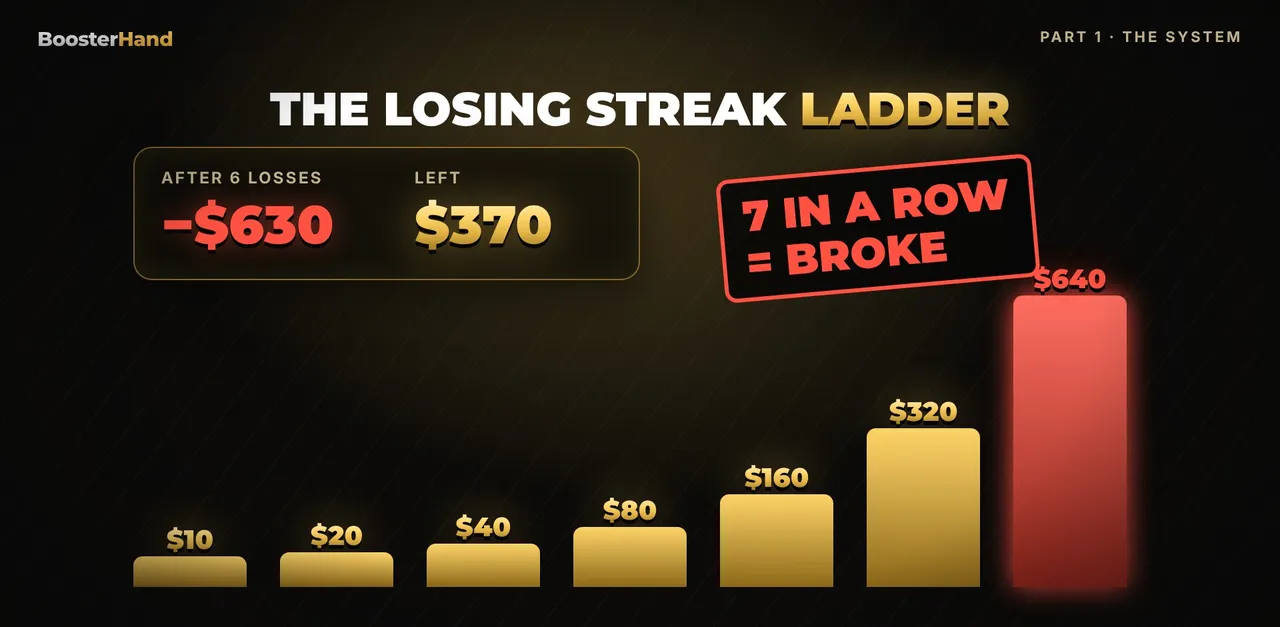
| 6 | $640 | $630 |
After six losses in a row, you’ve lost $630 and the next bet is $640. You only have $370 left. So a $1,000 bankroll survives six losses in a row. Not seven. And even with a bigger bankroll, the $1,000 table limit would block the $1,280 bet anyway.
How likely are 7 losses in a row?
On any given spin, missing red seven times in a row is about 1 in 106. That sounds rare. But Martingale players don’t play one spin. In a session of 1,000 spins, a streak of at least seven showed up 99% of the time.

Longer streaks were common too. Across 1,000-spin sessions in the simulation:
| Longest losing streak (at least) | Share of sessions |
|---|---|
| 7 | 98.8% |
| 8 | 49.8% |
| 9 | 29.4% |
| 10 | 16.3% |
| 12 | 4.1% |
| 14 | 0.6% |
This is the gambler’s fallacy in reverse: a streak doesn’t make the next spin “due,” and it doesn’t make the streak stop either. Our 1,000,000 roulette spin test looks at that in detail. If you want to check your own bankroll and base bet, the Martingale calculator shows how many losses you can survive and your bust probability.
One player: doubled, then broke
Before the big numbers, look at one player. The line climbs in small steps: small win, small win, small win. It almost never goes down. By spin 539, this player has doubled their money to $2,080.
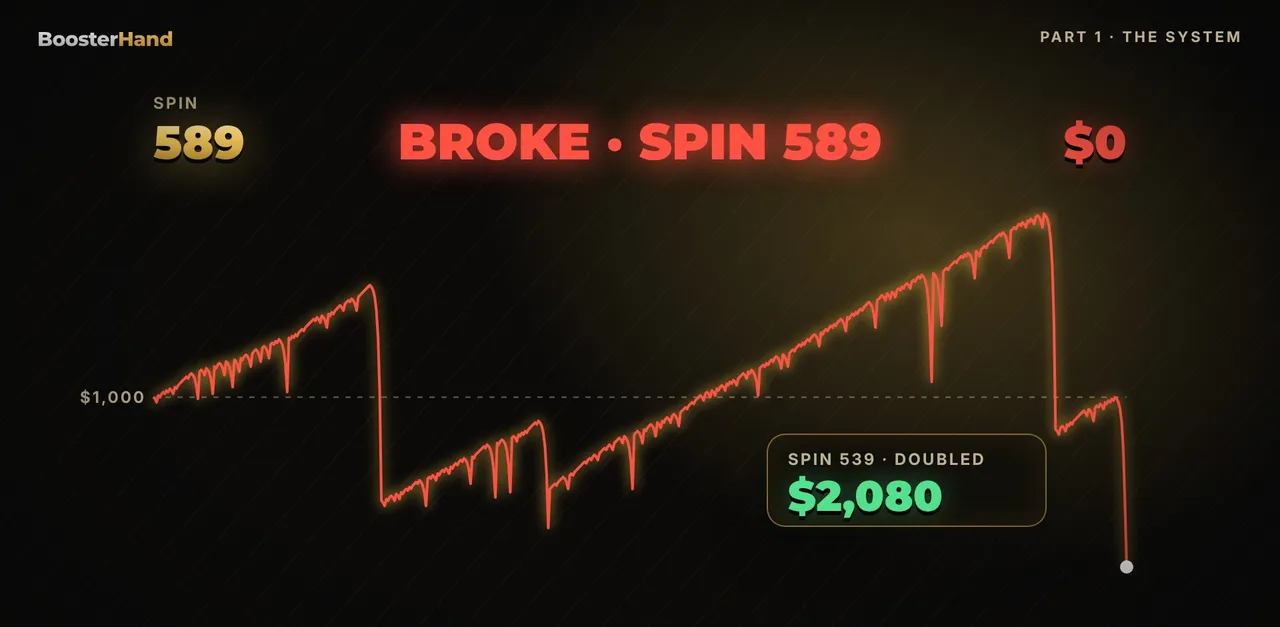
Then, 50 spins later, one bad streak. By spin 589 it’s over. That is the shape of the Martingale strategy in a single chart.
Martingale strategy results: 10,000 players
Before you look at the table, make a guess: after 1,000 spins, what percentage of the 10,000 players do you think ended up ahead?
| After spins | Players ahead | Players broke | Median balance |
|---|---|---|---|
| 10 | 79.7% | 2.4% | $1,040 |
| 50 | 74.0% | 18.4% | $1,210 |
| 100 | 62.0% | 29.7% | $1,390 |
| 250 | 34.3% | 49.1% | $385 |
| 500 | 27.8% | 65.7% | $0 |
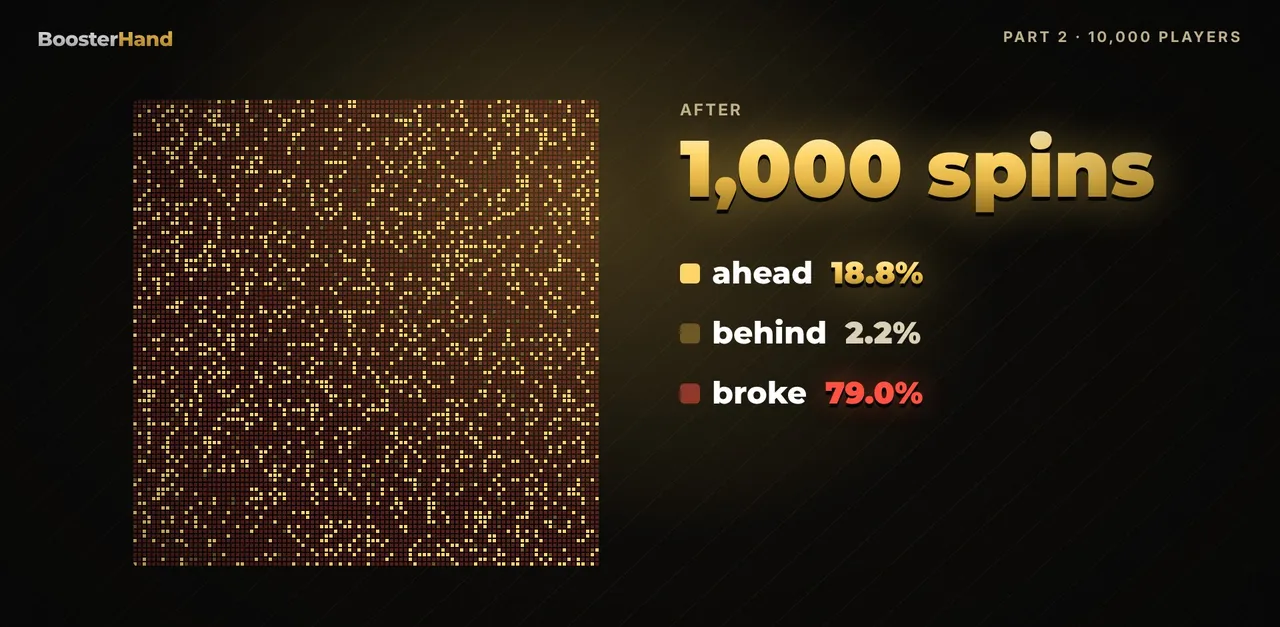
| 1,000 | 18.8% | 79.0% | $0 |
After 10 spins, 80% of players are ahead. After 100 spins, 62% are still winning and the median player is up $390. Martingale looks like a genius strategy. After 250 spins, half of them are broke. After 1,000 spins, 79% are broke and only 18.8% are ahead. The median player went broke at around spin 165.
Why it feels like it works
Here’s the cruel part: 81% of all players were up at least $200 at some point. They felt the system working. Most of them kept going. That’s exactly how Martingale gets you. The wins are frequent and visible, the loss is rare and total.
Where the money went: same edge, different shape
The average player brought $1,000 but bet more than $14,726 over the session. The average loss was $379. That’s 2.6% of everything they bet, almost exactly the 2.7% house edge of a European wheel.
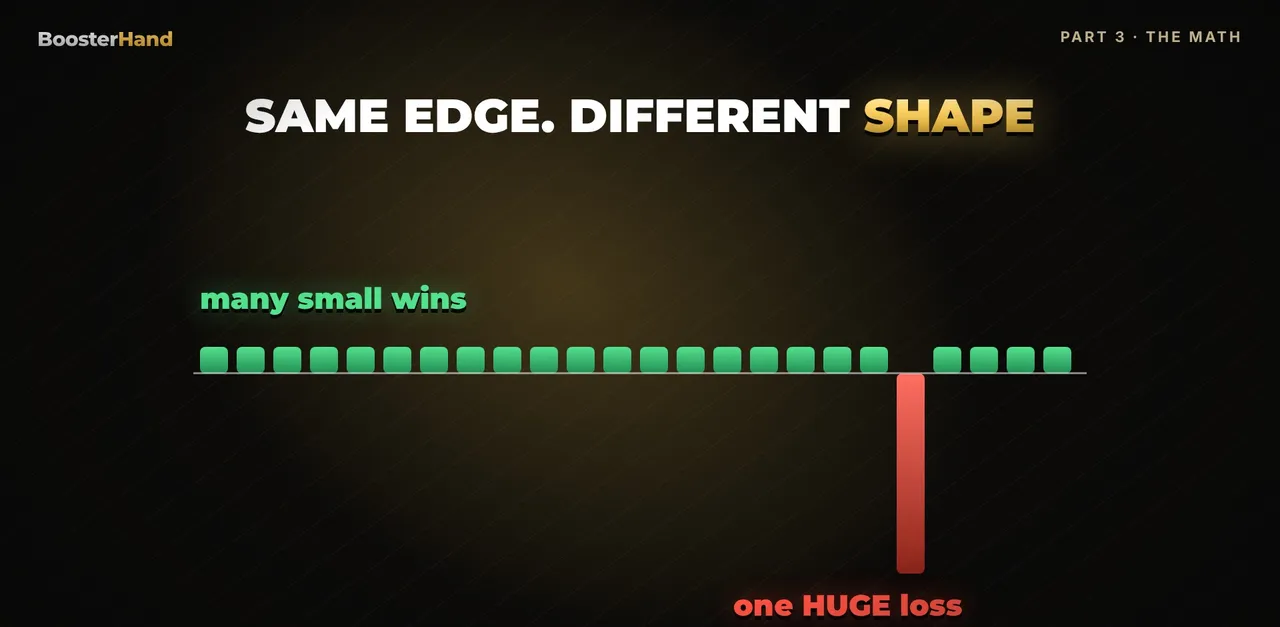
Martingale doesn’t beat the edge. It changes the shape: lots of small wins and one rare, huge loss. The same thing happens on slots, where big jackpots are already priced in, as our house edge simulation shows.
Does stopping at +$100 save Martingale?
A common fix: quit once you’re $100 up. We tested it.
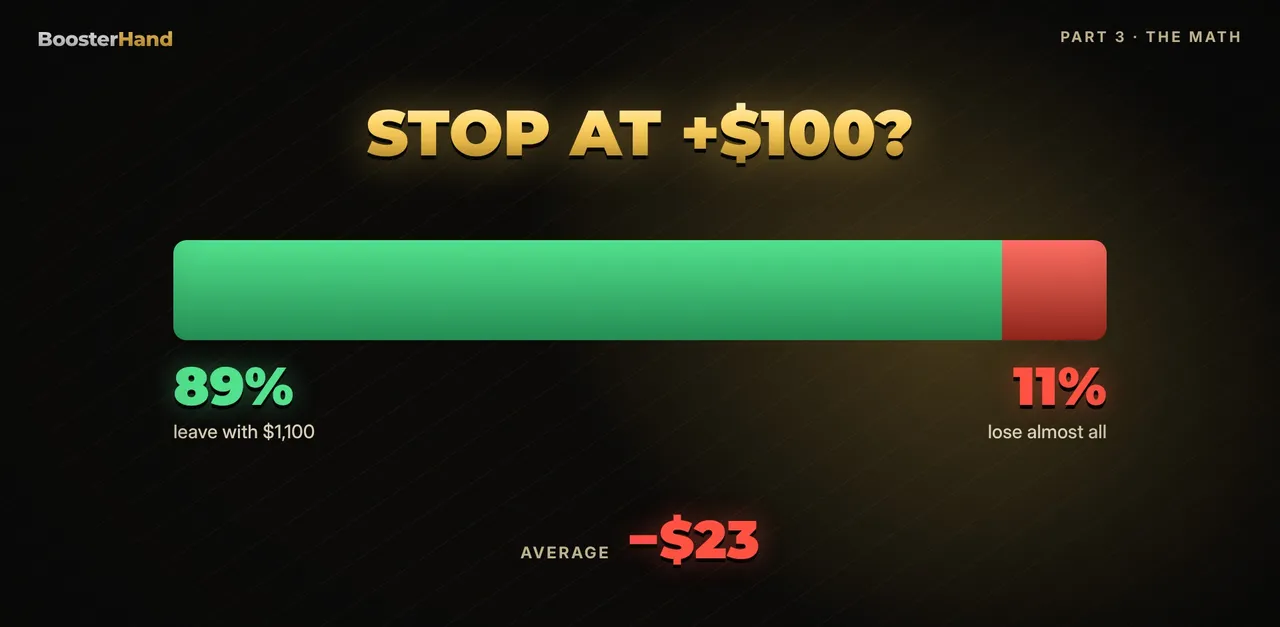
89% hit the goal and walked away happy, $100 up. The other 11% lost almost everything. On average, every player still lost $23. The math still wins. It just hides inside the rare disasters, which is why the strategy gets so many enthusiastic reviews from the people who happened to land in the 89%.
Why casinos have table limits
Table limits exist for a reason. A limit stops the doubling right when you need it most. In our setup, the $1,000 limit means the ladder ends at $640. Even an unlimited bankroll couldn’t take the seventh step.
Now the question from the video: at what step would you stop a Martingale run? After three losses, after five, or never? Tell us in the comments under the video.
What this means for you
Three things to take away from this test:
- A system can change how often you win, not how much the house keeps. Every version we ran landed close to the 2.7% edge.
- A long run of small wins is not proof. It’s the setup for the big loss. 81% of players were up $200+ at some point, and 79% still went broke.
- Never chase losses with bigger bets. That is Martingale, even if you don’t call it that.
One more caveat: this was a model of a European wheel. On an American wheel with a double zero, the house edge is 5.26%, and every number here gets worse. Martingale isn’t the only progression people swear by, so we also tested six others in our betting systems comparison.
If you play, use a fixed budget and stick to it. You must be 18+, and if gambling stops being fun, take a break. Our responsible gambling page lists tools and places to get help.
FAQ
Does the Martingale strategy work?
No. In our simulation of 10,000 roulette players, 79% were broke after 1,000 spins and only 18.8% were ahead. Martingale produces many small wins, but one long losing streak wipes them out.
How many losses in a row can a Martingale bankroll survive?
With a $1,000 bankroll and a $10 base bet, you can survive 6 losses in a row. After 6 losses you are down $630 and the next bet is $640, but you only have $370 left.
How likely is a losing streak of 7 in roulette?
Missing red 7 times in a row on a European wheel is about 1 in 106 on any given spin. Over a 1,000-spin session, our simulation saw a streak of at least 7 in 99% of sessions.
Why do casinos have table limits?
A table limit caps how far you can double. With a $1,000 limit and a $10 base bet, the ladder breaks after $640, so the next doubled bet of $1,280 is not allowed.
Is Martingale safer on European or American roulette?
European is less bad. A European wheel has a 2.7% house edge, while an American wheel with a double zero has 5.26%, which makes every Martingale result worse.
Related
Simulations use generic models, not any real game or casino. Results show long-run math, not predictions for one session. 18+ only. If gambling stops being fun, take a break: responsible gambling.
Next experiment: Betting Systems Tested on 70,000 Players: Which One Fails Fastest?