

BoosterHand Lab · simulation
House Edge Explained: 1,000,000 Slot Spins, Where the Money Went
Updated 2026-10-29 · By BoosterHand Lab · Method: Monte Carlo simulation (Python/NumPy, fixed seed)
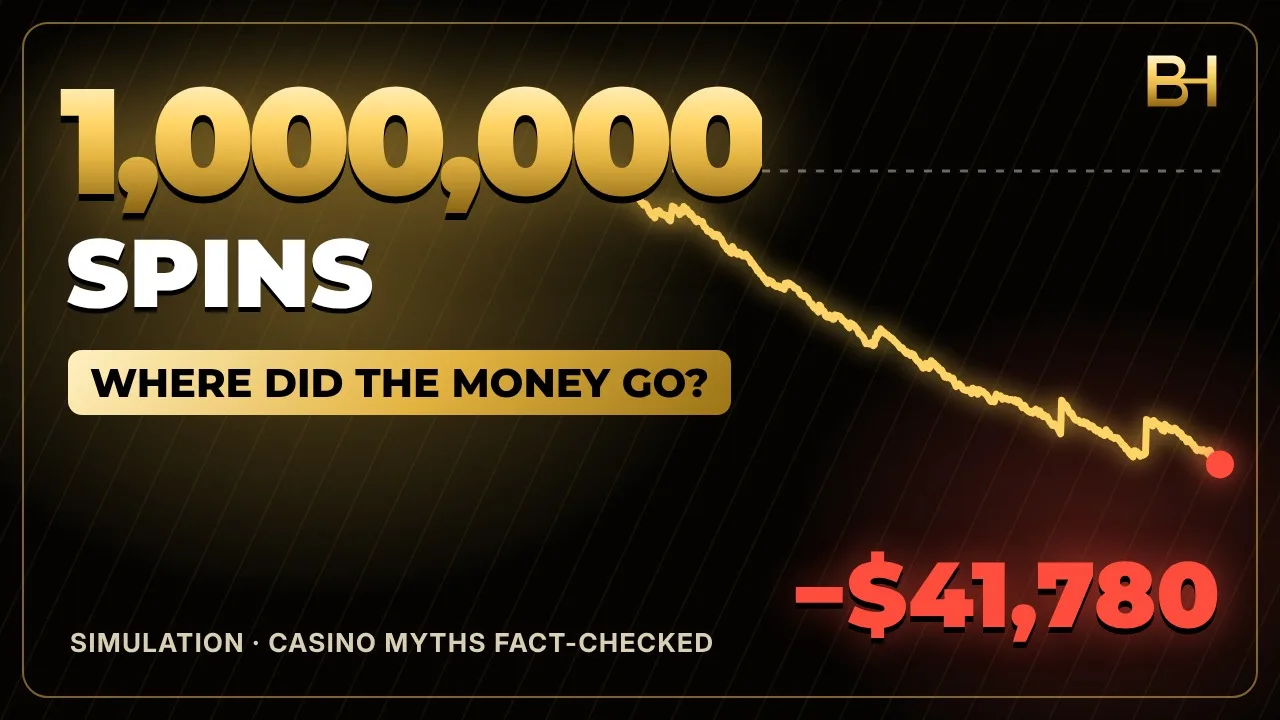
- 1,000,000 spins at $1 on a 96% RTP slot paid back $958,220: a net loss of $41,780 (4.18%), almost exactly the 4% house edge.
- The balance peaked at +$283 on spin 4,027 and never got back there again.
- About 100,000 "wins" paid only half the bet: losses disguised as wins.
- Of 10,000 players with $100 each, 93.6% went broke within 5,000 spins and only 5.5% ended ahead.
- "Quit at +50%" worked for 34% of players, but the average player still lost $22.50 per $100.
- $1,000,000 deposited became over $12,000,000 wagered, and the house kept about $458,000.
I gave a computer one dollar and made it bet that dollar one million times. At one point it was up $283. By the end it had lost $41,780, and that number is the cleanest way to get the house edge explained: not as a theory, but as a bill that arrives on time.
This is the full write-up of the simulation behind our video. We ran one machine for a million spins, then handed $100 to 10,000 simulated players and watched what happened to every one of them.
How we ran the simulation
Everything here comes from a Monte Carlo simulation written in Python with NumPy and a fixed random seed, so the results are reproducible. The slot is a generic model we built in code. It is not a copy of any real game, but it works the way modern video slots work: a pay table, a probability for each outcome, and a random draw on every spin.
The model parameters:
- Bet: $1 per spin
- RTP (return to player): 96%, which means a house edge of 4%
- Hit rate: 37.8% of spins pay something
- Top prize: 5,000x the bet
- Part 1: one machine, 1,000,000 spins
- Part 2: 10,000 players, $100 bankroll each, $1 per spin, playing until 5,000 spins or broke
- Part 3: the same 10,000 players, but each stops at +50% ($150) or at zero
Here is the pay table behind every spin:
| Payout (x bet) | Chance per spin |
|---|---|
| 0x (nothing) | 62.18% |
| 0.5x | 10% |
| 1x (bet back) | 7% |
| 2x | 12% |
| 3x | 4.5% |
| 5x | 2.8% |
| 10x | 1.05% |
| 20x | 0.3% |
| 50x | 0.12% |
| 100x | 0.04% |
| 250x | 0.01% |
| 1,000x | 0.002% |
| 5,000x | 0.0003% |
Be clear on the limits: this is a generic model, not a measurement of any casino. Real games vary, and many run a lower RTP than 96%, which only makes the numbers below worse. Our methodology page explains how we build and check these simulations.
Part 1: one machine, 1,000,000 spins
The first 4,000 spins feel like a winning streak
The first 200 spins go badly. Then things turn: a 20x, a 50x, a 100x hit. By spin 4,027 the balance is up $283. If you were sitting at that screen, it would feel like the machine had warmed up, or that you had figured something out.
You hadn’t. Watch what the line does next.
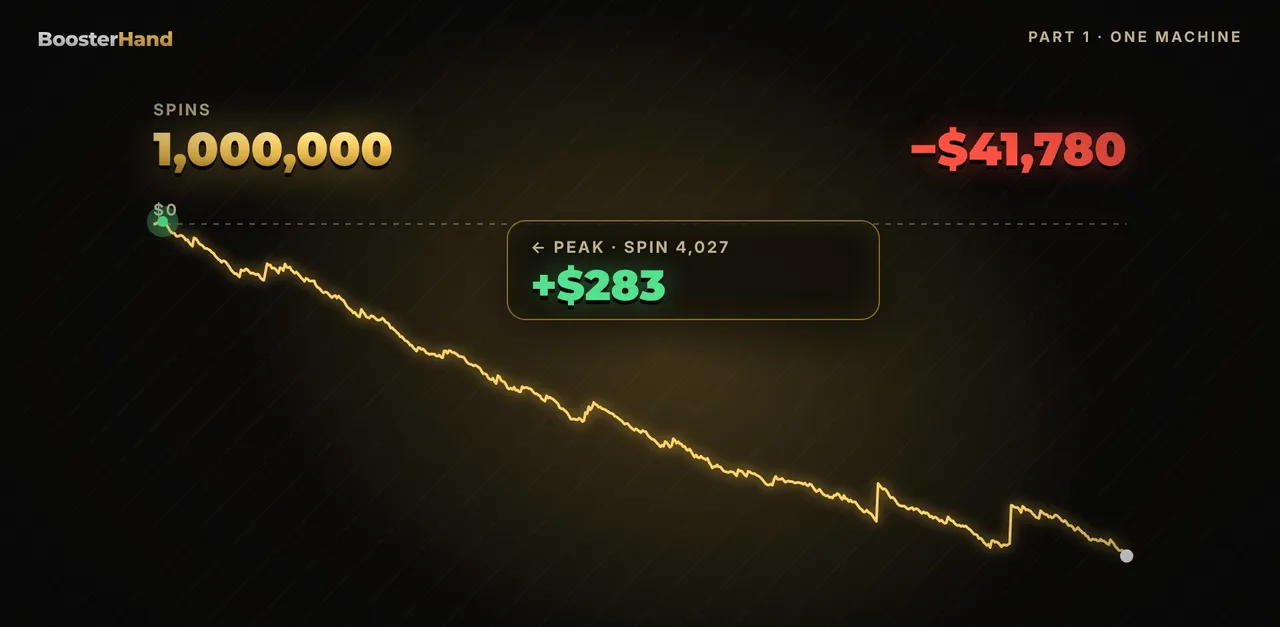
There is noise. There are spikes. But the direction never changes. That peak at spin 4,027 was the high point of the entire million-spin run. The balance never got back there again.
The final bill: $41,780
After one million spins, the machine had taken in $1,000,000 and paid back $958,220. Net loss: $41,780, or 4.18% of everything wagered.
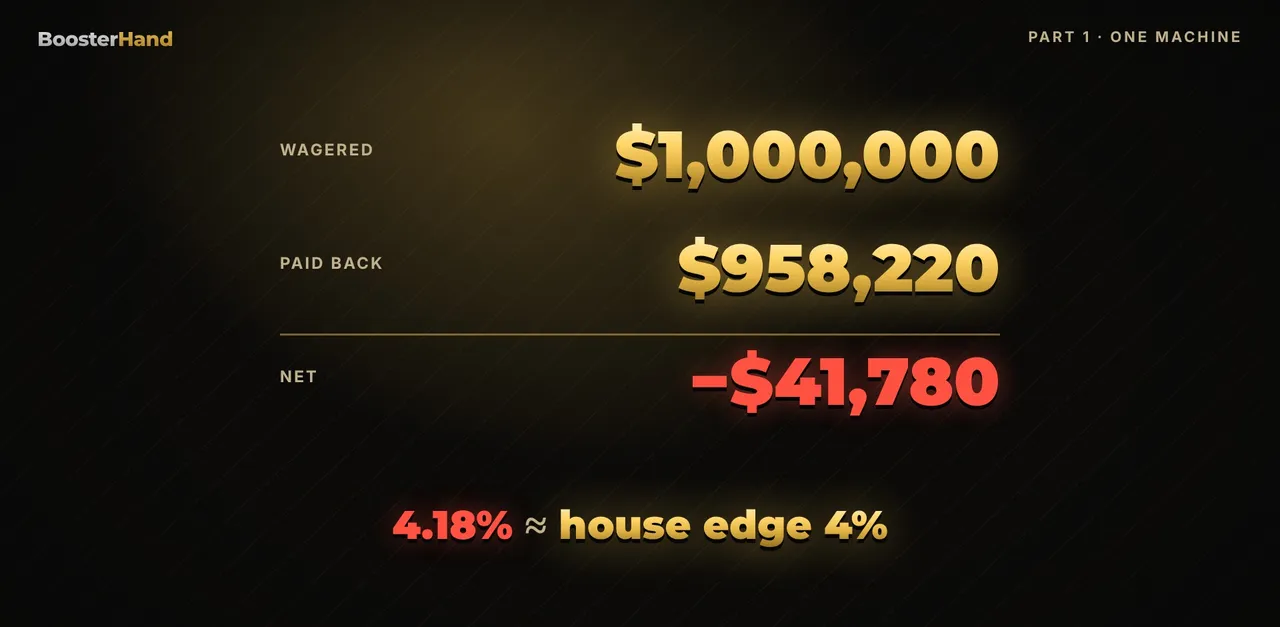
That is almost exactly the house edge. The math didn’t care about the lucky start. It just waited. And a million spins isn’t as absurd as it sounds: at one spin every three seconds, that’s about 830 hours, or three hours a night for about nine months.
Losses disguised as wins
Here is the first trick of slot design. Out of 1,000,000 spins, the machine flashed a win 377,918 times. Yet only 208,019 spins actually paid more than the bet. About 100,000 of those “wins” (100,222, to be exact) paid only half the stake. You lose 50 cents and the screen celebrates.
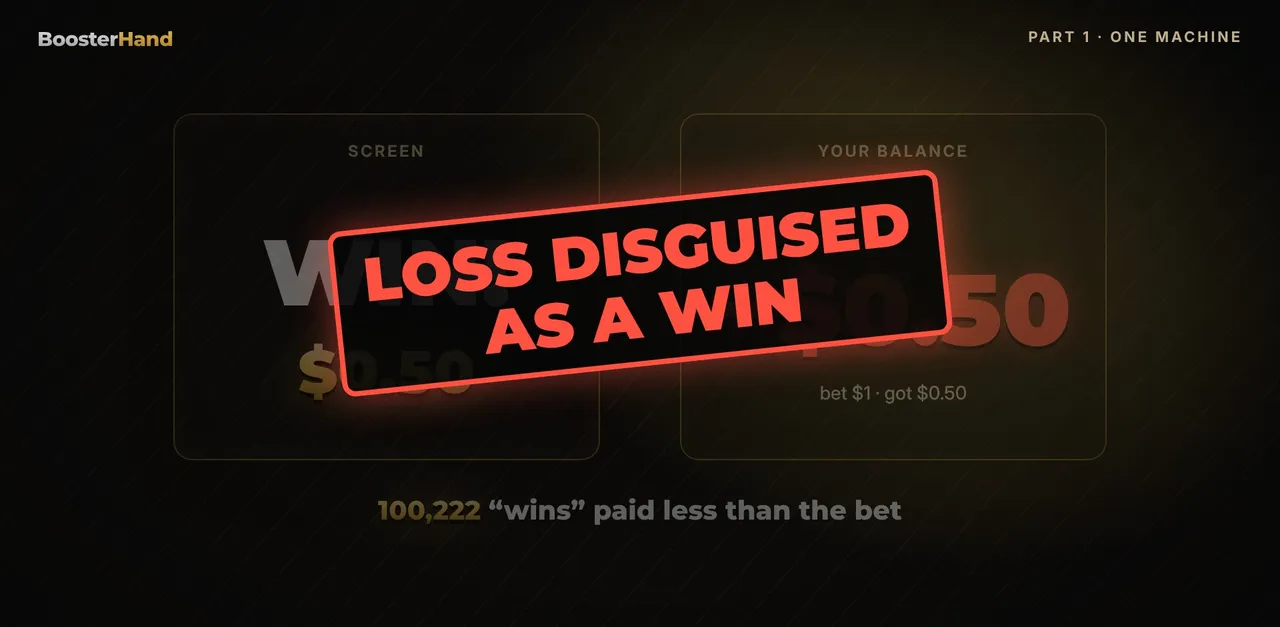
Researchers call this a loss disguised as a win. Your brain hears the jingle. Your balance just went down.
Did the jackpots help?
They hit. The 5,000x top prize landed twice. That’s the kind of clip people share online. And the machine still lost $41,780.
| Win size | Times hit in 1,000,000 spins |
|---|---|
| 20x | 3,069 |
| 50x | 1,217 |
| 100x | 410 |
| 250x | 98 |
| 1,000x | 22 |
| 5,000x | 2 |
Big wins don’t beat the house edge. They are part of it. Every one of those payouts is already priced into the 96% RTP, which is why a high-volatility game can feel generous and still cost you the same 4% over time. If you want to see how that plays out with different payout shapes, read our slot volatility simulation.
Part 2: 10,000 players, $100 each
One machine is one story. So we made it 10,000 stories. Each player deposits $100 and bets $1 a spin until they hit 5,000 spins or run out of money.
Before you scroll: out of those 10,000 players, how many do you think ended up ahead? Make your guess, then drop it in the comments under the video.
Here is what the snapshots looked like:
| After spins | Players ahead | Players still alive | Median balance |
|---|---|---|---|
| 10 | 26.4% | 100% | $97 |
| 100 | 26.8% | 100% | $82.50 |
| 250 | 27.2% | 97.5% | $66 |
| 500 | 25.2% | 65.7% | $40 |
| 1,000 | 19.3% | 34.9% | $0.50 |
| 2,000 | 12.5% | 16.7% | $0.50 |
| 5,000 | 5.5% | 6.4% | $0.50 |
After 10 spins, about one in four players is ahead. After 100 spins, 27% are still winning and nobody is broke. This is the fun part. After 500 spins, a third of players are out. After 1,000 spins, 65% are broke and the median player has nothing left.
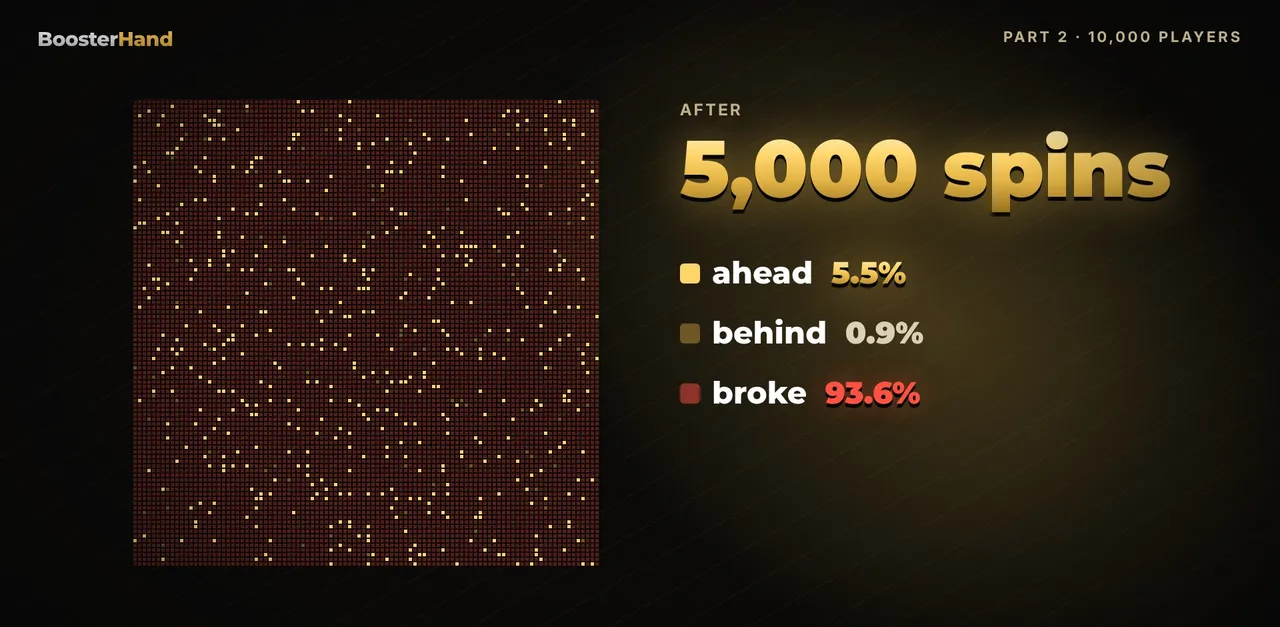
And the answer to the question: at 5,000 spins, 93.6% of players were busted and only 5.5% walked away ahead. If you guessed higher, you’re in good company. Most people do.
The typical player’s $100 lasted 692 spins. At three seconds a spin, that’s about 35 minutes. Our bankroll calculator lets you run the same kind of estimate with your own bet size and RTP.
The early winner’s trap
This is the part that matters most. At spin 100, 2,684 players were winning. They felt lucky. Some felt smart. By the end, only about one in ten of them (9.5%) was still ahead.
Being up early didn’t mean they were good at it. It meant they hadn’t played long enough yet. Along the way, 33% of all players were up 50% at some point and 20% doubled their money at some point. Only 4.6% finished with double.
Part 3: does “quit while you’re ahead” beat the house edge?
The classic advice says lock in a profit and leave. So we ran it again: every player stops the moment they reach $150 (+50%) or hits zero.
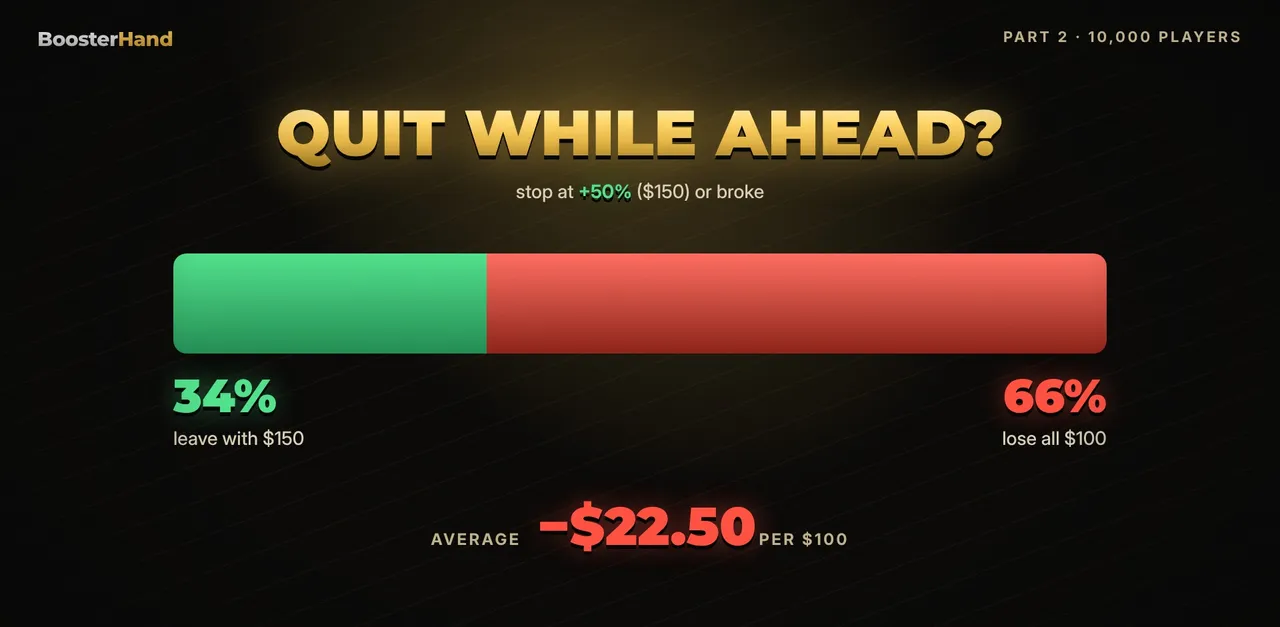
The result: 34% leave happy with $150. The other 66% lose everything. On average, each player ends with $77.50, a loss of $22.50 per $100. A stop-win changes how a session feels. It can’t change the edge underneath it. Betting systems run into the same wall, as our Martingale strategy test shows.
Where did the money go?
The 10,000 players deposited $1,000,000 in total. But they didn’t bet $1,000,000. They bet more than $12,000,000. The average player wagered $1,233 from a $100 deposit, because wins go straight back into the balance and get bet again. Each $100 went around about twelve times.
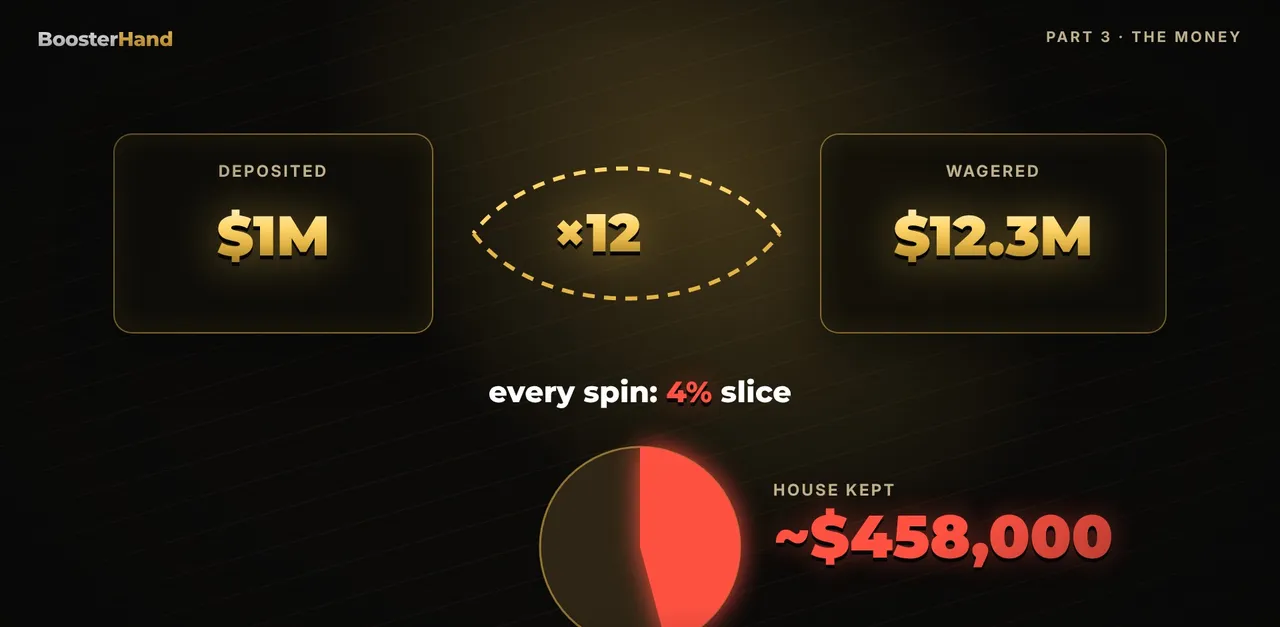
Every time, the 4% edge took its small slice. At the end, players held $542,251 between them. The house kept about $458,000, nearly half of everything deposited. No cheating. No rigged reels. Just 4%, again and again.
This is the key point of the whole experiment, and why “4%” sounds small but isn’t: the house edge applies to money wagered, not money deposited. Our RTP simulation digs into that difference in more detail.
The one number that decides everything
It isn’t the jackpot. It isn’t even the RTP. It’s the number of spins. The longer you play, the closer your results get to the house edge. Over 100 spins, a quarter of players are ahead. Over 5,000 spins, almost nobody is. Time is the casino’s best friend.
What this means for you
If you gamble, here are three rules straight from the simulation:
- Treat it as paid entertainment. Your budget is a ticket price, not an investment. Expect it to be spent.
- Wins are not signals. An early win doesn’t mean you’re on a streak. Nine out of ten early winners in this test gave it back.
- Set a time limit, not just a money limit. The thing that hurts you is the number of spins, so cap the session length before you start.
Our responsible gambling page covers deposit limits, cool-off tools and where to get help. You must be 18+ to gamble, and if it stops being fun, take a break.
FAQ
What is the house edge on a slot machine?
The house edge is the share of every bet the game keeps over the long run. On a 96% RTP slot, the house edge is 4%, so every $100 wagered pays back about $96 on average over a huge number of spins.
Is the house edge the same as RTP?
They are two sides of the same number. RTP is what the game pays back, and the house edge is what it keeps: 96% RTP means a 4% house edge.
Can you beat the house edge on slots?
Not over time. In our simulation, 1,000,000 spins lost 4.18% of everything wagered, even though the 5,000x top prize hit twice. Short-term winners exist, but the longer you play, the closer your result gets to the edge.
Does quitting while you're ahead work?
It changes how a session feels, not the math. When 10,000 simulated players stopped at +50%, 34% left with $150, 66% lost everything, and the average player still lost $22.50 per $100.
What is a loss disguised as a win?
It is a spin that triggers a win animation but pays less than you bet. In our 1,000,000-spin test, about 100,000 spins paid half the stake while the screen celebrated.
Related
Simulations use generic models, not any real game or casino. Results show long-run math, not predictions for one session. 18+ only. If gambling stops being fun, take a break: responsible gambling.
Next experiment: Martingale Strategy Tested on 10,000 Players: Does It Really Work?