

BoosterHand Lab · simulation
European vs American Roulette: Why One Extra Zero Costs You Double
Updated 2026-10-31 · By BoosterHand Lab · Method: Monte Carlo simulation (Python/NumPy, fixed seed)
- House edge: 2.70% on a European wheel (37 pockets), 5.26% on an American wheel (38 pockets), 7.69% on a triple-zero wheel.
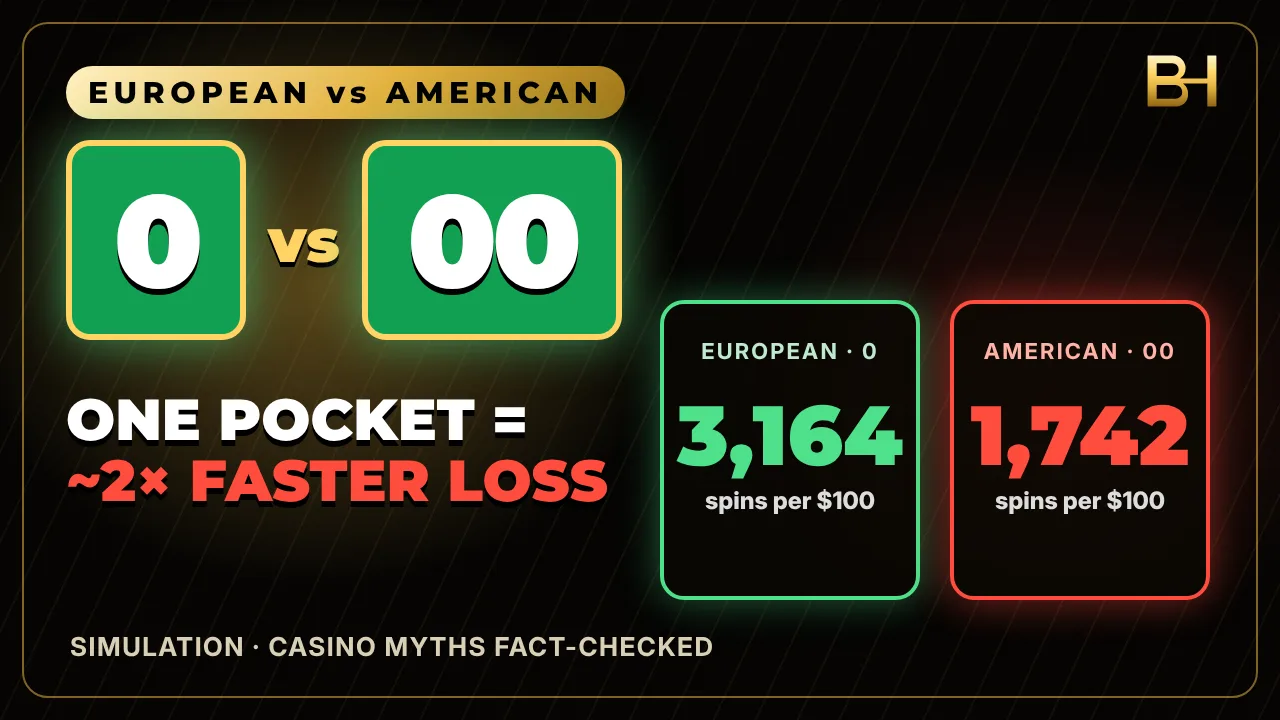
- Betting $1 on red until broke, the typical $100 lasted 3,164 spins in Europe, 1,742 in America and 1,230 on triple zero.
- After 1,000 spins, 18% of European players were ahead, versus 4.6% of American players and 0.7% on triple zero.
- Broke after 1,000 spins: 1.8% European, 9% American, 28% triple zero.
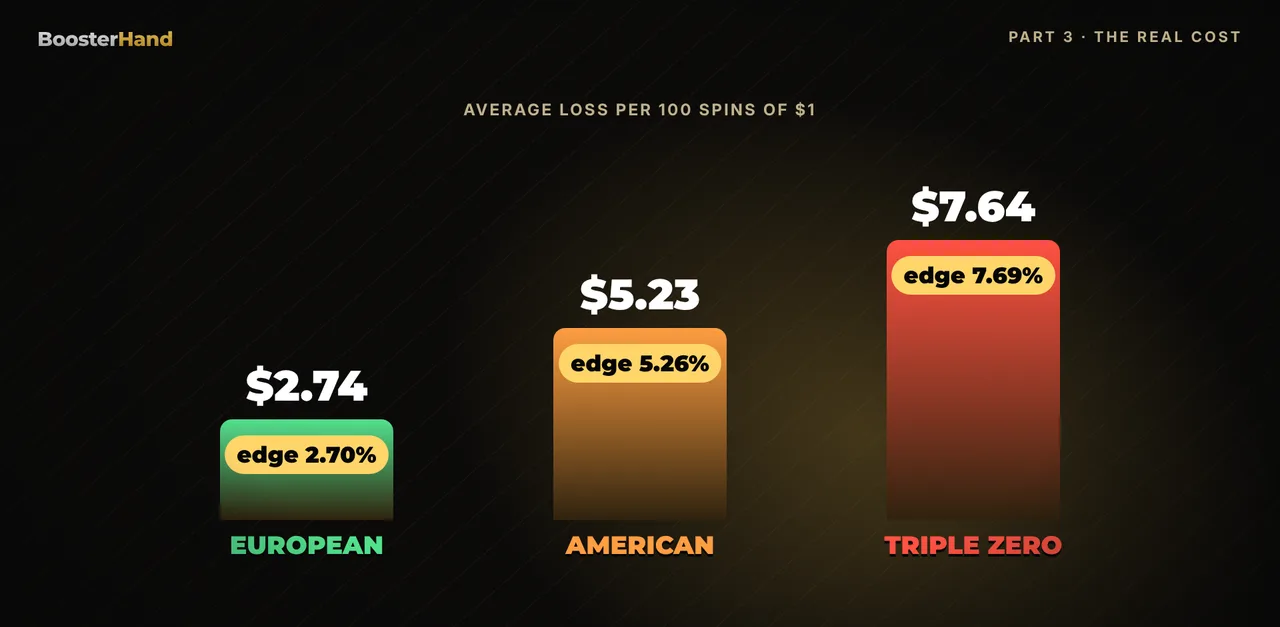
- Average loss per 100 spins of $1: $2.74 European, $5.23 American, $7.64 triple zero, almost exactly the house edge.
Same $100. Same $1 bet on red, every spin. On one roulette wheel, the typical player’s money lasted over 3,000 spins. On the other, about 1,700. The difference between European vs American roulette comes down to one tiny green pocket, and in this article I’ll show you exactly how much that pocket costs, with 10,000 simulated players on each wheel.
If you’ve ever wondered why people say “always play the single-zero wheel”, this is roulette odds explained with real numbers instead of folklore.
European vs American roulette: the wheels
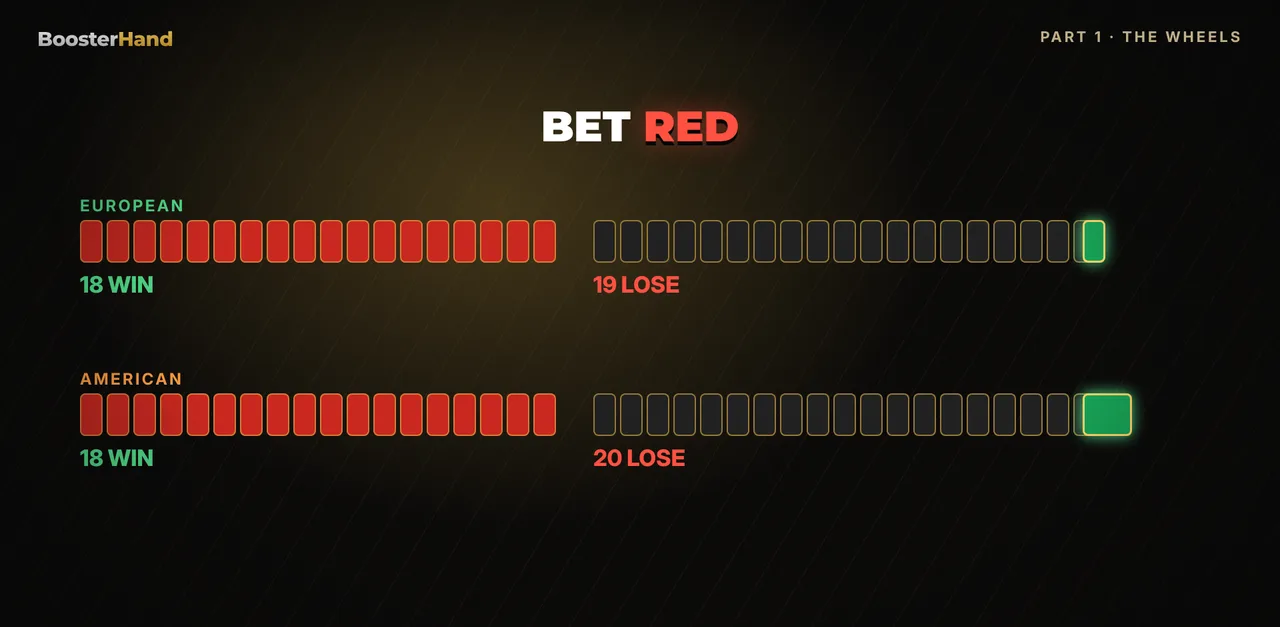
A European wheel has 37 pockets: 18 red, 18 black and one green zero.
An American wheel keeps all of that and adds a second green pocket, the double zero. That makes 38.
Now bet on red. On both wheels you have 18 ways to win. But in Europe you have 19 ways to lose (18 black plus the zero), and in America you have 20 (18 black plus 0 and 00). Your chance of hitting red drops from about 48.6% to about 47.4%. It looks like a rounding difference. It isn’t.
Roulette odds explained: why the zero is the whole edge
The cleanest way to see the house edge is a single-number bet. Put $1 on one number. If it hits, it pays 35 to 1.
If the wheel had only the 36 numbers, that payout would be perfectly fair. You’d lose 35 times, win once, and break even over time.
But the zero is there. So the true odds on a single number are 36 to 1 on a European wheel and 37 to 1 on an American wheel. The casino still pays 35 to 1, as if the zero didn’t exist. That gap between what the bet pays and what it should pay is the house edge:
| Wheel | Pockets | Single number true odds | Payout | House edge |
|---|---|---|---|---|
| European (single zero) | 37 | 36 to 1 | 35 to 1 | 2.70% |
| American (double zero) | 38 | 37 to 1 | 35 to 1 | 5.26% |
| Triple zero (bonus) | 39 | 38 to 1 | 35 to 1 | 7.69% |
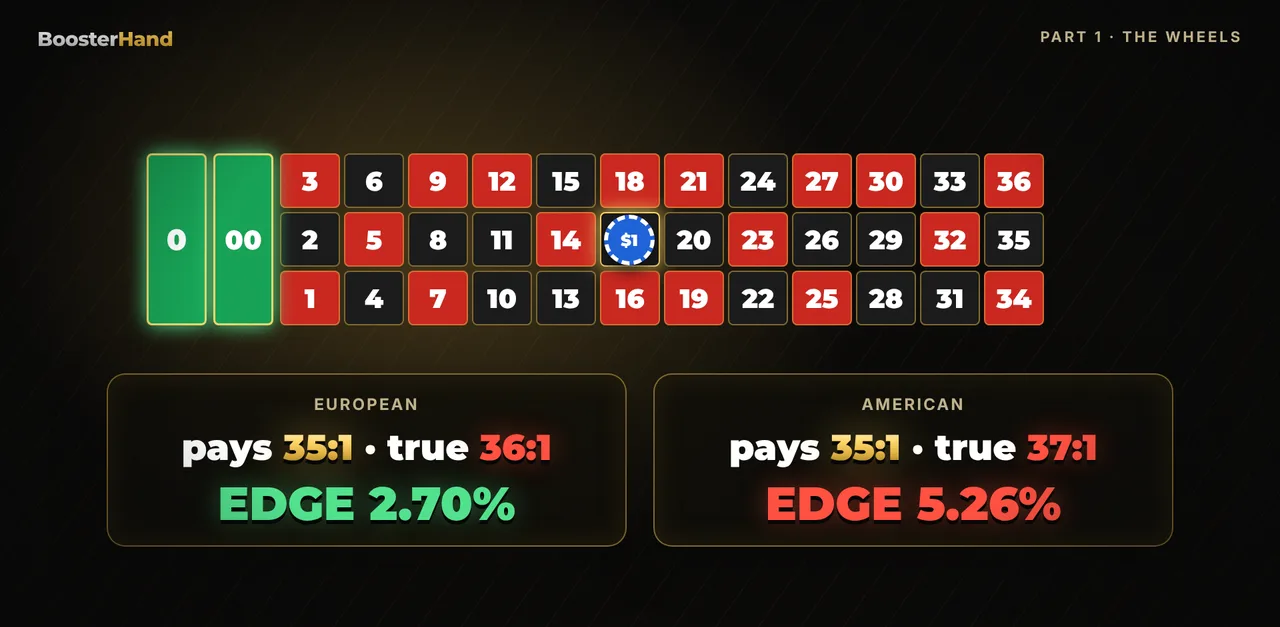
Here’s the part people miss: red works the same way. Red pays 1 to 1, which would be fair if half the pockets were red. They aren’t, because the zero steals a slice. On a European wheel, betting red carries the same 2.70% edge as betting a single number. On an American wheel, both carry 5.26%. The bet type changes how bumpy the ride is, not what it costs.
One more thing worth noticing: adding a single pocket almost doubles the edge, from 2.70% to 5.26%. That’s the claim the simulation puts to the test.
How we ran the simulation
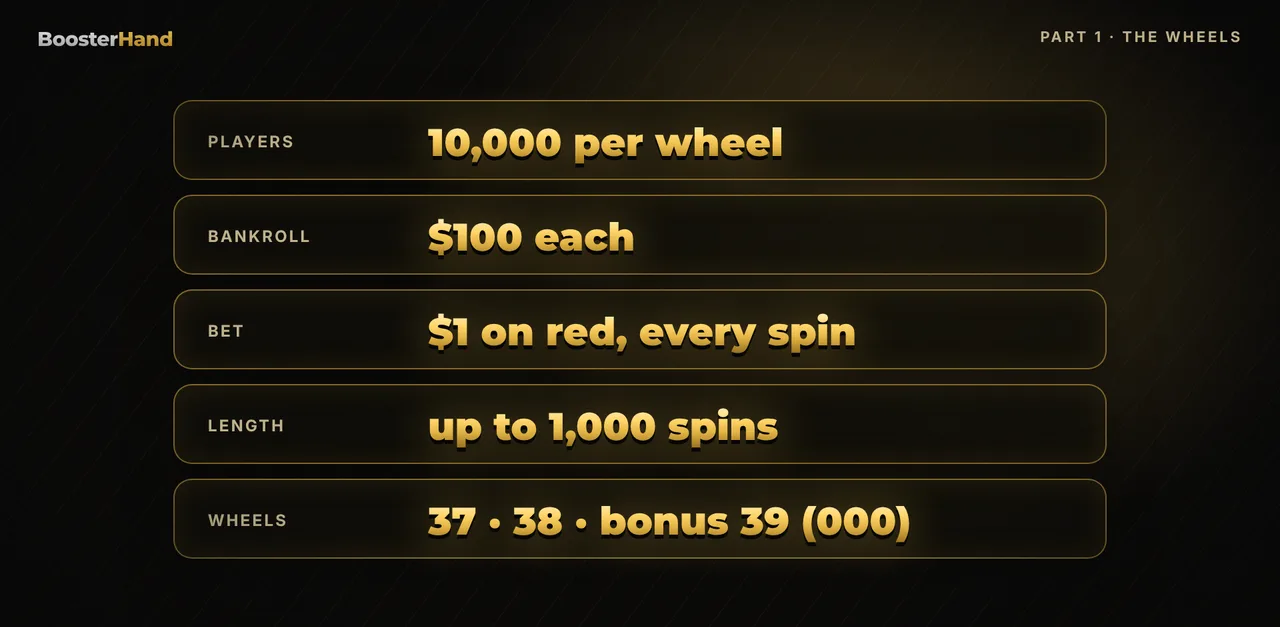
This is a generic model of fair roulette wheels, not data from any real casino. The setup:
- Wheels: European (37 pockets), American (38 pockets), plus a bonus triple-zero wheel (39 pockets) to show where the trend goes
- Players: 10,000 per wheel
- Bankroll: $100 each
- Bet: flat $1 on red every spin (even money, 18 winning pockets)
- Main test: up to 1,000 spins, with snapshots at 100, 300, 500 and 1,000 spins
- Extension: the same players kept going (up to a cap of 50,000 spins) to measure how long the typical $100 lasted. Every player on every wheel went broke before the cap.
- Method: Monte Carlo simulation in Python (NumPy), fixed random seed for reproducibility
It’s deliberately simple: flat bets, a perfectly fair wheel, no special table rules. Real tables can differ, but the core math of the zero applies to every one of them.
Before the results, make a guess. One extra pocket: does it eat your money a little faster, or twice as fast? Hold that thought.
The results: who’s ahead and who’s broke
After 100 spins, nobody on any wheel was broke. That’s expected: you’d need to lose 100 more bets than you win. But the gap in who was ahead was already visible.
| After… | European ahead | American ahead | Triple zero ahead |
|---|---|---|---|
| 100 spins | 36% | 27% | 19% |
| 300 spins | 30% | 17% | 8% |
| 500 spins | 26% | 11% | 4% |
| 1,000 spins | 18% | 4.6% | 0.7% |
After 1,000 spins, nearly one in five European players was still up. On the American wheel it was under one in twenty. On triple zero, fewer than one in a hundred.
Meanwhile the broke pile grew. After 1,000 spins, 1.8% of European players had lost the full $100. On the American wheel it was 9%, five times as many. On triple zero, 28%.
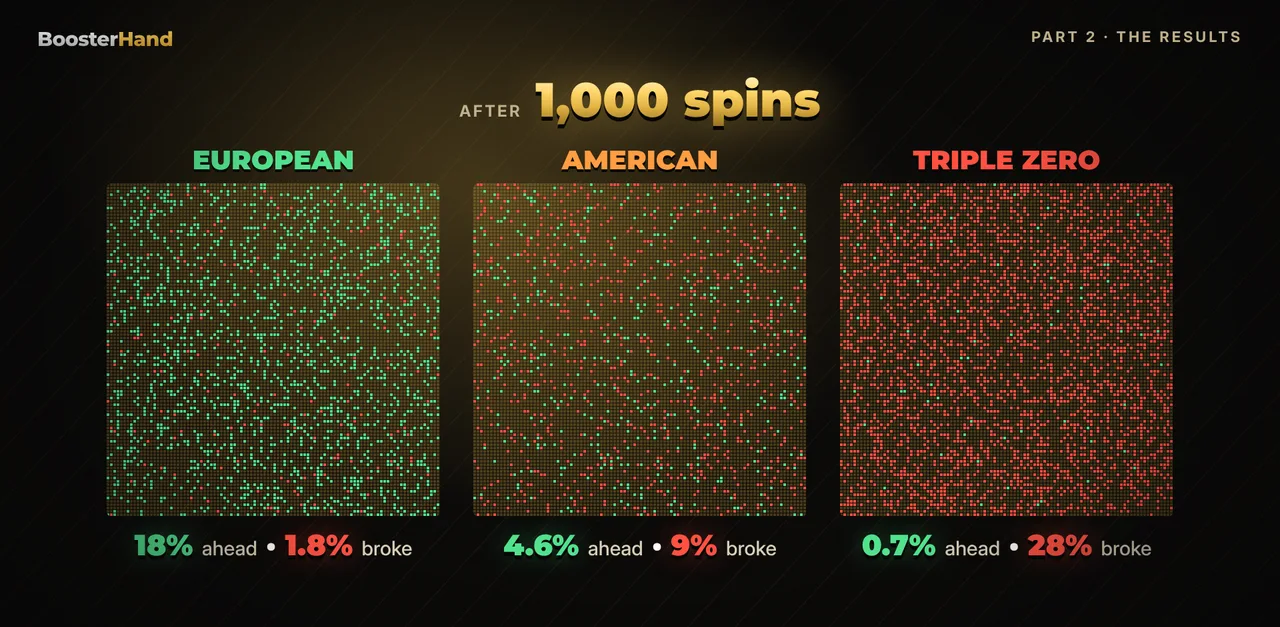
Notice how nonlinear that is. The edge roughly doubles from Europe to America, but the bust rate at 1,000 spins goes up about fivefold. Small differences in edge compound into big differences in outcomes once enough spins pile up.
How long $100 lasted on each wheel
Then I let every player keep going until the money ran out. The typical player (the median) lasted:
- European: 3,164 spins
- American: 1,742 spins
- Triple zero: 1,230 spins
So, back to your guess. One extra pocket, and your money disappears almost twice as fast. Not a little faster. Nearly double.
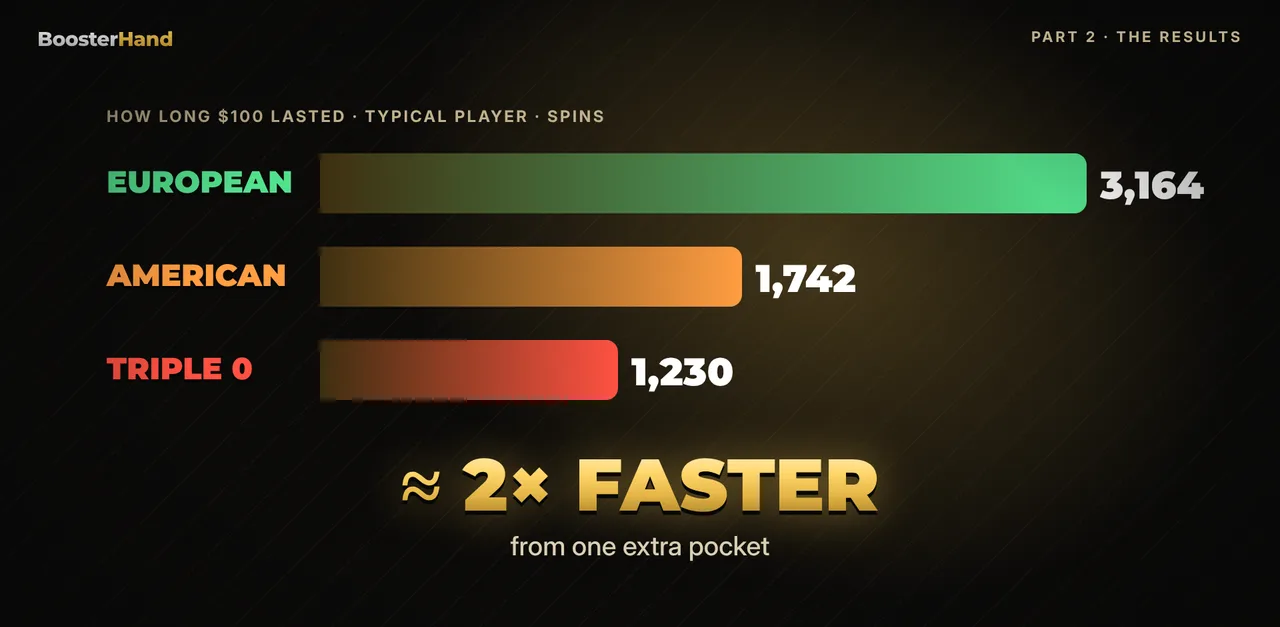
And note that every single player eventually went broke on every wheel. The European wheel didn’t let people win. It just made the money last longer. That’s the honest way to think about a lower house edge: it buys you time, not profit. If you want to estimate this for your own bets and pace, our bankroll calculator does exactly that.
The real cost per 100 spins
Here’s where the math lines up almost perfectly. For every 100 spins of $1, the average loss was:
| Wheel | House edge | Simulated loss per 100 spins of $1 |
|---|---|---|
| European | 2.70% | $2.74 |
| American | 5.26% | $5.23 |
| Triple zero | 7.69% | $7.64 |
That’s almost exactly the house edge. Over enough spins, the math always shows up. Individual players bounced around, some up, some down, but across 10,000 of them the losses landed within a few cents of the theory. We saw the same pattern with slots in our house edge test of 1 million slot spins: the house edge is simply RTP seen from the other side.
What’s left after 1,000 spins
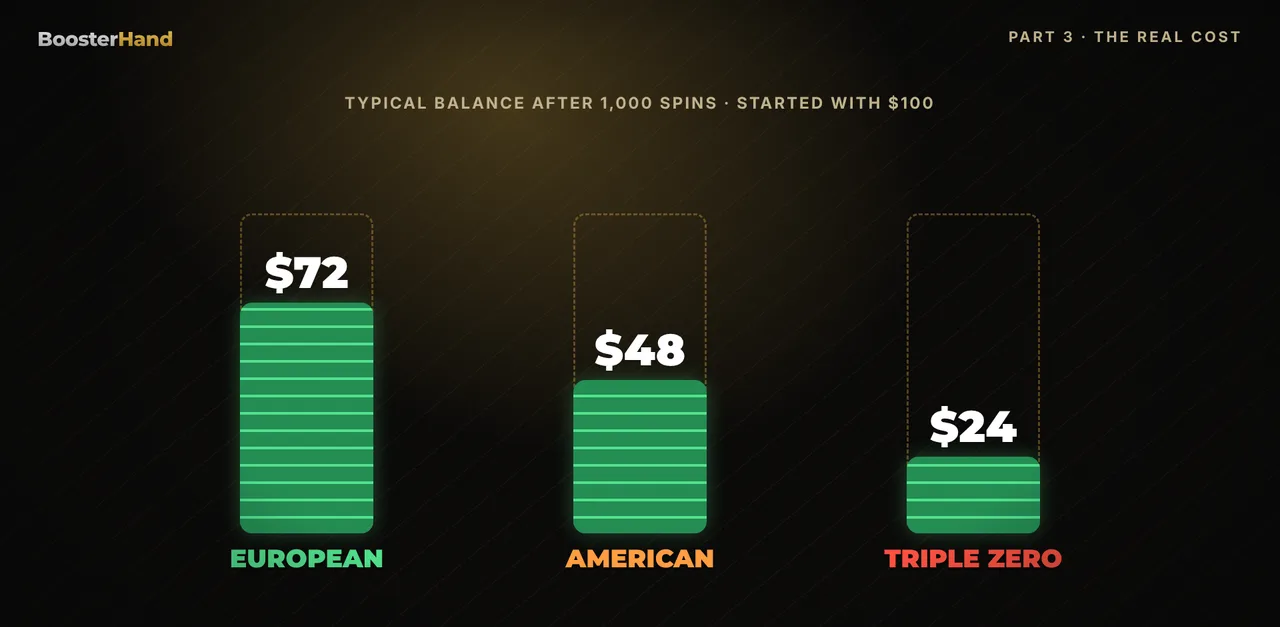
Another way to see it: the typical (median) balance after 1,000 spins.
| Wheel | Median balance after 100 spins | After 500 spins | After 1,000 spins |
|---|---|---|---|
| European | $98 | $86 | $72 |
| American | $94 | $74 | $48 |
| Triple zero | $92 | $62 | $24 |
After 100 spins, the three wheels look almost the same. That’s why the difference is easy to ignore in a short session. After 1,000 spins, the typical European player still had $72. The American player had $48. Triple zero, just $24.
Three takeaways
- The zero is the whole edge. Roulette payouts are set as if the zero isn’t there. Every bit of the casino’s advantage comes from that gap.
- A double zero almost doubles the edge. From 2.70% to 5.26%, and in the simulation the typical bankroll went almost twice as fast.
- No bet escapes the zero. Red, black or a single number, the edge is the same on a given wheel. Betting systems don’t change that either, as our test of 7 betting systems on 70,000 players showed.
The same logic sinks the classic “red is due” idea. The zero applies to every spin regardless of what came before, which we tested in 1,000,000 roulette spins on the gambler’s fallacy.
Your turn: can you explain in one sentence why the zero matters? Try it in the comments.
What this means for you
Roulette is a game of pure chance with a fixed price, and that price is set by the number of green pockets. A few practical points:
- Know which wheel you’re looking at. A 0 and a 00 on the layout means 38 pockets and a 5.26% edge. A single 0 means 37 pockets and 2.70%. That one detail decides how fast a budget drains.
- Lower edge means slower losses, not wins. In this simulation every player on every wheel eventually went broke. The European wheel just took longer. Treat the difference as a cheaper price for entertainment, not as an opportunity.
- Short sessions hide the cost. After 100 spins the median balances were $98, $94 and $92. The gap only becomes obvious over hundreds of spins, which is exactly when many players stop paying attention.
- Decide your budget first. Pick an amount you’re comfortable losing entirely, and stop when it’s gone. Don’t increase bets to “win it back”.
If gambling stops feeling like fun, take a break. Our responsible gambling page has tools and support.
Next in the Lab: crash game math, and when you should cash out. Read the crash game cash-out strategy simulation.
FAQ
What is the difference between European and American roulette?
A European wheel has 37 pockets with a single green zero. An American wheel adds a double zero for 38 pockets. The payouts stay the same, so the American house edge is 5.26% versus 2.70% in Europe.
Which roulette has better odds, European or American?
European roulette. In our simulation of 10,000 players per wheel, the typical $100 lasted 3,164 spins on European roulette and only 1,742 on American roulette, betting $1 on red every spin.
Why does the zero give the casino an edge in roulette?
A single number pays 35 to 1, which would be fair if there were only 36 numbers. The zero (or zeros) adds pockets that aren't paid for, so the true odds are 36 to 1 in Europe and 37 to 1 in America. That gap is the house edge.
What are the odds of hitting red in roulette?
On a European wheel, 18 of 37 pockets are red, about 48.6%. On an American wheel it's 18 of 38, about 47.4%. The green pockets are why it's never 50%.
Is there a roulette bet that avoids the house edge?
No. Red, black or a single number all carry the same edge on a given wheel: 2.70% on European and 5.26% on American. No bet escapes the zero.
Related
Simulations use generic models, not any real game or casino. Results show long-run math, not predictions for one session. 18+ only. If gambling stops being fun, take a break: responsible gambling.
Next experiment: Crash Game Strategy: When Should You Cash Out? 60,000 Players Tested