

BoosterHand Lab · simulation
Blackjack Basic Strategy vs Gut Feeling: 1 Million Hands Simulated
Updated 2026-10-31 · By BoosterHand Lab · Method: Monte Carlo simulation (Python/NumPy, fixed seed)
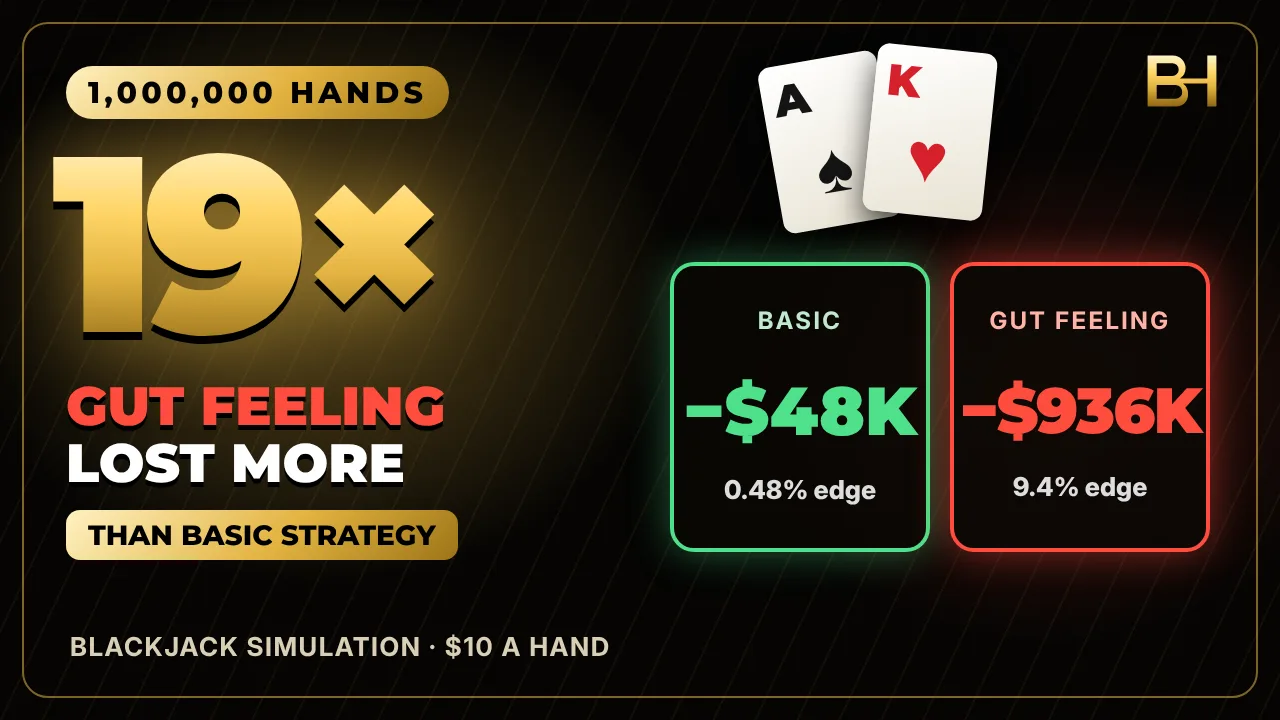
- Perfect blackjack basic strategy still lost $48,250 over 1,000,000 hands at $10 a hand: a 0.48% house edge.
- Gut feeling (follows the chart 70% of the time on judgment calls) lost $936,210: a 9.4% edge, about 19x more.
- Mimic the dealer lost 5.7% ($57 per 100 hands) and busted on 27 of every 100 hands. Never bust lost 6.2% ($62 per 100 hands).
- Basic strategy was ahead after 10,000 hands, but after about 60,000 hands it was never ahead again.
- In 100-hand sessions, basic strategy finished ahead 47% of the time. Gut feeling: under 19%.
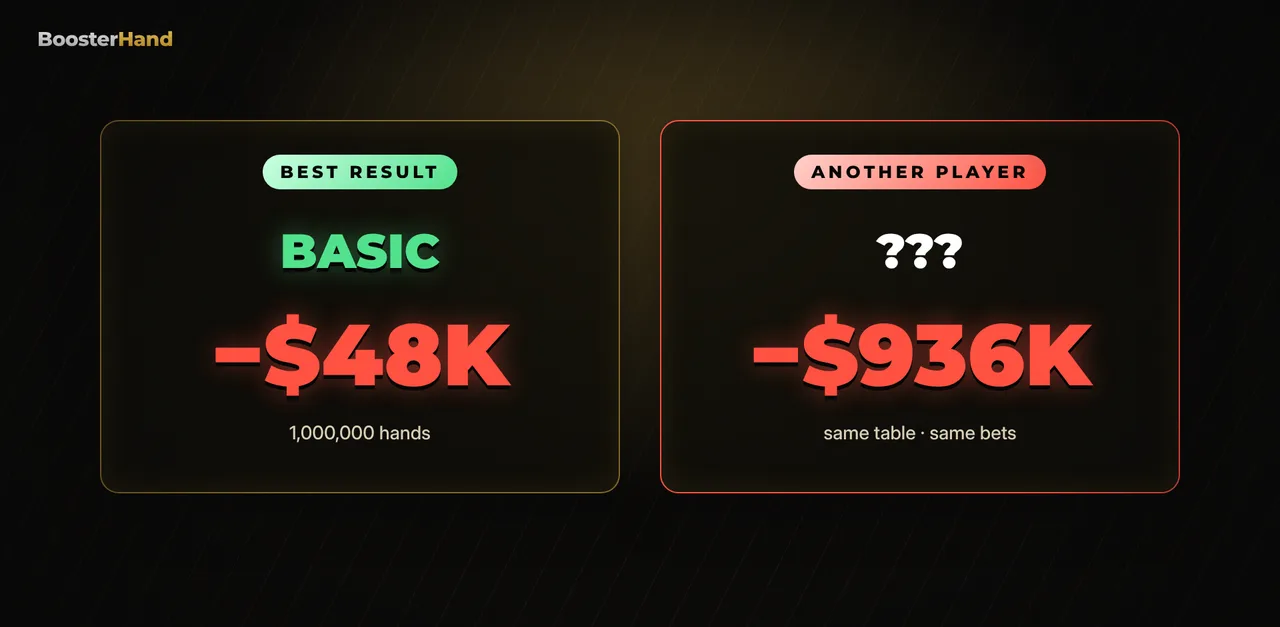
Perfect blackjack basic strategy, one million hands, $10 a hand. It still lost $48,250. And that was the best result at the table: a player going with their gut lost $936,210 playing the exact same game.
I simulated four players with four different approaches to see how much basic strategy really saves you, and how much a few “I just have a feeling” decisions cost.
The table: one set of blackjack rules for everyone
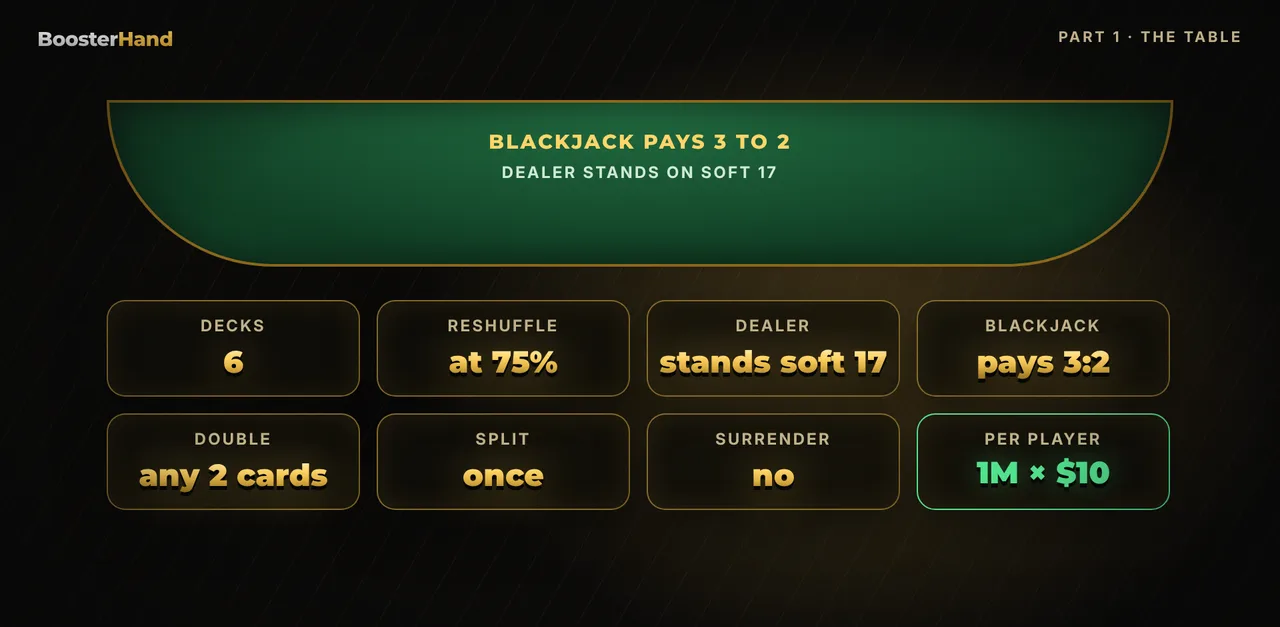
Every player sat at the same generic table, with rules that are fairly friendly to the player:
- 6 decks, reshuffled after 75% of the shoe is dealt
- Dealer stands on soft 17 and peeks for blackjack
- Blackjack pays 3:2
- Double on any first two cards, double after split allowed
- Split once (no resplitting), split aces get one card each
- No surrender
Each player got 1,000,000 hands at a flat $10 per hand.
Four players, four strategies
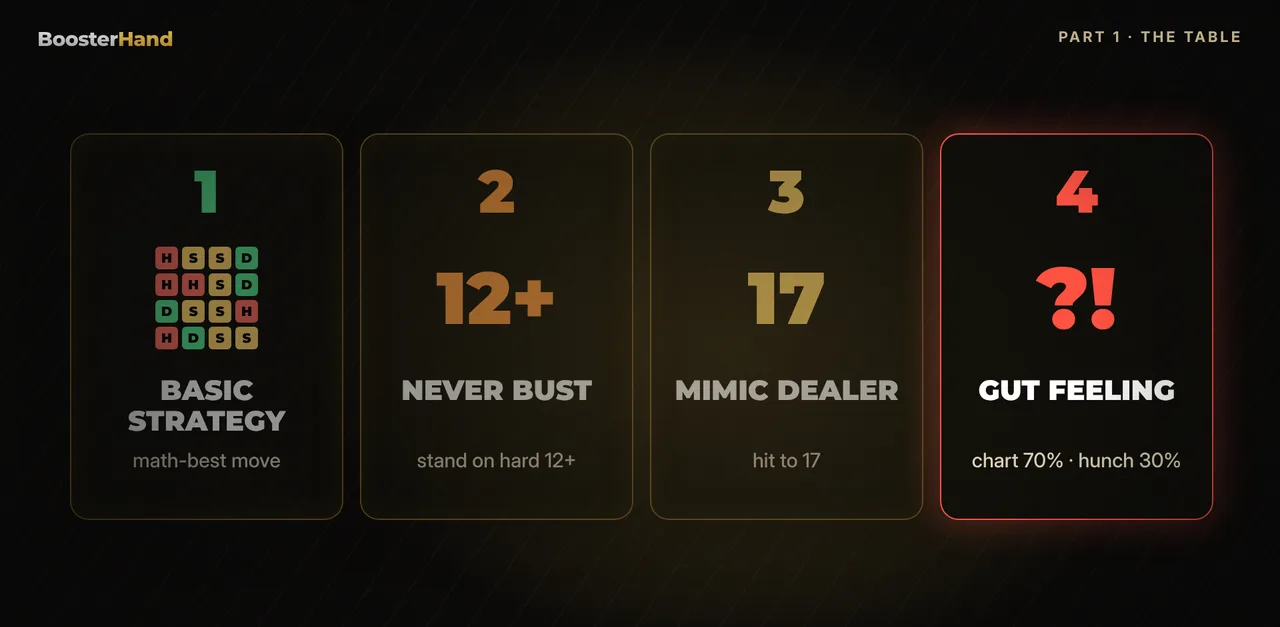
Here’s exactly how each simulated player decides. These are simple, mechanical models, so it’s worth being precise about what they do and don’t do.
- Basic strategy. Plays the mathematically best move for every hand on these rules: the standard chart for when to hit, stand, double and split.
- Never bust. Never takes a card that could bust them: stands on any hard 12 or more. Soft hands (which can’t bust) hit until soft 18. No doubles, no splits.
- Mimic the dealer. Plays like the house: hits until 17, stands on 17 or more (including soft 17). No doubles, no splits.
- Gut feeling. Starts from the basic strategy chart. On obvious hands (hard 8 or less, hard 17 or more, soft 19 or more) it always follows the chart, because nobody hits a hard 20 on a hunch. On judgment calls (hard 9 to 16, soft 13 to 18, and any pair), it follows the chart 70% of the time. The other 30% it goes with a hunch: hit instead of stand, stand instead of hit, or skip a correct double or split and just hit or stand. In the run, 30.1% of its judgment calls were hunches.
Note that the gut feeling player is not a wild gambler. It plays the correct move on every easy hand and on most hard ones. It just second-guesses itself on roughly three judgment calls in ten.
Before you scroll: who wins more over 1M hands, basic strategy or gut feeling? Guess the gap. Put your number in the comments, then check it below.
How we ran the simulation
This is a generic model, not a copy of any real casino’s game:
- Players: 4 strategies, 1,000,000 hands each
- Bet: flat $10 per hand (doubles and splits add a second $10)
- Rules: as listed above (6 decks, 75% penetration, S17, peek, 3:2, double any two, double after split, split once, split aces one card, no surrender)
- Bankroll: unlimited, so we could measure the long-run result without anyone going broke
- Measurement: result per hand, the running bankroll every 10,000 hands, and the share of 100-hand sessions that finished ahead
- Method: Monte Carlo simulation in Python (NumPy), with a fixed random seed per strategy for reproducibility
The house edge here is the average loss per hand as a share of the initial $10 bet. Even at a million hands, there’s a margin of error of about ±0.2 percentage points on each number. That’s tiny next to the gaps between strategies, but it’s why the basic strategy result reads “about half a percent” rather than an exact figure.
This test is about decision-making only. It doesn’t model card counting, side bets or any betting system.
The results: blackjack basic strategy vs the rest
| Strategy | House edge | Lost per 100 hands | Total over 1M hands | Hands won | Hands lost | Pushes |
|---|---|---|---|---|---|---|
| Basic strategy | 0.48% | $4.83 | −$48,250 | 43.4% | 47.9% | 8.8% |
| Mimic the dealer | 5.7% | $56.68 | −$566,800 | 41.1% | 49.1% | 9.8% |
| Never bust | 6.2% | $61.70 | −$617,015 | 42.5% | 50.9% | 6.5% |
| Gut feeling | 9.4% | $93.62 | −$936,210 | 39.9% | 52.7% | 7.4% |
Basic strategy lost about $4.80 per 100 hands. Gut feeling lost about $94. Over the full million hands, that’s $48,250 versus $936,210: gut feeling lost roughly 19 times more.
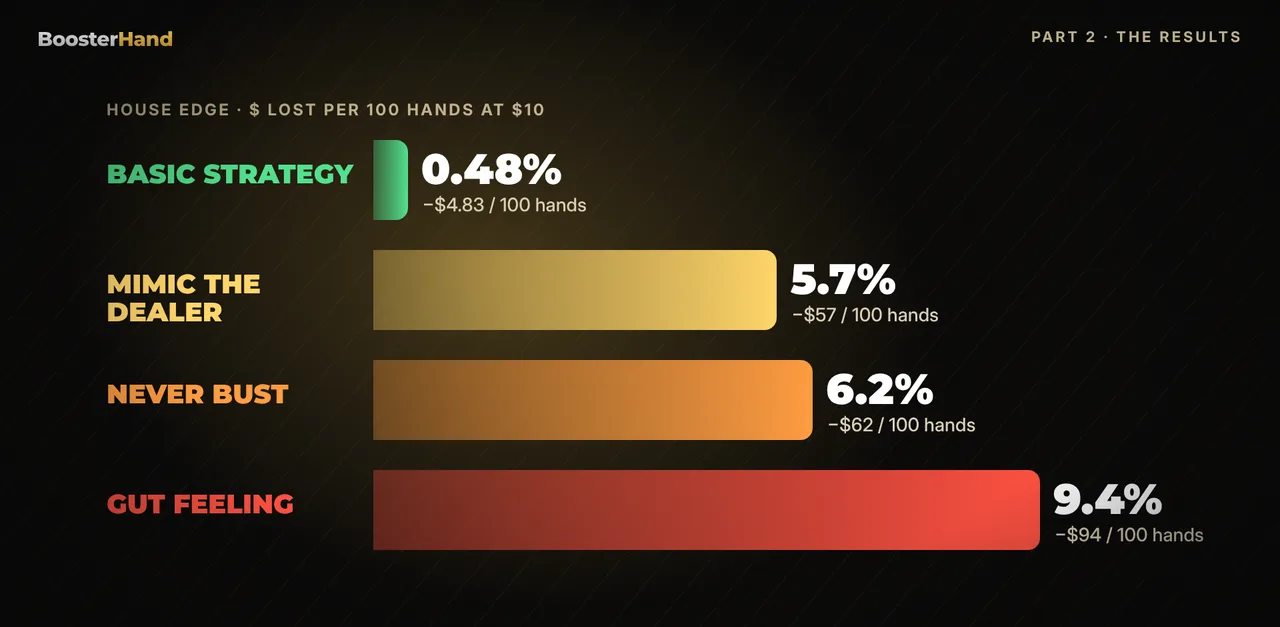
Look at the “hands won” column. Basic strategy didn’t win dramatically more hands than the others: 43.4% versus 42.5% for never bust. The difference is in which hands make money. Basic strategy doubled on about 10.3 of every 100 hands and split on about 2.5, putting extra money on the table exactly when the odds favored the player. Never bust and mimic the dealer never did either, so they gave up those spots entirely.
Why 70% right is a disaster
Following the chart 70% of the time on judgment calls sounds respectable. In school it’s a passing grade. At a blackjack table it was the worst result by far, worse than the two players who never doubled or split at all.
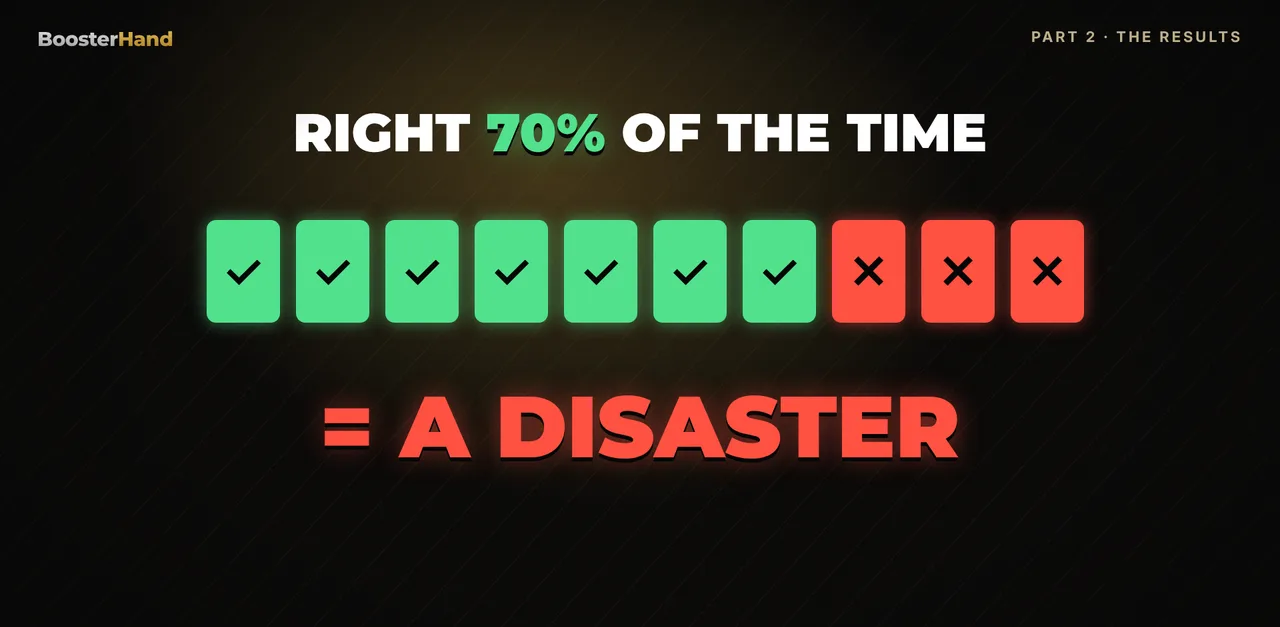
The reason is where the mistakes land. The gut feeling player only deviates on the close decisions, and those are exactly the hands where the correct move matters. Standing on a 16 against a dealer 10, hitting a 13 against a dealer 6, skipping a double on 11: each hunch hands the house a little extra edge, and the gut feeling player made a hunch call on 30% of those spots. The doubles show it too: 7.0 per 100 hands versus 10.3 for basic strategy, so the hunches also skipped some of the most profitable plays.
Why mimicking the dealer loses so much
If the dealer’s strategy works for the house, why doesn’t it work for you? Because the rules aren’t symmetrical. You act first.
If you bust, your hand is over and you lose your bet, even if the dealer busts later in the same round. The dealer never faces that risk on a hand you’ve already busted. Copying the dealer means taking the dealer’s bust risk without the dealer’s advantage of going last.
The numbers are clear: the mimic player busted on about 27 of every 100 hands. Basic strategy busted on about 16, because it stands on stiff hands like 13 to 16 when the dealer shows a weak card and lets the dealer take the bust risk instead.
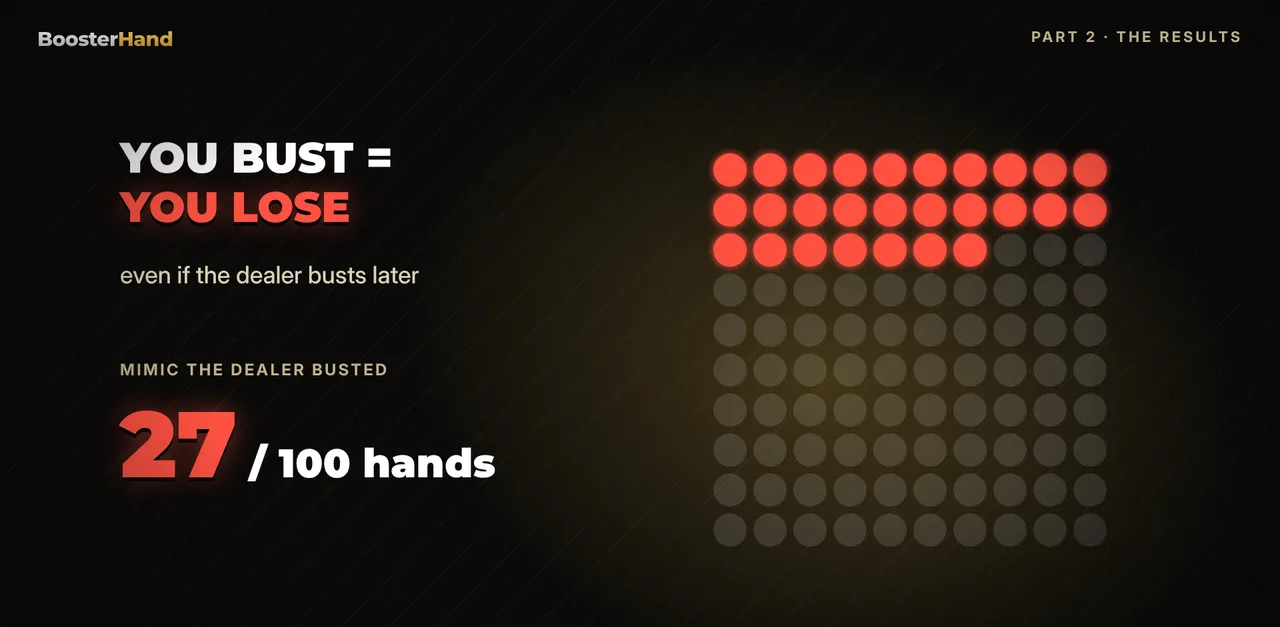
Never bust tries to fix that by refusing to bust at all, and it did: 0 busts per 100 hands. But it still lost 6.2%, because standing on every 12 to 16 regardless of the dealer’s card leaves you with too many weak totals, and it gives up every double and split. Avoiding one mistake doesn’t make up for ignoring the rest of the chart.
Basic strategy still loses
Here’s the part the basic strategy crowd doesn’t always mention. The best player at the table was ahead early: up $1,235 after 10,000 hands and $1,415 after 20,000. But by 30,000 hands it was down, and after hand 58,352 it was never ahead again. From there the line drifted steadily down to −$48,250.
The other three were never in the game. Never bust was last ahead at hand 12, mimic the dealer at hand 194 and gut feeling at hand 284.
Short sessions tell the same story with more noise. We split each million hands into 100-hand sessions ($1,000 of action at $10 a hand) and counted how many finished ahead:
| Strategy | 100-hand sessions ahead | Median 100-hand session |
|---|---|---|
| Basic strategy | 47% | −$5 |
| Mimic the dealer | 28% | −$55 |
| Never bust | 26% | −$60 |
| Gut feeling | under 19% | −$95 |
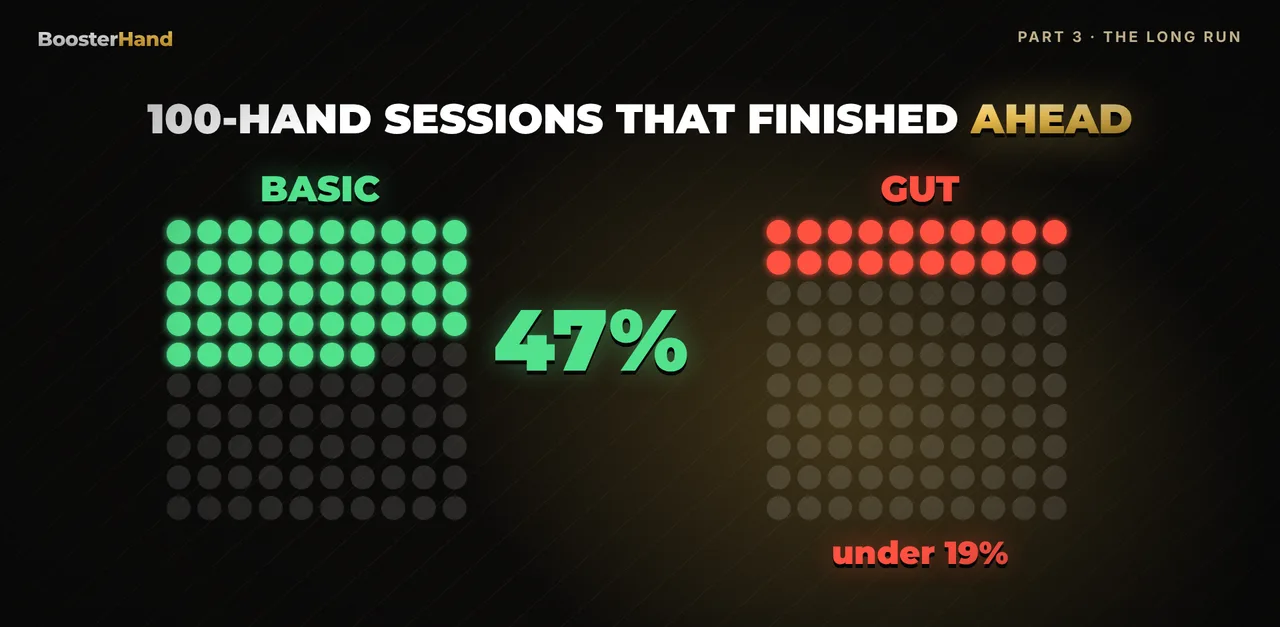
With basic strategy, a 100-hand session is close to a coin flip, slightly tilted toward the house. That’s why winning nights happen and why some players believe they’ve beaten the game. Stack enough sessions together and the 0.48% always shows up. If you want to see the same pattern in a different game, our house edge simulation of 1 million slot spins shows the long-run grind in action.
A note on the rules
These are simulated players on one set of rules, and the rules matter. Worse conditions, like blackjack paying 6:5 instead of 3:2, make the house edge bigger for every strategy, including basic. The ranking of the four players wouldn’t change, but the basic strategy loss would grow. The same logic applies at the roulette wheel, where one extra zero changes the edge: see our European vs American roulette odds simulation.
What this means for you
Three takeaways from 4,000,000 simulated hands:
- Blackjack basic strategy is the best way to play every hand, and it still loses. About half a percent per hand on these rules, or roughly $4.80 per 100 hands at $10.
- Gut feeling is not a strategy. Hunches on 30% of the close calls cost about 19 times more than perfect play. If you play blackjack, the chart is the only decision-making approach in this test that comes close to break-even, and close isn’t the same as winning.
- Basic strategy doesn’t beat the house. It only makes you lose slower. It also doesn’t change how much you should bring. Pick a budget you can afford to lose, decide your session length in advance, and stop when either runs out.
Changing your bet size won’t fix the edge either. We tested popular progressions in our betting systems simulation with 70,000 players, and the house still came out ahead. To estimate how far a budget stretches at a given edge and bet, try our bankroll calculator. And if gambling stops being fun, our responsible gambling page has tools and support.
So, how close was your guess? Basic strategy or gut feeling, and how big did you think the gap would be? Tell us in the comments.
FAQ
Does blackjack basic strategy beat the house?
No. In our 1,000,000-hand simulation, perfect basic strategy still had a house edge of about 0.48% and lost $48,250 at $10 a hand. It makes you lose slower, not win.
How much does blackjack basic strategy reduce the house edge?
On our table rules, basic strategy lost 0.48% per hand. A player who followed the chart only 70% of the time on judgment calls lost 9.4%, almost 19 times more.
Is it bad to copy the dealer in blackjack?
Yes. Mimicking the dealer (hit until 17, no doubles or splits) gave a 5.7% house edge in our test. You act first, so when you bust you lose even if the dealer busts later, and this player busted on about 27 of every 100 hands.
Is never busting a good blackjack strategy?
No. Standing on every hard 12 or more and never doubling or splitting cost 6.2% per hand in our simulation, more than 12 times the loss of basic strategy.
What are the odds of winning a blackjack session with basic strategy?
In our simulation, about 47% of 100-hand sessions with basic strategy finished ahead. Over longer play the house edge takes over: after about 60,000 hands, the basic strategy bankroll was never ahead again.
Related
Simulations use generic models, not any real game or casino. Results show long-run math, not predictions for one session. 18+ only. If gambling stops being fun, take a break: responsible gambling.
Next experiment: European vs American Roulette: Why One Extra Zero Costs You Double