

BoosterHand Lab · simulation
Near Miss Gambling: 665 Near Misses in 1,000,000 Slot Spins
Updated 2026-10-31 · By BoosterHand Lab · Method: Monte Carlo simulation (Python/NumPy, fixed seed)
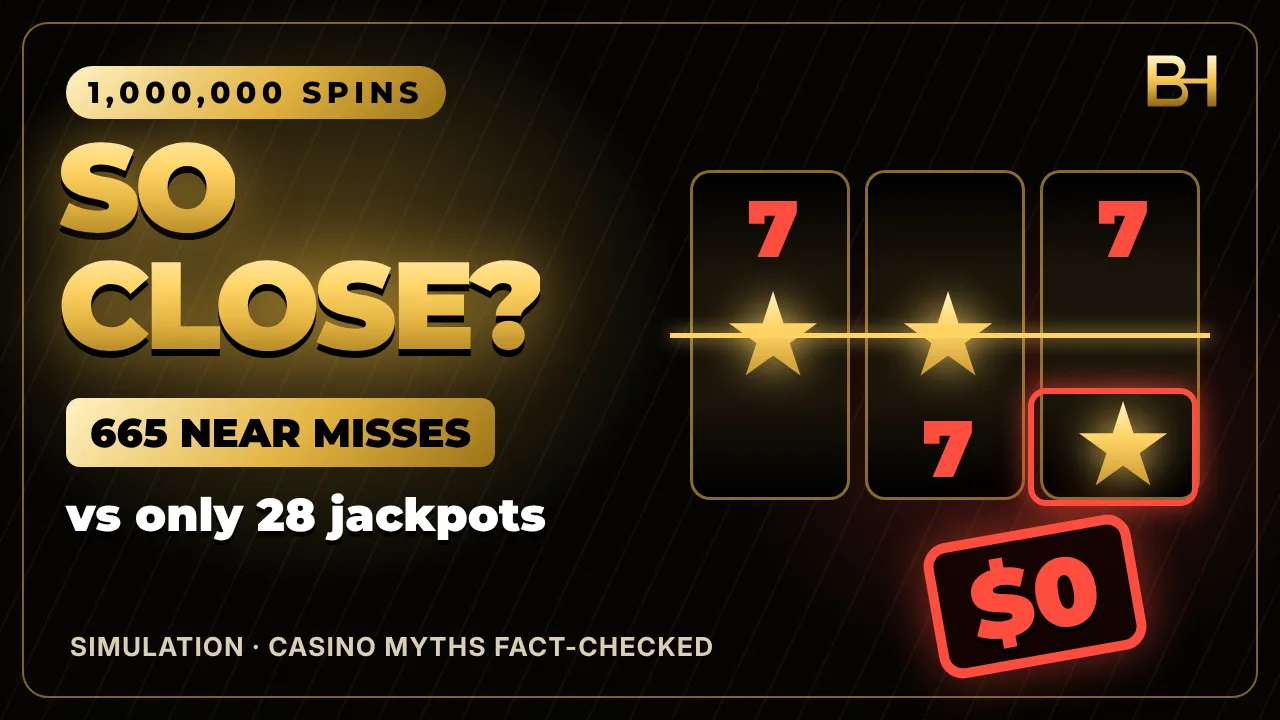
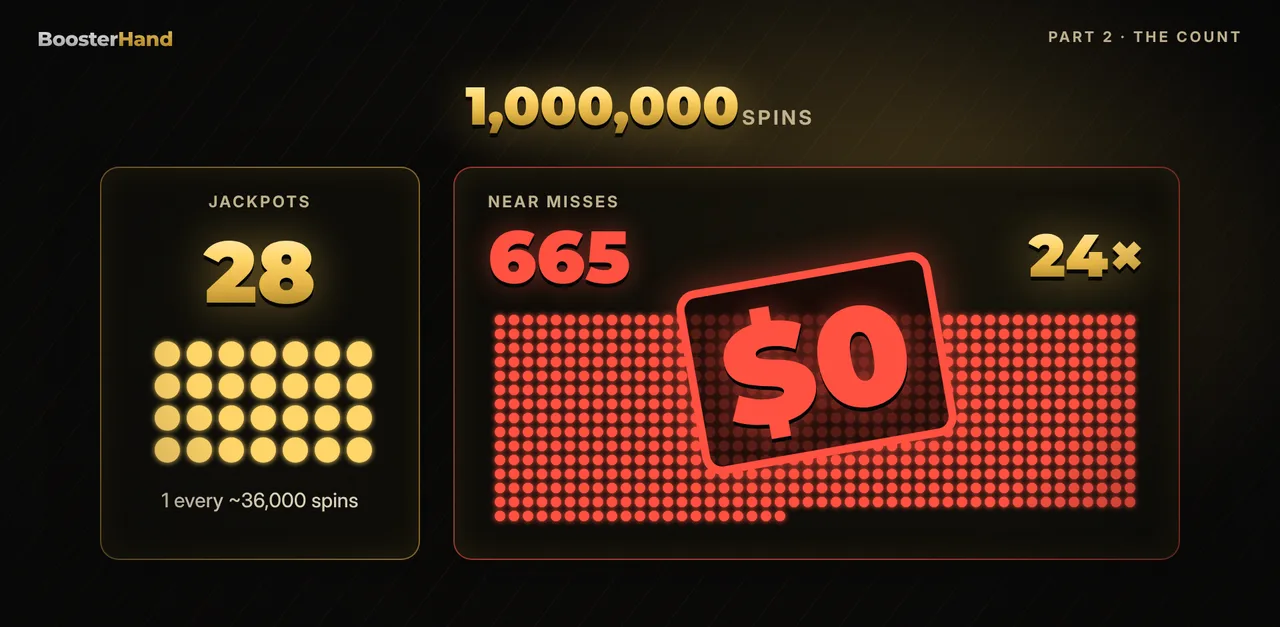
- In 1,000,000 simulated spins: 28 real jackpots (about 1 every 36,000 spins) and 665 near misses.
- That's about 24 near misses for every jackpot, and all 665 paid exactly $0.
- Over 1 billion extra spins, about 20 jackpots were expected right after a near miss. We got 25, inside the normal random range of about 11 to 29.
- Same reel strip with every stop equally likely: only about 5 near misses per jackpot. Weighting the blanks next to the jackpot pushed it to 24.
- 79% of all wins paid back less than the $1 bet: losses disguised as wins.
One million spins on a simulated slot machine produced 28 jackpots. But 665 times, the jackpot stopped just one row away, and every single one of those near misses paid exactly $0. Near miss gambling is one of the most talked-about features of slot machines, so I counted every one of them to see what a near miss is actually worth.
What a near miss is in gambling
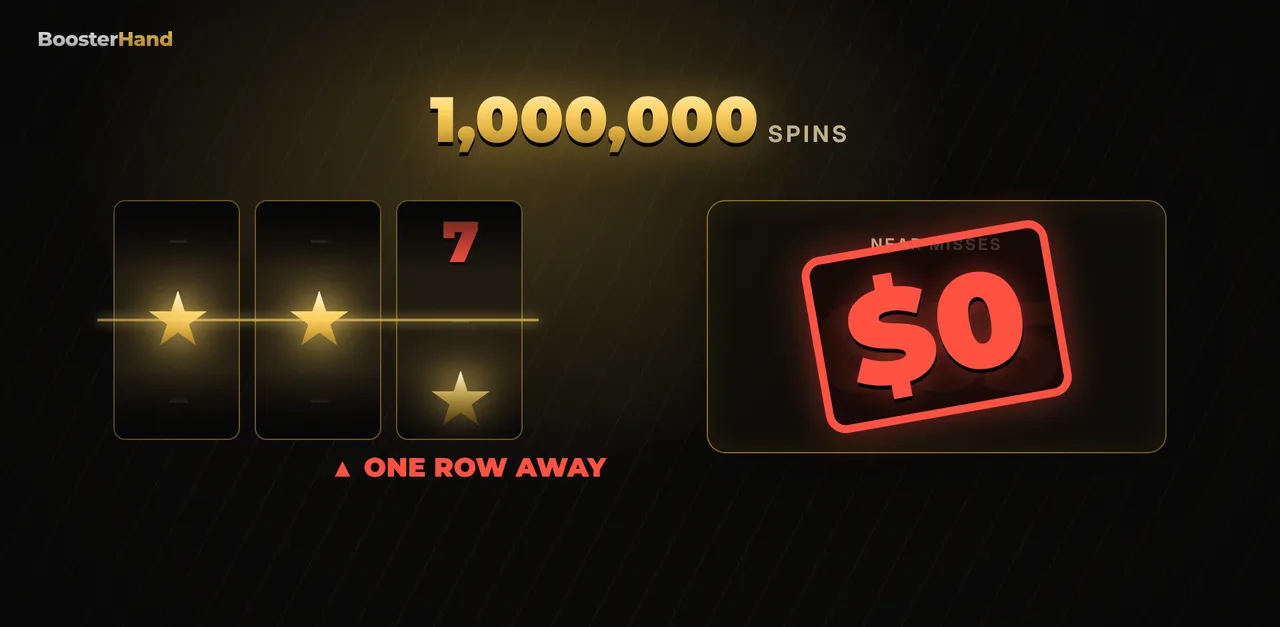
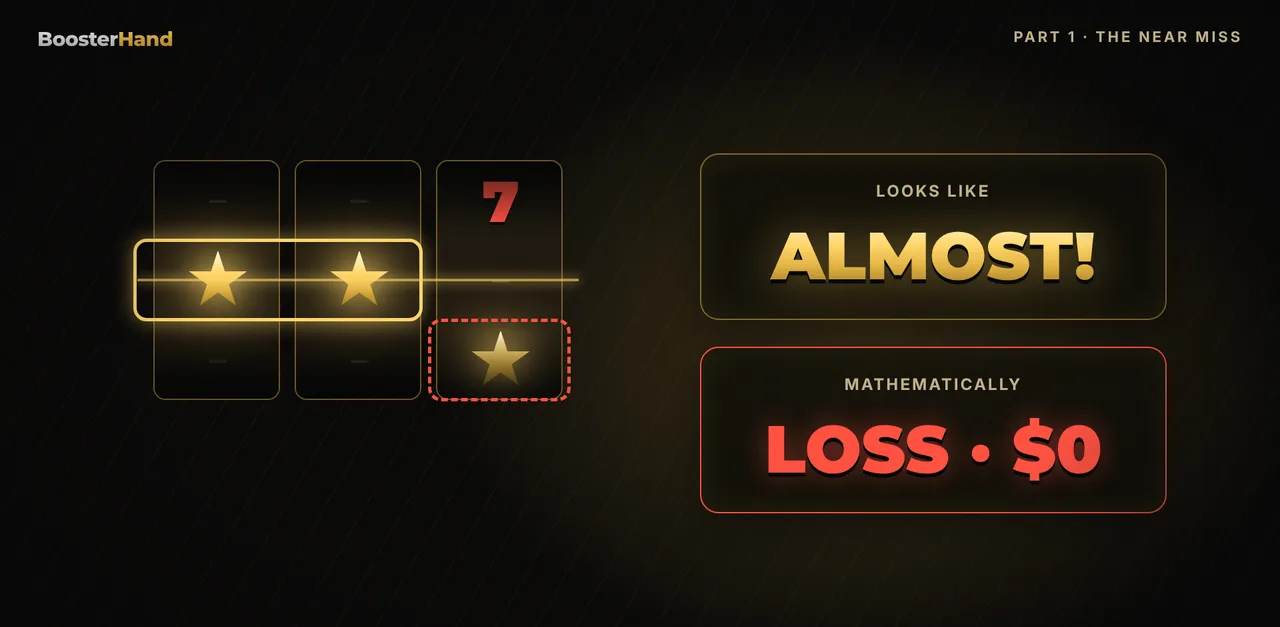
A near miss is when two jackpot symbols land on the payline and the third one stops just above or just below it. You can see the jackpot symbol sitting right there, one row off. It looks like you almost won.
Mathematically, it’s just a loss. The machine pays on what lands on the payline, not on what’s visible above or below it. Two jackpot symbols plus a blank pay the same as three blanks: nothing.
Before you scroll to the results: in a million spins, how many near misses do you think showed up for every real jackpot? Two? Ten? Twenty or more? Keep your guess in mind.
How we ran the simulation
This is a generic model I built, not a copy of any real machine. The setup:
- Machine: a classic three-reel slot, 22 physical stops per reel, one payline, $1 per spin
- Reel strip: symbols on every other stop (jackpot, 7, BAR, cherry), blanks in between. One jackpot symbol per reel, with a blank on each side of it
- Weighting: each reel uses 64 “virtual” stops mapped onto the 22 physical ones, so some stops come up more often than others. The jackpot symbol got 2 virtual stops, and each of the two blanks next to it got 7
- Pay table: 3 jackpots 5,000x, three 7s 100x, three BARs 40x, three cherries 10x, two cherries 2x, one cherry 0.5x
- Payback: about 92% by design (92.16% exact). The million-spin run returned 90.8%, which is normal variation for a game with a 5,000x top prize
- Runs: 1,000,000 spins on the weighted reels, 1,000,000 spins on the same strip with every stop equally likely, and 1,000,000,000 extra weighted spins to test whether a near miss predicts anything
- Method: Monte Carlo simulation in Python (NumPy), fixed random seed for reproducibility
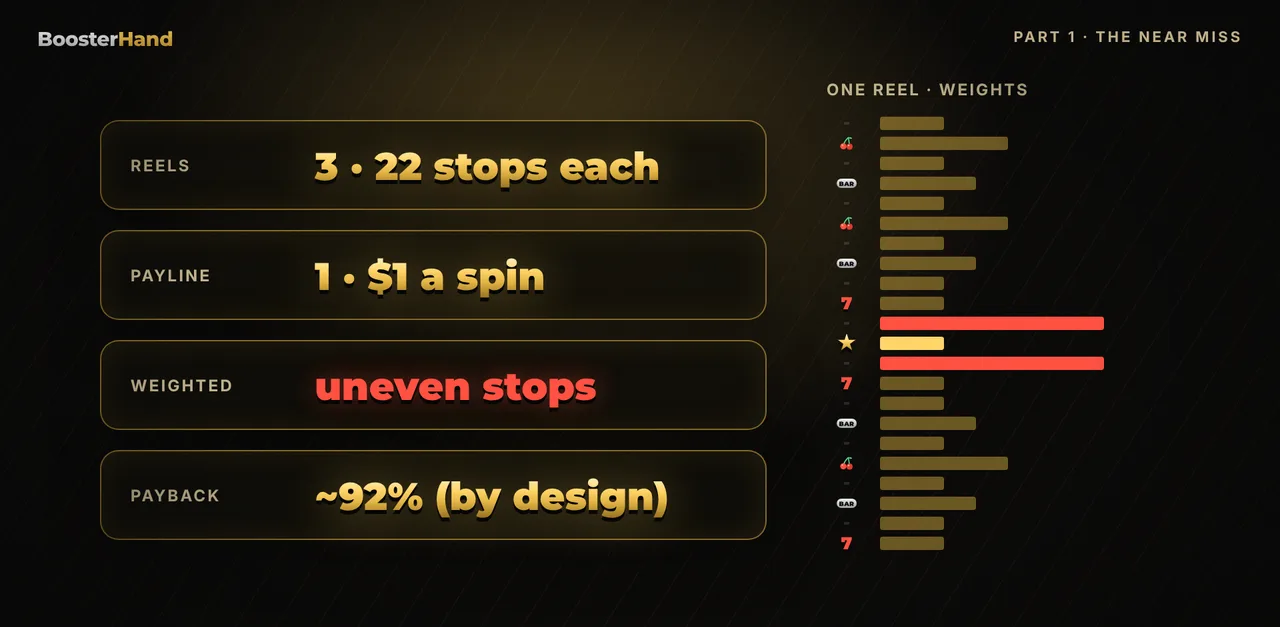
The reel weights are my choice. Real machines use different reels, pay tables and rules, so their exact numbers will differ. What this model shows is how the mechanics work, not what any specific game does. Our methodology page explains how we approach these tests.
The count: 665 near misses vs 28 jackpots
Here’s the main run.
| Result (1,000,000 spins) | Count | How often |
|---|---|---|
| Real jackpots | 28 | about 1 every 36,000 spins |
| Near misses | 665 | about 1 every 1,500 spins |
| Near misses per jackpot | about 24 | |
| Total paid on all near misses | $0 | |
| Spins with any win | 471,826 | 47.2% hit rate |
| Payback in this run | 90.8% |
Twenty-eight jackpots in a million spins. That’s roughly one every 36,000 spins. Near misses showed up 665 times, about once every 1,500 spins, or about 24 near misses for every real jackpot.
How did your guess compare? If you said two or ten, the machine fooled you on volume as well.
And the total paid out on all 665 near misses was $0. Not a small consolation prize, not a partial win. Zero. A player who saw a near miss every session would see “almost” far more often than they’d ever see the real thing.
Does a near miss mean a jackpot is coming?
The obvious follow-up question: if the jackpot was so close, is it “due”? In the million-spin run, none of the 665 spins right after a near miss hit the jackpot. But with only 28 jackpots in total, that sample is too small to say much. So I ran one billion more spins.
| Billion-spin check | Result |
|---|---|
| Spins | 1,000,000,000 |
| Jackpots | 30,635 (about 1 in 32,600 spins) |
| Near misses | 640,487 |
| Jackpots expected right after a near miss (if reels have no memory) | about 20 |
| Jackpots actually seen right after a near miss | 25 |
| Normal random range | about 11 to 29 |
That gave me about 640,000 near misses. If the reels have no memory, the chance of a jackpot on the next spin is the same as on any other spin, so about 20 of those next spins should be jackpots. I got 25. Anything from about 11 to 29 is normal random wobble, so 25 is exactly the kind of number you’d expect from a machine that doesn’t remember anything.
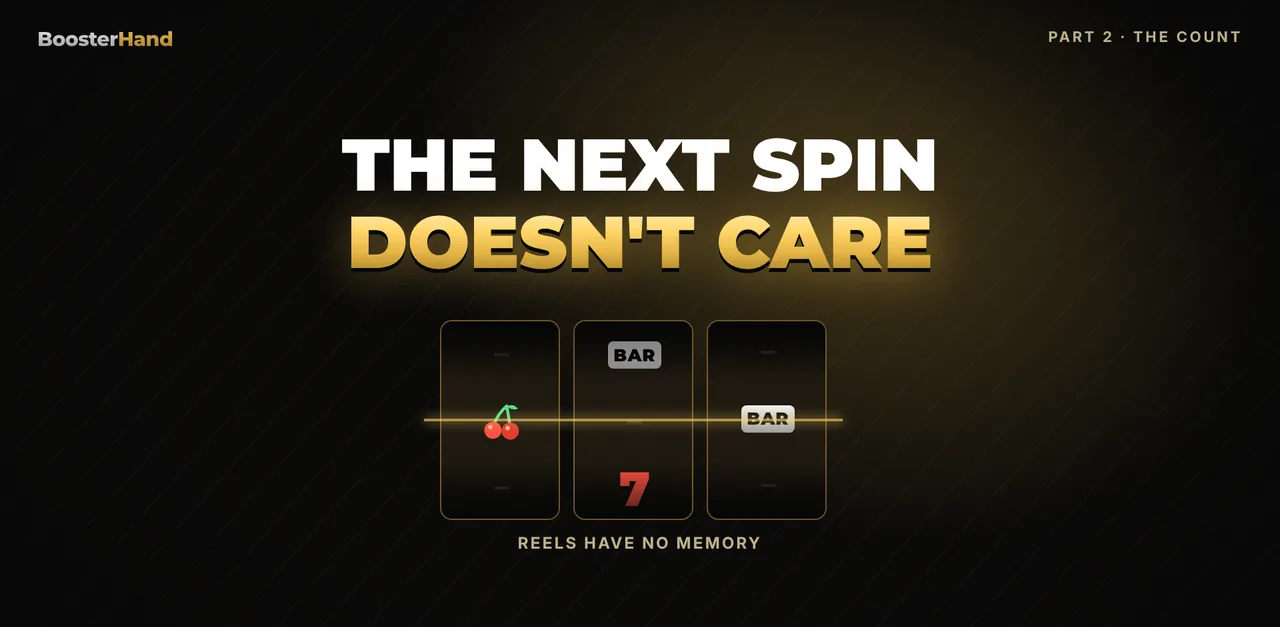
This is the same trap as the gambler’s fallacy. Each spin is independent, so “close” on one spin carries nothing over to the next. We tested the same idea at the roulette table in our gambler’s fallacy simulation of 1 million spins, with the same result: past results don’t change future odds.
Why near misses show up so often: reel weighting
So why did near misses outnumber jackpots so heavily? In my model, it comes down to weighting.
I ran the exact same reel strip, same symbols, same pay table, but with every stop equally likely. Then I compared it with the weighted version.
| Same reel strip | Jackpots (1M spins) | Near misses (1M spins) | Near misses per jackpot |
|---|---|---|---|
| Every stop equally likely | 101 | 547 | about 5 |
| Blanks next to the jackpot weighted up | 28 | 665 | about 24 |
With every stop equally likely, near misses showed up about five times as often as jackpots. Make the blank stops right next to the jackpot more likely, and it jumps to about 24. Same strip, same symbols. The only thing that changed was how often each stop comes up.
The trick is simple. On the weighted reels, the jackpot symbol itself is rare (2 of 64 virtual stops), but the blanks hugging it are common (7 each). So when a reel lands near the jackpot, it usually lands on a blank right beside it, putting the jackpot symbol in full view one row away. Fewer jackpots, more “almosts”.
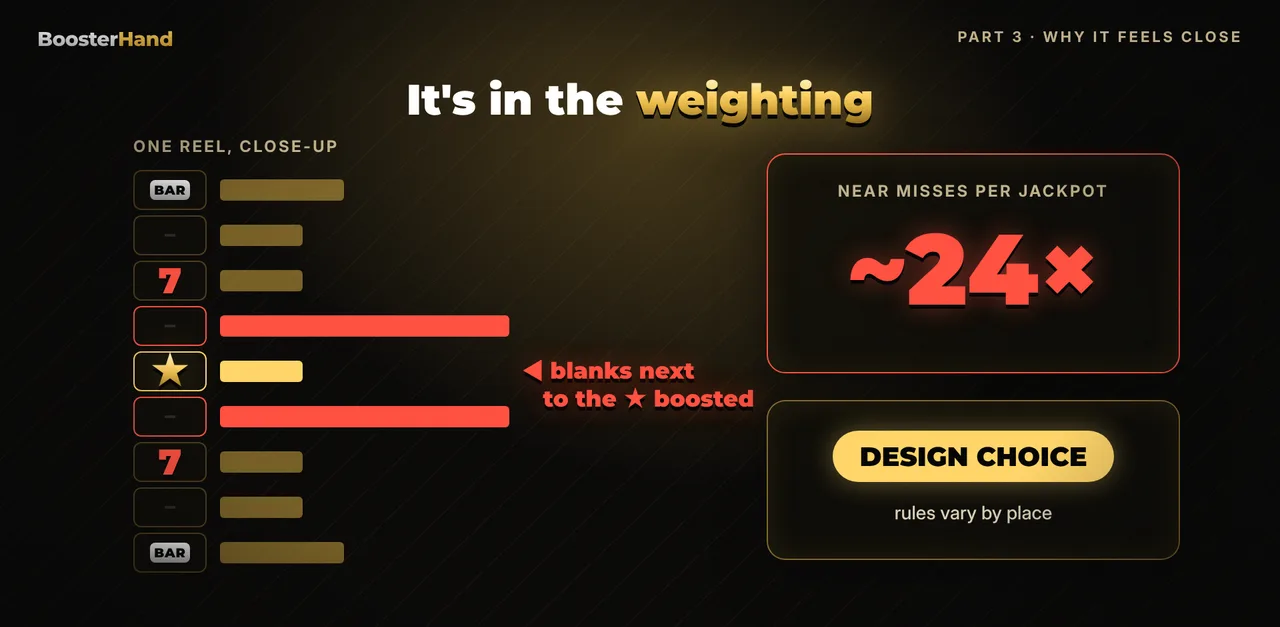
How real games set their reels is a design choice, and the rules around it vary from place to place. I’m not claiming any specific machine works like my model. The point is that the number of near misses you see is something the reel design can shape, and it has nothing to do with how close you really were to winning.
Why the near miss feels so close
That almost-won feeling is a known effect. Psychologists study near misses because they can feel closer to a win than a normal loss, even though the payout is identical. The jackpot symbol in plain view seems to say “you nearly had it”, and that can make it tempting to spin again.
Its cousin: losses disguised as wins
There’s a related effect worth knowing. In my model, a single cherry pays 50 cents on a $1 bet. The machine counts it as a win and may light up or play a sound, but you just lost half your bet.
These small “wins” are everywhere:
| All wins in 1,000,000 spins | Count | Share of wins |
|---|---|---|
| Paid less than the $1 bet | 371,905 | 79% |
| Paid more than the $1 bet | 99,921 | 21% |
| Total wins | 471,826 | 100% |
The machine “won” on 47% of spins. But 79% of those wins paid back less than the bet. Only about one in five wins actually left you with more than you put in on that spin.
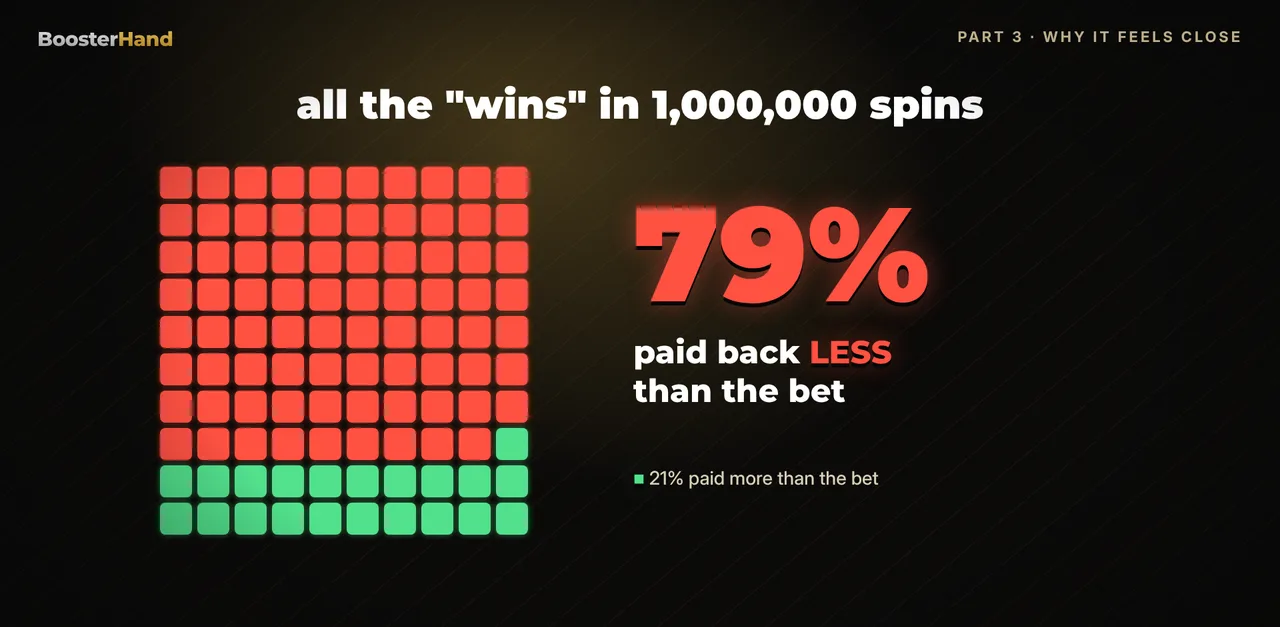
Put the two together and you get a machine that, most of the time, either shows you “almost” or celebrates a loss. Meanwhile the house edge does its work quietly in the background. You can see what that edge adds up to over a long session in our house edge simulation of 1 million slot spins.
What this means for you
Near misses are part of how slots feel, not part of how they pay. Three takeaways:
- A near miss is a loss. In our simulation, 665 near misses paid $0, every single time. Treat it exactly like any other losing spin.
- It says nothing about the next spin. Over a billion spins, the jackpot rate after a near miss stayed inside normal random range. The odds stay exactly the same, and no jackpot is ever “due”.
- When it feels so close, take a break. That “so close” moment is exactly when chasing feels most tempting. It’s a good time to step away, not to raise your bet or extend your session.
The same goes for the small celebrated wins. If the screen lights up but your balance went down, it was a loss. Watching your balance rather than the animations gives you a much clearer picture of how a session is really going.
None of this is a way to win. Slots have a built-in edge, and no pattern on the reels changes that. If you play, set a budget you can afford to lose before you start, and our bankroll calculator can show roughly how long it might last at a given payback and bet size. How often a slot pays also shapes the ride, which we tested in our slot volatility simulation. And if gambling stops being fun, our responsible gambling page has tools and support.
So, have you ever felt a near miss was “almost a win”? Yes or no? Tell us in the comments.
FAQ
What is a near miss in gambling?
A near miss is a losing result that looks close to a win, like two jackpot symbols on the payline with the third one stopping just above or below it. It pays nothing. In our simulation, all 665 near misses paid exactly $0.
Does a near miss mean a jackpot is coming?
No. Slot spins have no memory. Across 1 billion simulated spins we expected about 20 jackpots right after a near miss and saw 25, which is normal random wobble. The odds on the next spin stay the same.
Why do slots show so many near misses?
In our model it came down to reel weighting. With every stop equally likely, there were about 5 near misses per jackpot. Making the blank stops next to the jackpot more likely pushed it to about 24, on the same reel strip.
Why does a near miss feel like almost winning?
The near-miss feeling is a known effect that psychologists study, because a near miss can feel closer to a win than an ordinary loss. Mathematically, it is just a loss like any other.
What is a loss disguised as a win?
It's a payout smaller than your bet that the machine still celebrates. In our model, one cherry paid 50 cents on a $1 bet, and 79% of all wins in 1,000,000 spins paid back less than the bet.
Related
Simulations use generic models, not any real game or casino. Results show long-run math, not predictions for one session. 18+ only. If gambling stops being fun, take a break: responsible gambling.
Next experiment: Blackjack Basic Strategy vs Gut Feeling: 1 Million Hands Simulated