

BoosterHand Lab · simulation
Crash Game Strategy: When Should You Cash Out? 60,000 Players Tested
Updated 2026-10-31 · By BoosterHand Lab · Method: Monte Carlo simulation (Python/NumPy, fixed seed)
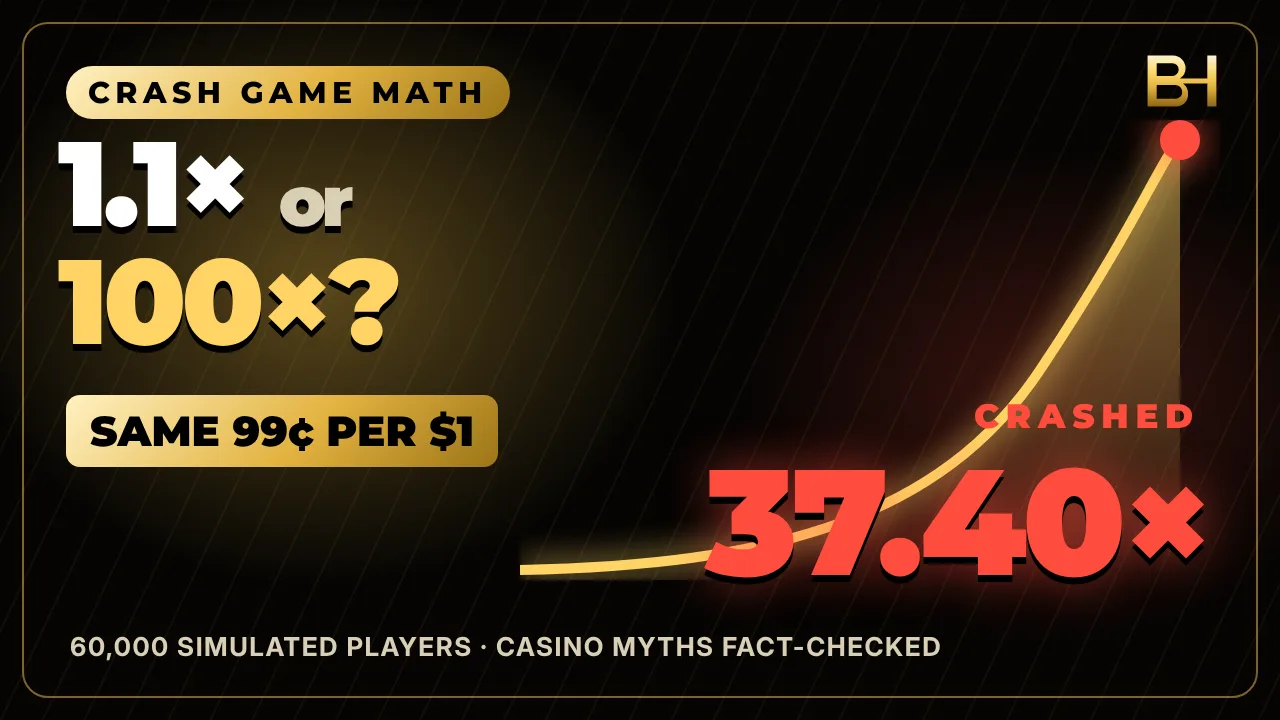
- In a crash game with a 1% house edge, the chance to reach any target x is 0.99 ÷ x, so target × chance is always 0.99.
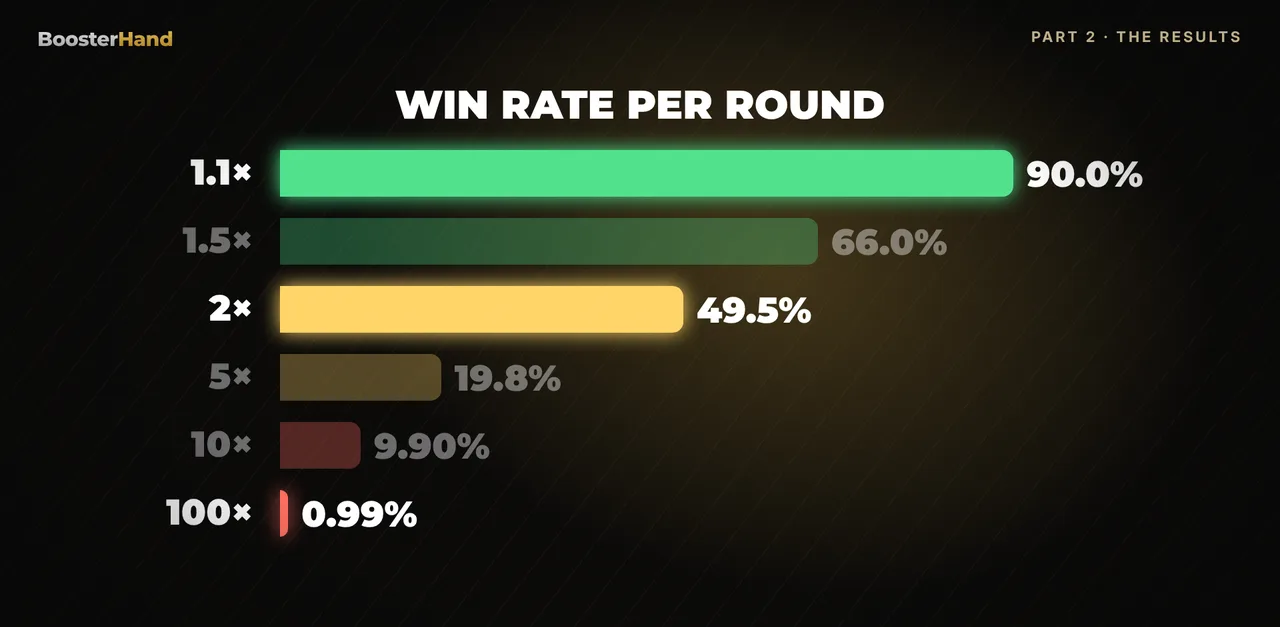
- Cashing out at 1.1x won 90% of rounds. Waiting for 100x won under 1%.
- Every one of 6 targets returned between 98.7 and 99 cents per $1 bet across 60,000 simulated players.
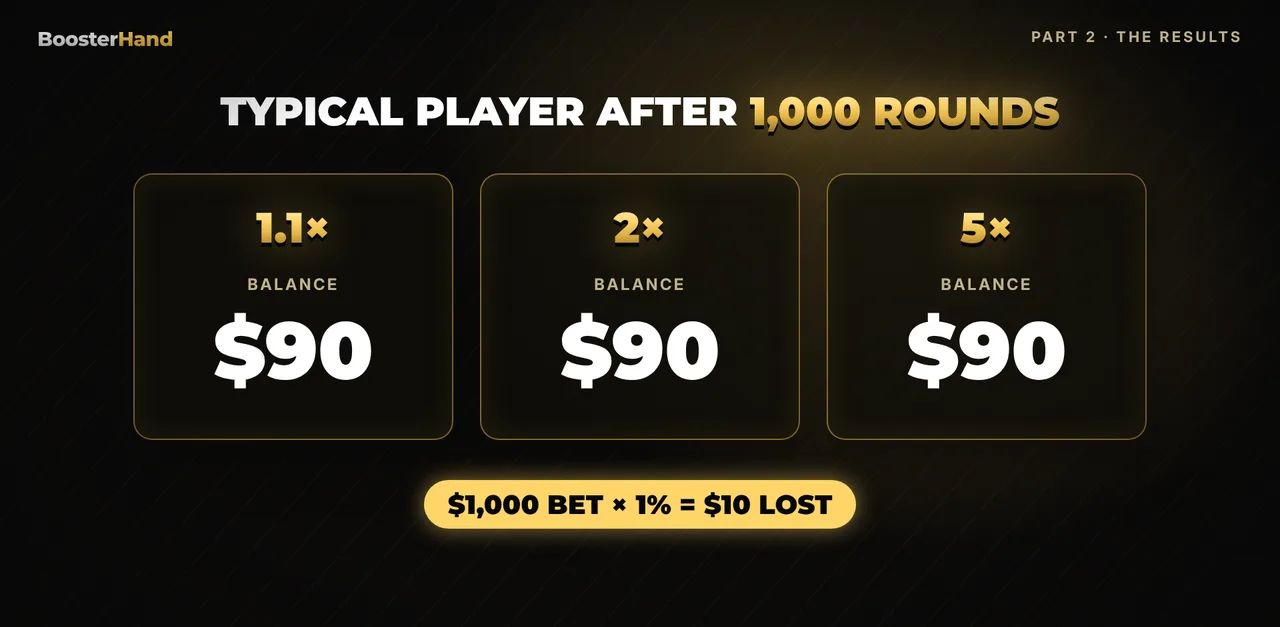
- After 1,000 rounds, the typical player at 1.1x, 2x or 5x had $90 left from $100: a loss of 1% of the $1,000 bet.
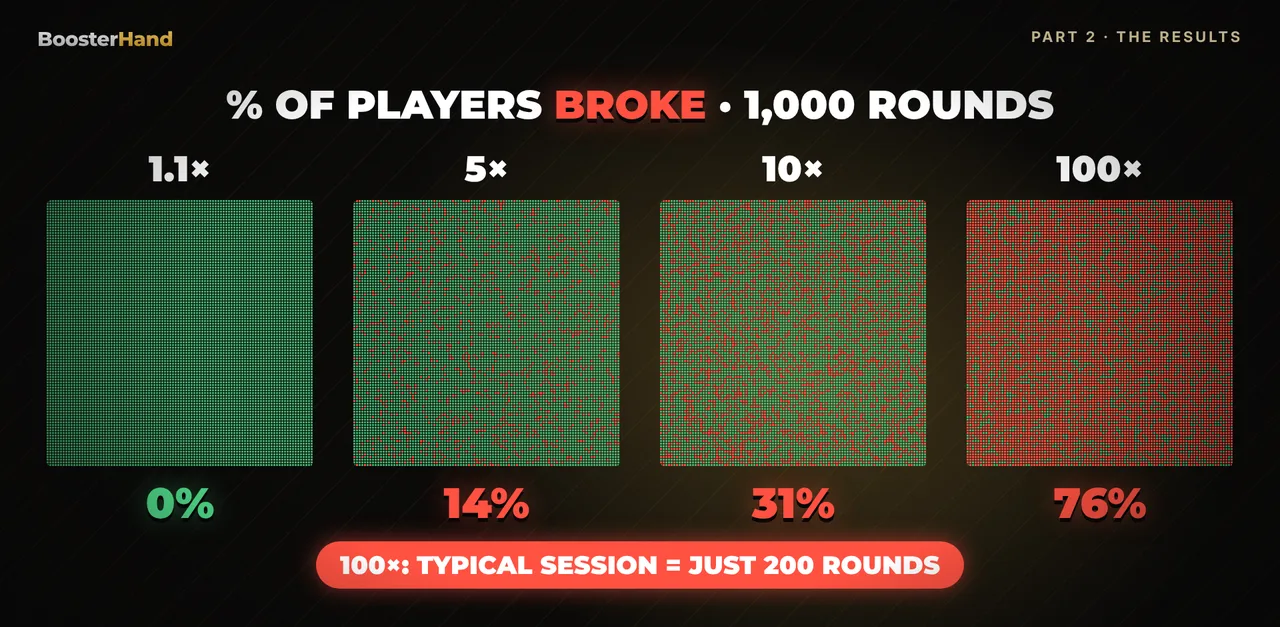
- Going broke: 0% at 1.1x, 14% at 5x, 31% at 10x and 76% at 100x.
- At 100x, 41% doubled their money at some point and the best balance hit $1,593. At 1.1x nobody doubled.
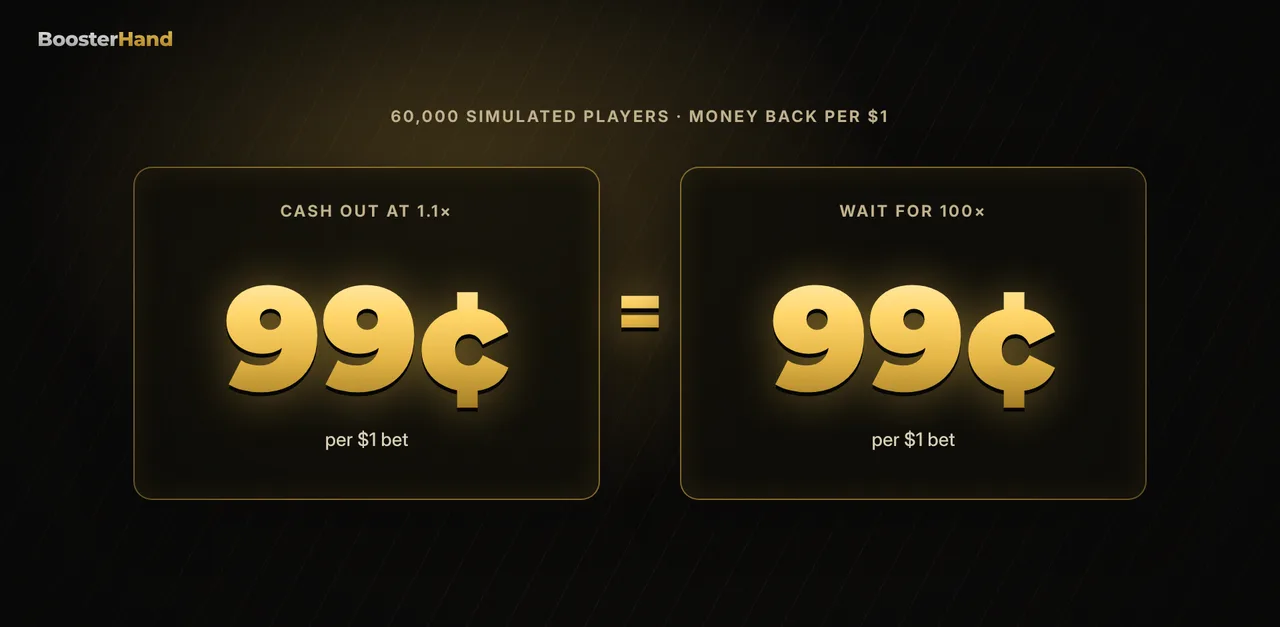
Every crash game strategy boils down to one decision: when to cash out. Cash out at 1.1x and you win 90% of rounds. Hold out for 100x and you win under 1%. I simulated 60,000 players across six cash out targets, and every single one got back the same 99 cents per dollar.
So the real question isn’t which target wins. It’s what each target does to your bankroll on the way to that same result. Here’s what the numbers showed.
How a crash game works (and the one formula behind it)
A crash game is simple. A multiplier starts at 1.00x and climbs. At some random moment it crashes. If you cashed out before the crash, you win your bet times the multiplier at that moment. If you didn’t, you lose the bet.
Most players use an auto cash out: you set a target, say 2x, and the game cashes you out automatically if the multiplier gets there. That target is your whole strategy.
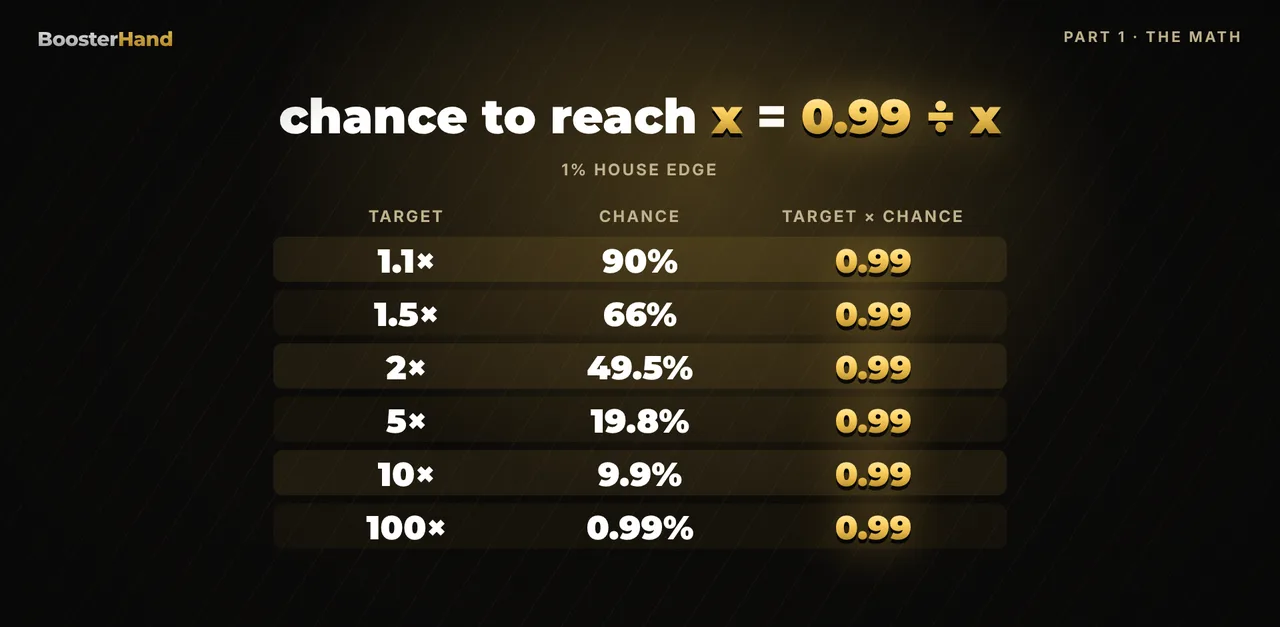
My generic crash game has a 1% house edge. With that edge, the chance that the multiplier reaches any target x is:
Chance to reach x = 0.99 ÷ x
Plug in a few targets:
- 2x is reached 49.5% of the time
- 10x is reached 9.9% of the time
- 100x is reached 0.99% of the time
- About 1 round in 100 crashes instantly at 1.00x, before anyone can cash out
Now notice the trick. Multiply the target by its chance and you always get the same number: 2 × 0.495 = 0.99. 10 × 0.099 = 0.99. 100 × 0.0099 = 0.99. Whatever target you pick, the expected payout on a $1 bet is 99 cents. The house edge is baked into every possible cash out point equally.
That’s the theory. The simulation checks whether it holds up for real players with real bankrolls who can go broke.
How we ran the simulation
This is a generic model, not a copy of any real crash game. The parameters:
- Game: crash multiplier with P(multiplier ≥ x) = 0.99 ÷ x, so a 1% house edge (about 1% instant crashes at 1.00x). Multipliers are shown to 2 decimals.
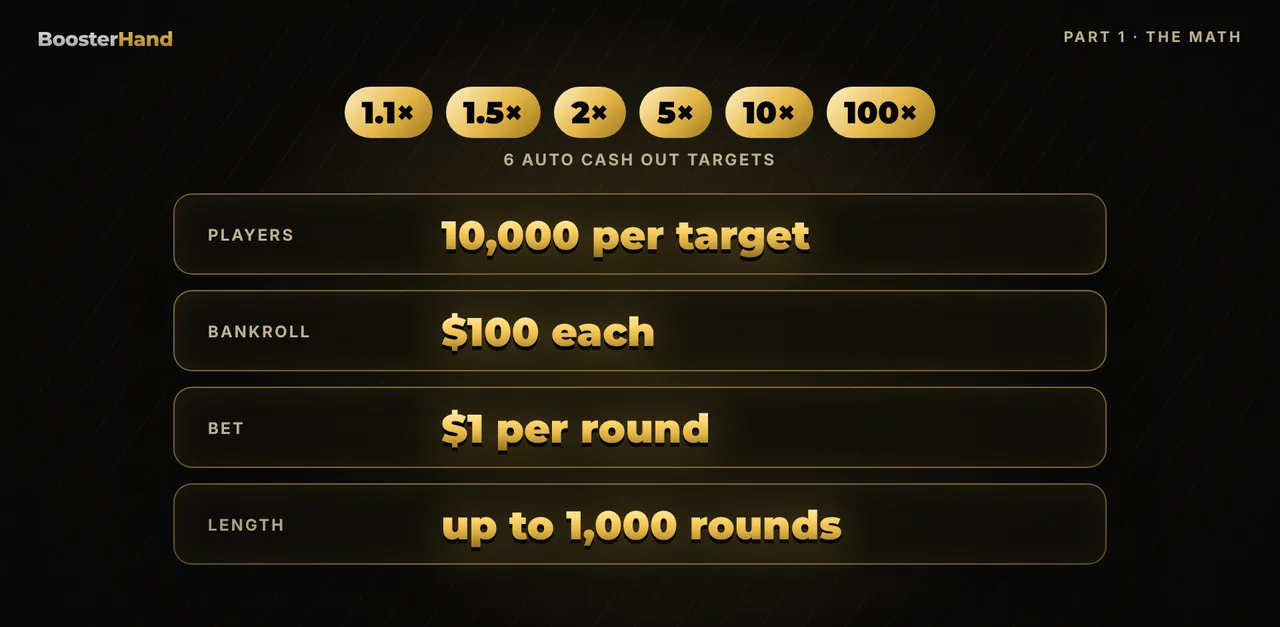
- Strategies: 6 auto cash out targets: 1.1x, 1.5x, 2x, 5x, 10x and 100x
- Players: 10,000 per target, 60,000 in total
- Bankroll: $100 each
- Bet: flat $1 per round
- Length: up to 1,000 rounds, or until the player can’t cover a $1 bet
- Code: Monte Carlo simulation in Python (NumPy) with a fixed seed, so results are reproducible
Real crash games can use different house edges, and the exact payout math varies by site. The relationship (higher target, lower chance) is the same everywhere. Our methodology page explains how we build every Lab simulation.
Before you read the results: which cash out target do you think lost the least money? And more personally, at what multiplier would you cash out? Write your number in the comments under the video, then see how it held up below.
Crash game strategy results: win rate per target
First, the easy part. How often did each target actually win? The simulation matched the formula almost to the decimal.
| Cash out target | Theory (0.99 ÷ x) | Simulated win rate |
|---|---|---|
| 1.1x | 90% | 90.0% |
| 1.5x | 66% | 66.0% |
| 2x | 49.5% | 49.5% |
| 5x | 19.8% | 19.8% |
| 10x | 9.9% | 9.9% |
| 100x | 0.99% | 0.99% |
At 1.1x, you win nine rounds out of ten. That feels like a winning strategy. At 100x, you lose about 99 rounds out of 100, which feels like a losing one. Neither feeling tells you what happens to your money.
Money back per $1: the number that matters
Win rate is the headline players notice. Return per dollar is the number that decides your bankroll. Here’s what each group got back for every $1 it bet:
| Cash out target | Money back per $1 | Typical balance after 1,000 rounds |
|---|---|---|
| 1.1x | 99.0¢ | $90 |
| 1.5x | 99.0¢ | $90 |
| 2x | 99.0¢ | $90 |
| 5x | 98.9¢ | $90 |
| 10x | 99.0¢ | $80 |
| 100x | 98.7¢ | $0 |
Every target landed between 98.7 and 99 cents. The safe strategy and the greedy one, side by side, all paying the same 1% toll.
The typical (median) player at 1.1x, 2x or 5x finished 1,000 rounds with $90. That’s exactly what the math predicts: 1,000 bets of $1 is $1,000 wagered, and 1% of $1,000 is $10. The cash out target didn’t change the size of that bill. It only changed who paid it and how.
This is the same pattern we found in our house edge simulation over 1 million slot spins: the edge works on everything you bet, not on any single round.
When to cash out in a crash game: who goes broke
If every target costs the same on average, does the choice matter at all? Yes, a lot. The average hides how differently players lose.
| Cash out target | Went broke | Ever doubled to $200 | Best balance reached | Ahead after 1,000 rounds |
|---|---|---|---|---|
| 1.1x | 0% | 0% | $132 | 15.6% |
| 1.5x | 0.01% | 0% | $177.50 | 33.3% |
| 2x | 0.44% | 0.06% | $207 | 36.9% |
| 5x | 14.2% | 8.4% | $359 | 40.8% |
| 10x | 30.9% | 25.4% | $481 | 41.7% |
| 100x | 76.4% | 41.2% | $1,593 | 20.9% |
At 1.1x, nobody went broke. At 5x, 14% did. At 10x, 31%. At 100x, 76% of players ran out of money, and the typical 100x session lasted just 200 rounds before the bankroll was gone. Even early on it was brutal: after 300 rounds, 58% of the 100x players were already broke.
Low targets leak slowly. You win small amounts almost every round, but the rare losses and the steady 1% drain grind you down. High targets do the opposite: long losing streaks, a few big hits, and most bankrolls don’t survive long enough to see one.
The ride: why anyone waits for 100x
So why would anyone pick 100x? Because of the ride.
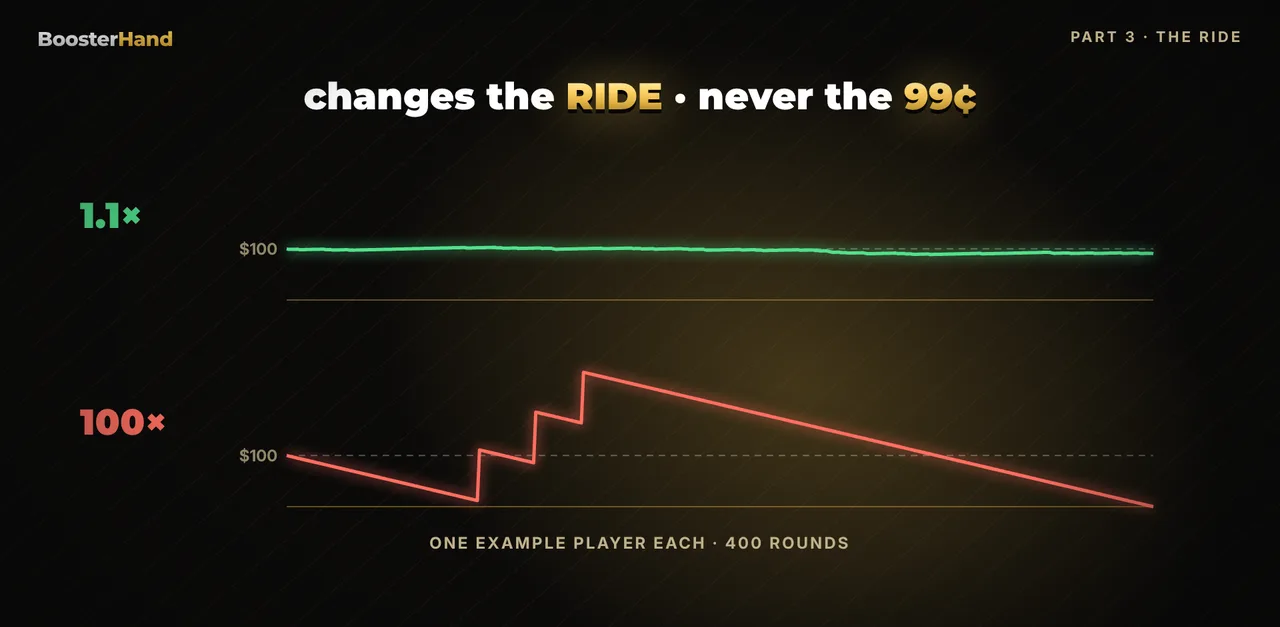
At 1.1x, not a single player out of 10,000 ever doubled their $100. The best balance anyone reached was $132. It’s a slow, predictable slide with almost no upside.
At 100x, 41% of players doubled their money at some point. The biggest balance in the whole test hit $1,593 from a $100 start. Those moments are real, and they’re what make high targets exciting. But most of those players kept betting, and the same math pulled them back down. By round 1,000, only 20.9% of the 100x group were still ahead.
If you watch the video, the individual balance lines shown for each target are illustrations of the pattern, not specific players picked from the data. The table above is the actual result.
The target changes the ride. Win often and small, or rarely and big. It never changes the 99 cents. If you’re curious how this compares with progressive betting, our Martingale simulation and the test of betting systems on 70,000 players show the same lesson from a different angle: changing how you bet reshapes the risk, never the edge.
Three takeaways from the crash game strategy test
- No cash out target beats the house edge. Every target from 1.1x to 100x returned about 99 cents per dollar. There is no magic multiplier.
- Low targets leak slowly, high targets bust fast. At 1.1x nobody went broke but nobody doubled. At 100x, 76% went broke.
- Your loss is about 1% of everything you bet. Fewer rounds means a smaller total bet, and a smaller expected loss. The number of rounds matters more than the target.
One more myth to clear up: past rounds never predict the next crash. Each round is independent. A string of low crashes doesn’t mean a high one is “due”. We tested that kind of thinking in our gambler’s fallacy simulation over 1 million roulette spins.
What this means for you
Crash games look like skill games because you choose when to cash out. The simulation shows that choice is about risk, not profit.
- Pick a target for the ride you can afford, not to win. Low targets mean slow, steady losses. High targets mean big swings and a high chance of busting.
- Budget for the edge. With a 1% edge, expect to lose about $1 for every $100 you bet over time. Our bankroll calculator shows how long a bankroll lasts at a given bet size and pace.
- Count rounds, not wins. Crash rounds are fast, so total wagered climbs quickly. 1,000 rounds of $1 is $1,000 bet, even if you never deposited more than $100.
- Ignore prediction tools and “patterns”. No history of crash points tells you where the next one lands.
- Set limits before you start. Decide your budget and stopping point in advance. If gambling stops being fun, take a break, and see our responsible gambling page for support.
So, at what multiplier would you cash out? Write your number in the comments. Next in the Lab: cashback and rakeback, and whether 10% back can beat the house.
FAQ
What is the best crash game strategy?
No cash out target beats the house edge. In our simulation every target from 1.1x to 100x returned about 99 cents per dollar bet, so the target only changes how bumpy the ride is, not the long-run cost.
When should you cash out in a crash game?
There is no multiplier that improves your expected return. Low targets win often and lose slowly, while high targets win rarely and bust most players. Pick based on how much risk you accept, and remember the cost is about 1% of everything you bet.
Is cashing out at 2x a good crash strategy?
At 2x you win about 49.5% of rounds, but you still get back only about 99 cents per dollar on average. In our test, the typical 2x player went from $100 to $90 after 1,000 rounds of $1 bets.
Can you predict when a crash game will crash?
No. Each round is independent, so past crash points never predict the next one. Any tool or pattern that claims to forecast the crash is selling a myth.
What are the odds of hitting 100x in a crash game?
In a crash game with a 1% house edge, the chance to reach 100x is 0.99 ÷ 100, or 0.99% per round. Our simulation measured just under 1%, and 76% of players aiming for 100x went broke within 1,000 rounds.
Related
Simulations use generic models, not any real game or casino. Results show long-run math, not predictions for one session. 18+ only. If gambling stops being fun, take a break: responsible gambling.
Next experiment: Casino Cashback vs Rakeback: Does 10% Back Beat the House?