

BoosterHand Lab · simulation
Mines Strategy: The Math Behind Every Click (Odds, Multipliers, RTP)
Updated 2026-11-04 · By BoosterHand Lab · Method: Monte Carlo simulation (Python/NumPy, fixed seed)
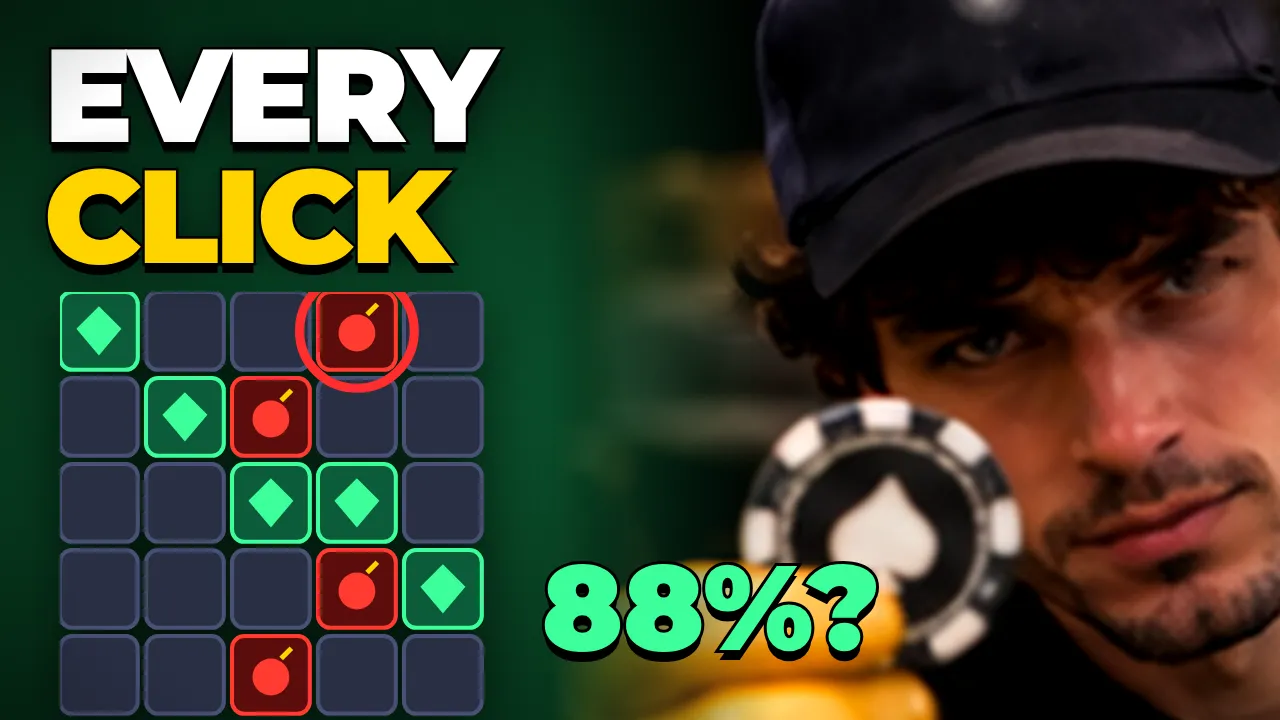
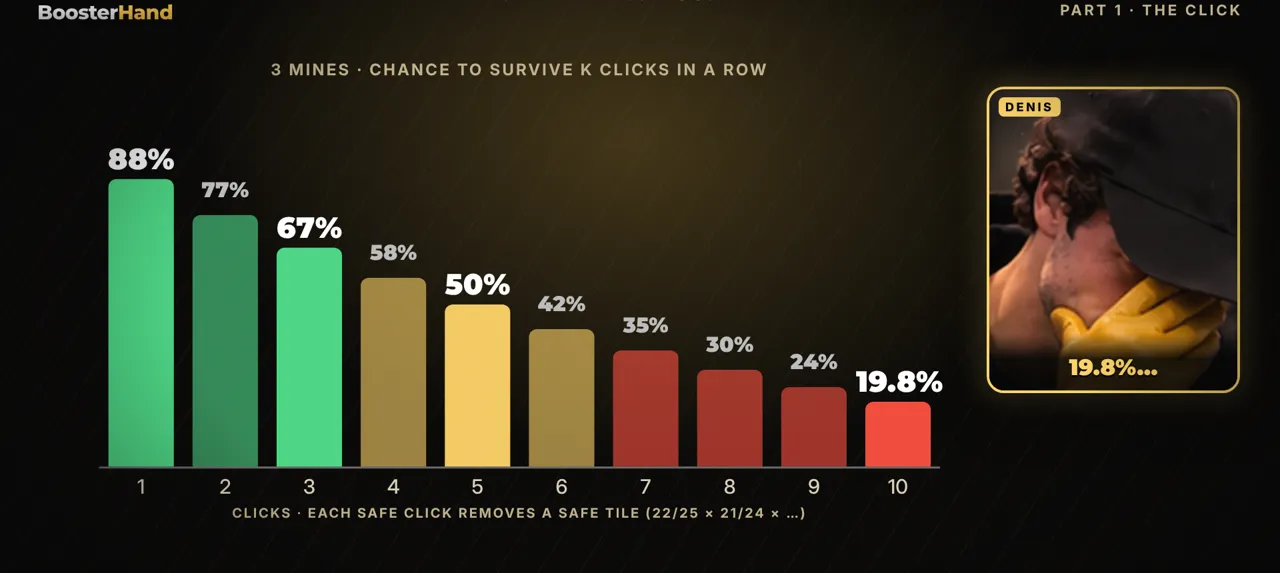
- With 3 mines the first click is 88% safe. Survival compounds down fast: 49.6% after 5 clicks, 19.8% after 10.
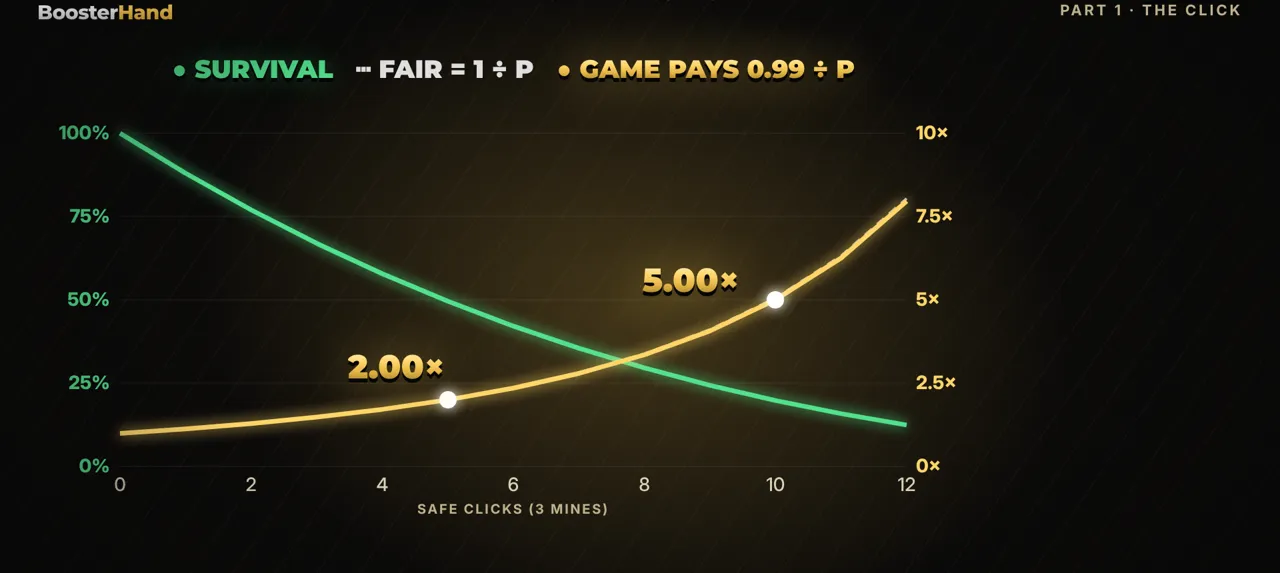
- A fair multiplier is 1 ÷ survival chance. A 99% RTP game pays 0.99 ÷ chance: 2.00x at 5 clicks, 5.00x at 10 (3 mines).
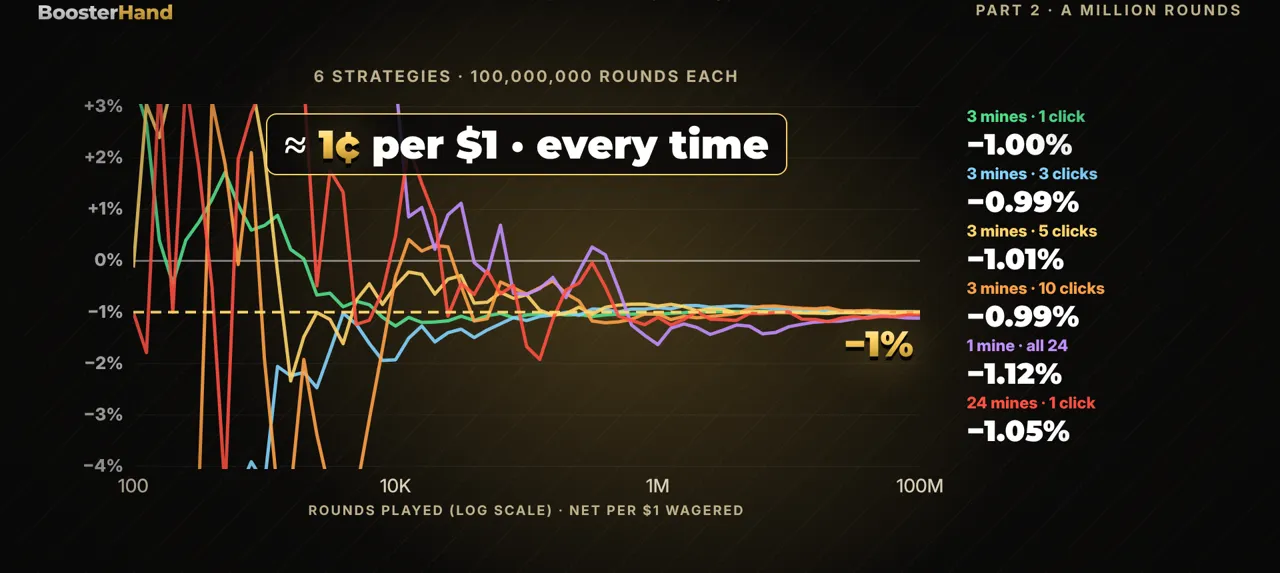
- 1,000,000 rounds per strategy: every one lost money. Over 100,000,000 rounds each, all landed between −0.99% and −1.12% per $1.
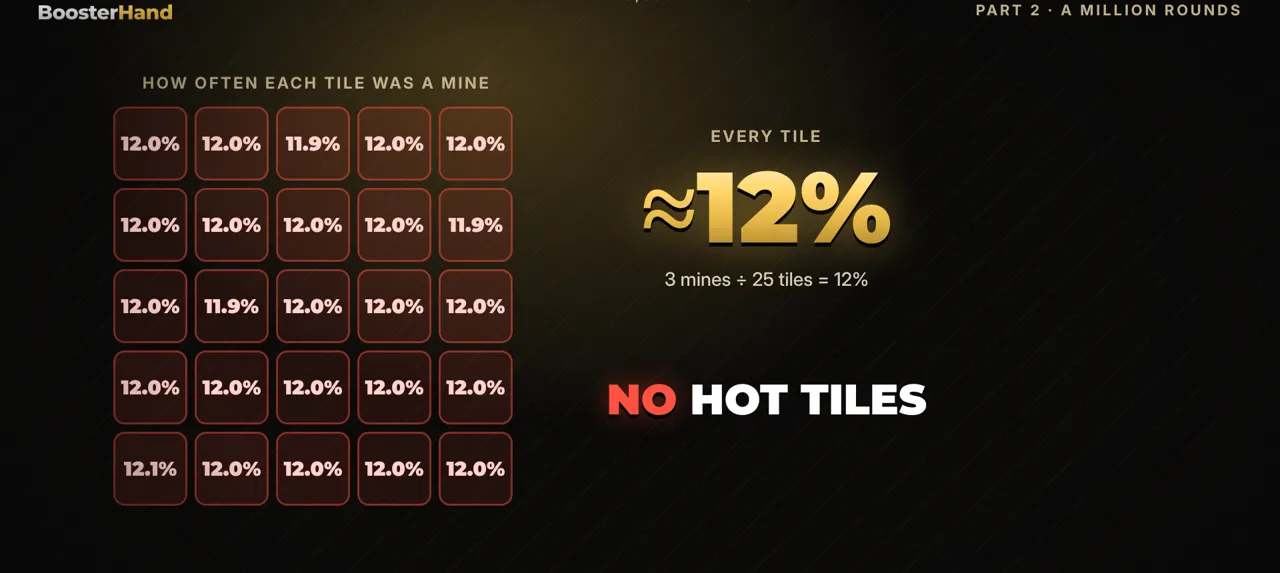
- Corners, center or avoiding last round's mines: all survived 49.5–49.6% of the time. Every tile was a mine about 12% of the time. No hot tiles.
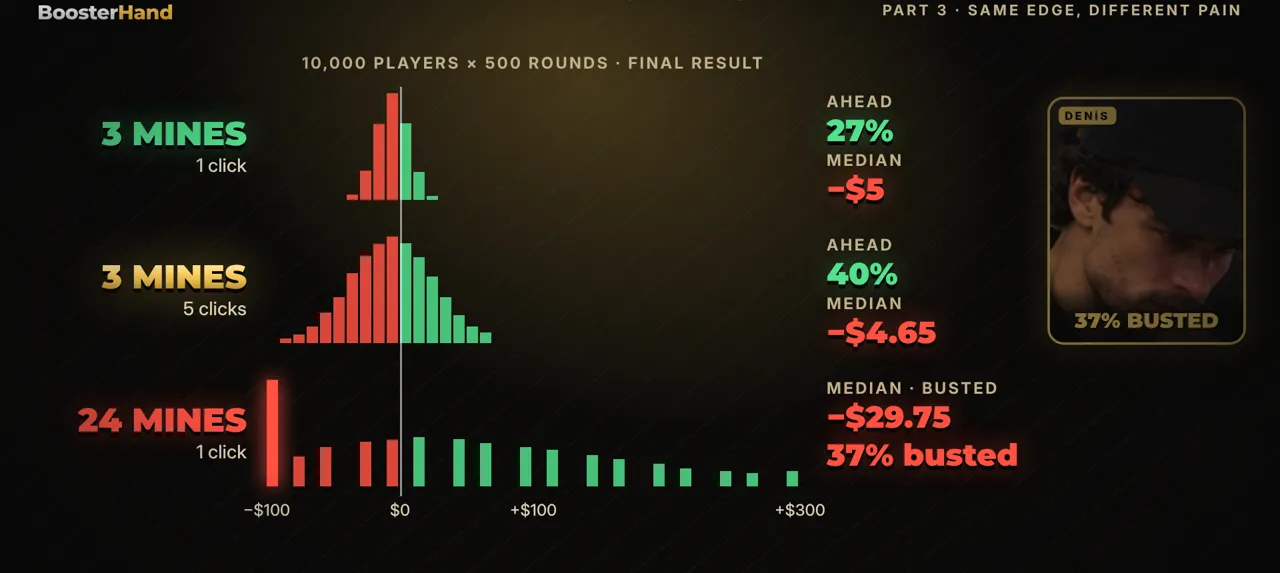
- 10,000 players × 500 rounds: 24 mines/1 click had the best winner (+$415.75), but the median player lost $29.75 and 37% lost their whole $100.
Mines feels like a game of nerve: click a tile, collect a gem, decide whether to push your luck. With 3 mines the first click is safe 88% of the time, so it feels like you’re in control. I calculated every click exactly, then simulated 1,000,000 rounds of six popular strategies to see whether any of them beats the house.
Short answer: none do. But the way they lose is very different.
How a Mines board works
The board has 25 tiles. Before the round, the game hides m mines among them. You click tiles one by one; each safe tile raises your multiplier, and you can cash out at any time. Hit a mine and the round is lost.
Every safe click leaves one safe tile fewer, so the odds get worse with each click. With 3 mines:
| Click | Chance this click is safe | Chance to survive all clicks so far |
|---|---|---|
| 1 | 22/25 = 88.0% | 88.0% |
| 2 | 21/24 = 87.5% | 77.0% |
| 3 | 20/23 = 87.0% | 67.0% |
| 5 | 18/21 = 85.7% | 49.6% |
| 10 | 13/16 = 81.3% | 19.8% |
The general formula for surviving k clicks is C(25 − m, k) / C(25, k).
How the multiplier is set
A fair multiplier is simply 1 ÷ the chance of surviving. The game keeps its edge by paying a little less: with a 99% RTP it pays 0.99 ÷ chance. With 3 mines that is 1.13x after 1 click, 2.00x after 5 and 5.00x after 10.
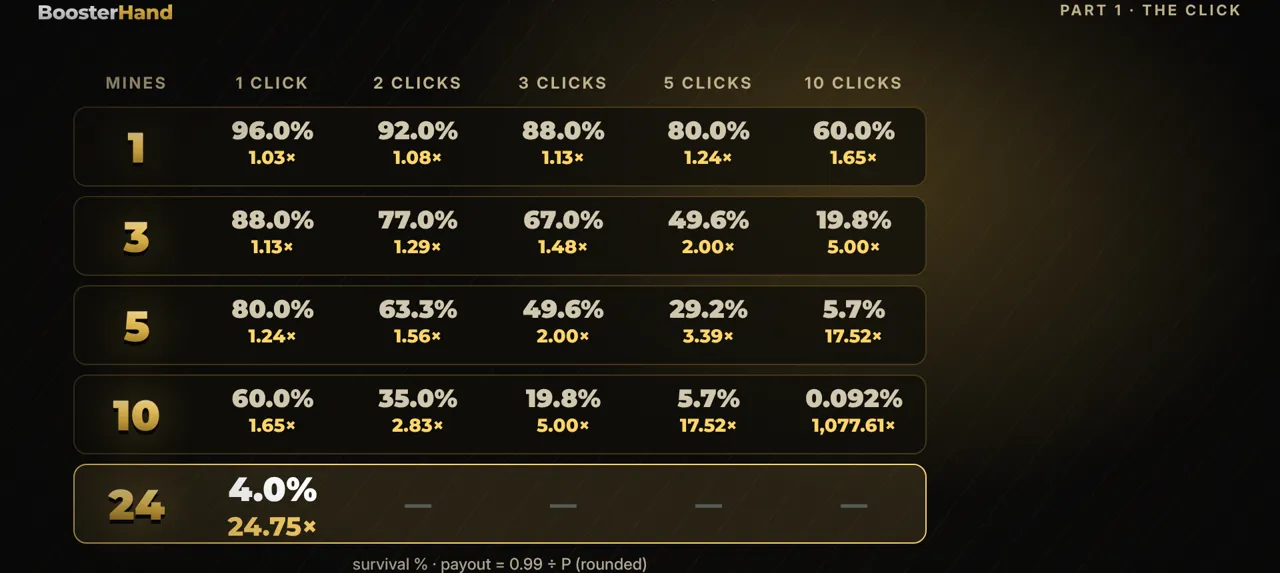
More mines work the same way. With 24 mines there is one safe tile: a 4% chance and a 24.75x payout.
Want the numbers for your own settings? Our Mines calculator computes every click for any mine count and RTP.
Before the results: which strategy do you think loses the least — 1 click and cash out, 10 clicks deep, or one shot at 24 mines?
How we ran the simulation
- Board: generic 5×5 Mines game, a fresh random layout every round
- Payout: 0.99 ÷ survival chance (99% RTP)
- Strategies: 3 mines with 1, 3, 5 and 10 clicks; 1 mine clicking all 24 safe tiles; 24 mines with 1 click
- Test 1: 1,000,000 rounds of $1 per strategy, then 100,000,000 rounds each
- Test 2: click patterns (corners first, center first, random, avoiding last round’s mines, same tiles every time)
- Test 3: 10,000 players × 500 rounds of $1 with a $100 budget
- Method: exact combinatorics plus Monte Carlo simulation in Python (NumPy), fixed random seed
1,000,000 rounds per strategy
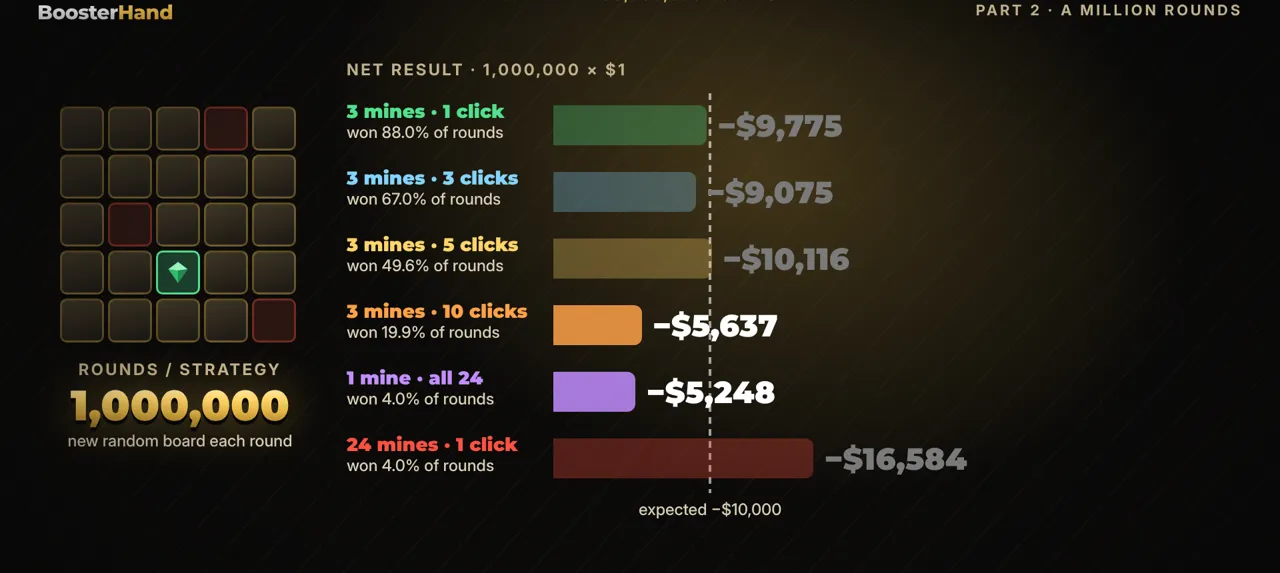
With a 1% edge the expected loss on $1,000,000 wagered is about $10,000. Here’s what happened:
| Strategy | Rounds won | Net result |
|---|---|---|
| 3 mines, 1 click | 88.0% | −$9,775 |
| 3 mines, 3 clicks | 67.0% | −$9,075 |
| 3 mines, 5 clicks | 49.6% | −$10,116 |
| 3 mines, 10 clicks | 19.9% | −$5,637 |
| 1 mine, all 24 tiles | 4.0% | −$5,248 |
| 24 mines, 1 click | 4.0% | −$16,584 |
The 1-click strategy won 88% of its rounds and still lost $9,775. And the strategies that lost less? That was luck: their wins are rare and big, so a million rounds still isn’t enough to settle them.
So I ran 100,000,000 rounds of each. Every strategy converged to the same place: between −0.99% and −1.12% per $1 wagered.
Corners, patterns and “hot tiles”
A popular idea is that some tiles are safer: corners, the center, or the tiles where the mines were last round. I tested 3 mines with 5 clicks for each pattern:
| Pattern | Survived 5 clicks |
|---|---|
| Corners first | 49.6% |
| Center first | 49.6% |
| Random tiles | 49.6% |
| Same tiles every round | 49.6% |
| Avoid last round’s mines | 49.5% |
Every one matches the exact math (49.6%). And over all rounds, each of the 25 tiles was a mine about 12% of the time — exactly 3 mines ÷ 25 tiles. On a fair random board there are no hot tiles.
10,000 players: same edge, different pain
A real session is short, so I gave 10,000 players 500 rounds of $1 each with a $100 budget.
| Strategy | Ended ahead | Median result | Best | Lost the whole $100 |
|---|---|---|---|---|
| 3 mines, 1 click | 27% | −$5.00 | +$27.63 | 0% |
| 3 mines, 5 clicks | 40% | −$4.65 | +$69.25 | 0% |
| 24 mines, 1 click | 41% | −$29.75 | +$415.75 | 37% |
The 24-mine lottery produced the biggest winner, but the typical player lost $29.75 and 37% lost the whole $100. The 1-click grinder almost never won much, but nobody went broke. Same edge, very different ride.
Limits of this model
Our game is a clean model: a fair random board and a 99% RTP built into every multiplier. Real games set their own multipliers and RTP, so check the game’s info screen; if the game is provably fair, you can verify each board yourself.
What this means for you
- No click pattern changes the odds. Corners, center and “hot tiles” all survive at exactly the mathematical rate.
- Every setting has the same edge. Mine count and cash-out point change how often you win and how big the swings are, not the ~1% you lose per $1 over time.
- High risk means fast busts. One shot at 24 mines made the best winner, but more than a third of players lost their whole budget within 500 rounds.
Mines is a game of chance with the edge built into the multipliers. Set a budget you can afford to lose and stop when it’s gone. If gambling stops being fun, our responsible gambling page has tools and support.
Did you pick the right strategy? And for the same math on a falling ball, see what happened when we dropped 1,000,000 Plinko balls.
FAQ
What is the best Mines strategy?
There is no strategy that beats the house. In our simulation every mine count and every cash-out point ended close to −1% of the money wagered over 100,000,000 rounds. Strategies only change how often you win and how big the swings are.
What are the odds in Mines with 3 mines?
On a 5×5 board with 3 mines, the first click is safe 88% of the time, 2 clicks 77%, 3 clicks 67%, 5 clicks 49.6% and 10 clicks 19.8%. The chance to survive k clicks is C(22, k) / C(25, k).
How are Mines multipliers calculated?
The fair multiplier is 1 divided by the chance of surviving all your clicks. A game with 99% RTP pays 0.99 divided by that chance, so 3 mines and 5 clicks pays about 2.00x instead of the fair 2.02x.
Are some tiles safer than others in Mines?
No. On a fair game every board is random. In our test every one of the 25 tiles was a mine about 12% of the time with 3 mines (3 ÷ 25), and corners, center and 'avoid the last mines' patterns all survived 5 clicks 49.5–49.6% of the time.
Is Mines rigged?
It doesn't need to be: the house edge is built into the multipliers. On provably fair games you can verify each board yourself; see our provably fair explainer.
Related
Simulations use generic models, not any real game or casino. Results show long-run math, not predictions for one session. 18+ only. If gambling stops being fun, take a break: responsible gambling.
Sources
- Combination — Wikipedia
- Hypergeometric distribution — Wikipedia
- Monte Carlo method — Wikipedia
- Expected value — Wikipedia
Next experiment: House Edge Explained: 1,000,000 Slot Spins, Where the Money Went