

BoosterHand Lab · simulation
I Tested a '99.999% Win' Roulette Strategy on 10,000 Players
Updated 2026-11-04 · By BoosterHand Lab · Method: Monte Carlo simulation (Python/NumPy, fixed seed)

- The plan bets $1 on each of two dozens: 24 of 37 numbers, a 64.9% win chance per spin. After a loss the stake triples, so any win repays everything plus $1.
- The '99.999%' is the chance of not losing 11 spins in a row. Surviving 11 losses needs $177,146. With $1,000 and a $500 table limit, 6 losses in a row end the plan: 99.81% per win.
- 10,000 players, one session each, stop at +$10: 98.15% hit the target. The 185 who didn't lost $719 to $728 each.
- All together they lost $35,667 of $1,362,006 wagered (−2.62%). The math says −2.70%: 1/37 of every dollar.
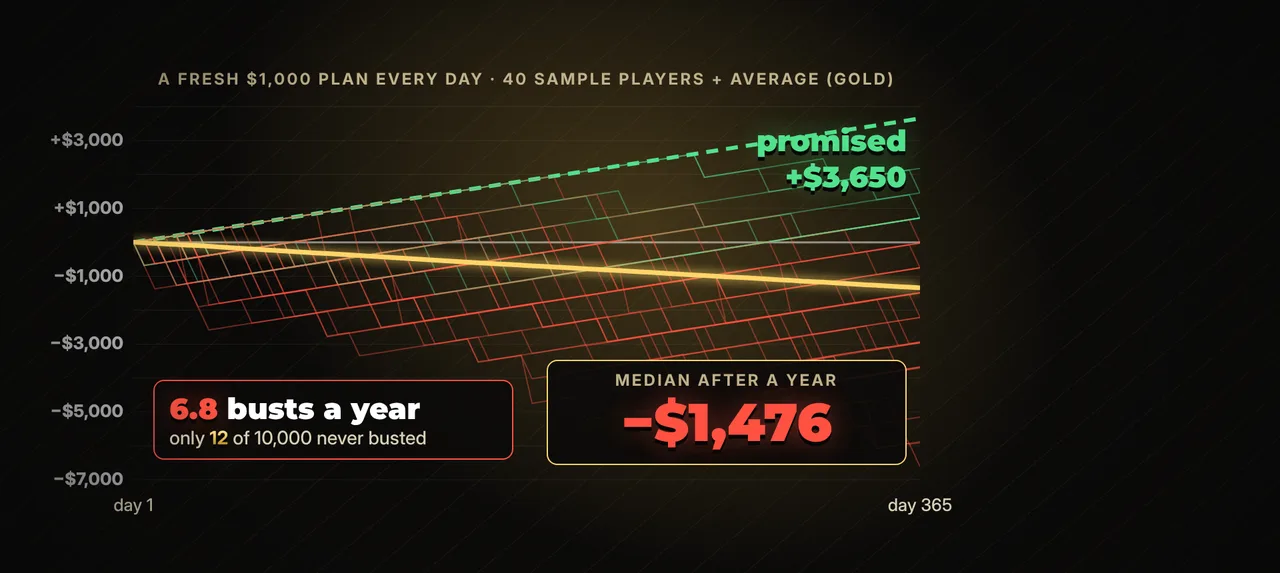
- Played every day for a year, the plan promised +$3,650. The median player ended at −$1,476 and 81% finished the year down.
There’s a roulette plan that keeps coming back with the same promise: cover most of the table, raise your bet after a loss, take a small profit and leave. “It wins 99.999% of the time.” I worked out the exact math on a single-zero wheel, then gave the plan to 10,000 simulated players with $1,000 each.
98% of them won. Together, they lost $35,667.
How the “99.999%” plan works
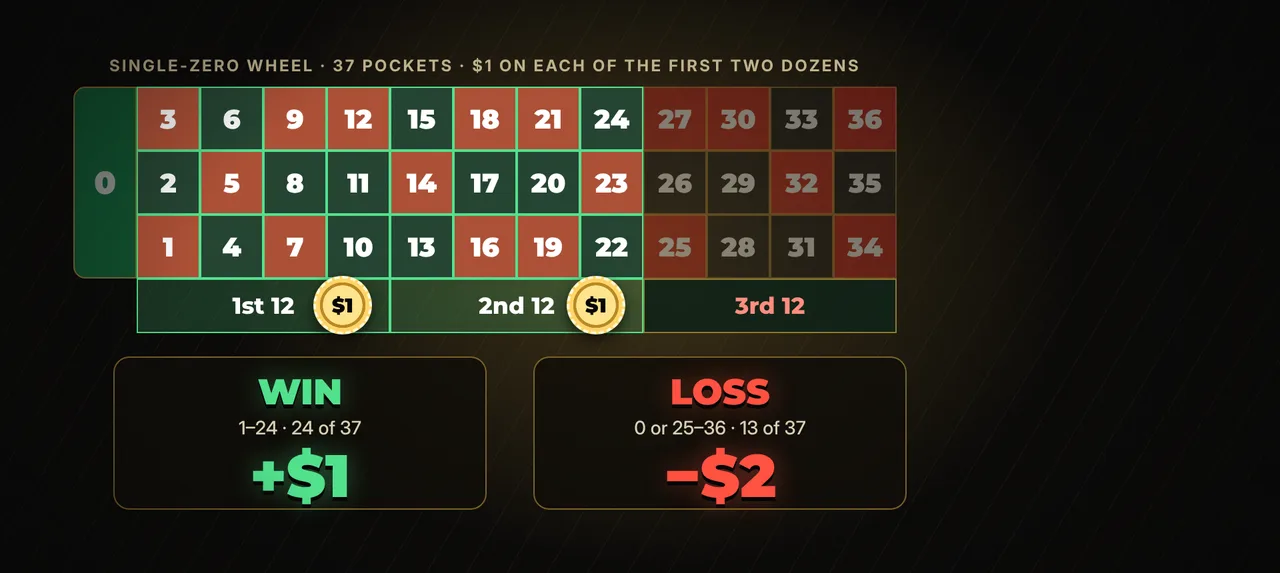
The wheel has 37 pockets: 1 to 36 plus a single zero. The plan bets $1 on the 1st dozen and $1 on the 2nd dozen, covering 24 numbers.
- Win (1–24): 24 of 37 = 64.9% of spins. One dozen pays 2:1 (+$2), the other loses (−$1): net +$1.
- Loss (0 or 25–36): 13 of 37 = 35.1%. Both bets lose: −$2.
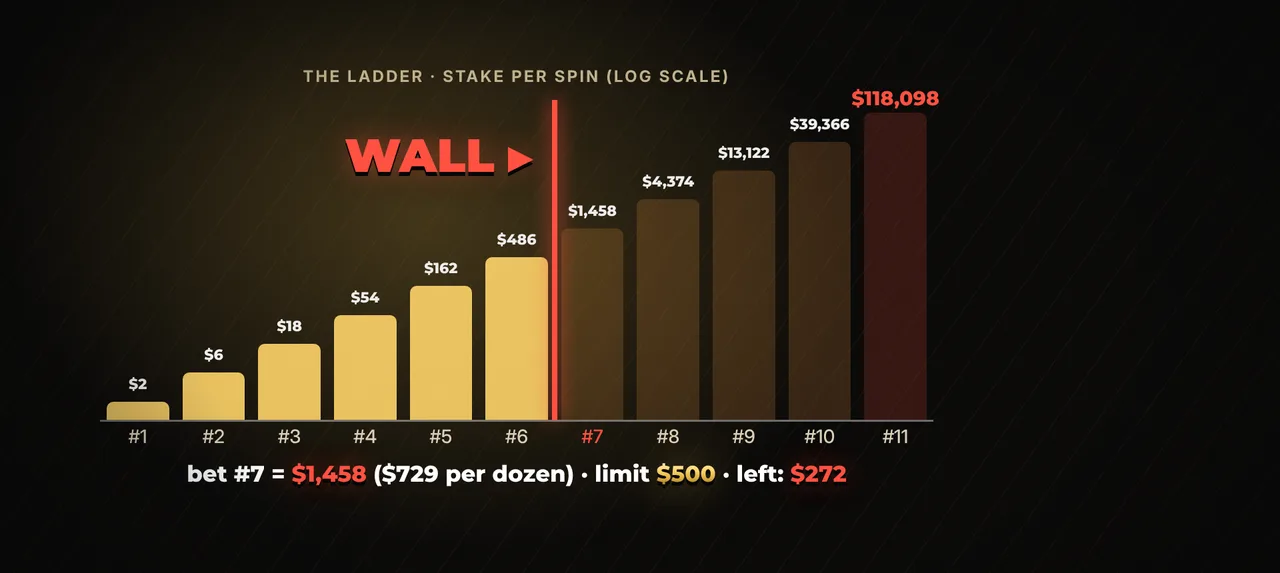
After every loss the stake triples: $2, $6, $18, $54, $162, $486. Because a win returns half the stake as profit, the next win always repays every loss in the streak plus $1. Lose $2, $6 and $18, then win on $54: +$27 − $26 = +$1. The player repeats this until the session is up +$10.
Where “99.999%” comes from
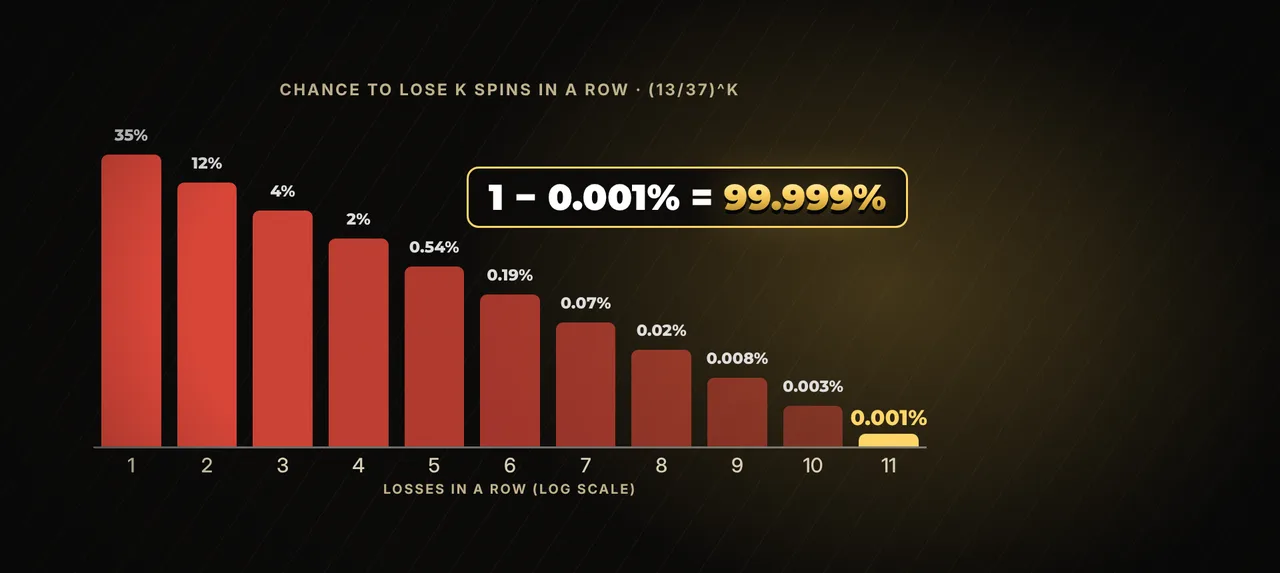
The plan only fails if the losses keep coming. The chance of losing k spins in a row is (13/37)^k:
| Losses in a row | Chance | Stake on that spin | Total lost |
|---|---|---|---|
| 1 | 35.1% | $2 | $2 |
| 3 | 4.34% | $18 | $26 |
| 6 | 0.188% (1 in 532) | $486 | $728 |
| 7 | 0.066% | $1,458 | $2,186 |
| 11 | 0.001% | $118,098 | $177,146 |
Eleven losses in a row happen about once in 100,000 tries. That’s the 99.999%. It is true, but only for someone who can keep tripling to a $118,098 bet.
The wall: bankroll and table limit
With $1,000 the ladder breaks much earlier. After 6 losses the player has lost $728 and has $272 left, but bet #7 is $1,458 ($729 per dozen). That’s more than the bankroll and more than a $500 table limit. So 6 losses in a row end the plan:
- per win cycle: 1 − (13/37)^6 = 99.81%, not 99.999%
- per session (10 wins for +$10): 0.9981^10 = 98.1%
Want to try your own bankroll, base bet and limit? Our Martingale calculator shows how many losses a progression survives.
Before the results: 10,000 players, one session each, 98% win rate. Do they finish up or down overall?
How we ran the simulation
- Wheel: single-zero (European), 37 pockets, every spin drawn at random
- Bet: $1 on the 1st dozen + $1 on the 2nd dozen, stake tripled after each loss, reset after a win
- Bankroll and limit: $1,000 per player, $500 maximum bet
- Session rule: stop at +$10, or when the next stake is larger than the bankroll or the limit
- Test 1: 10,000 players, one session each
- Test 2: the same 10,000 players, one fresh $1,000 session every day for 365 days
- Method: exact probability math plus Monte Carlo simulation in Python (NumPy), fixed random seed
10,000 players, one session each
The players spun 152,609 times and won 64.9% of those spins, exactly as the math predicts.
| Result | Players | Each |
|---|---|---|
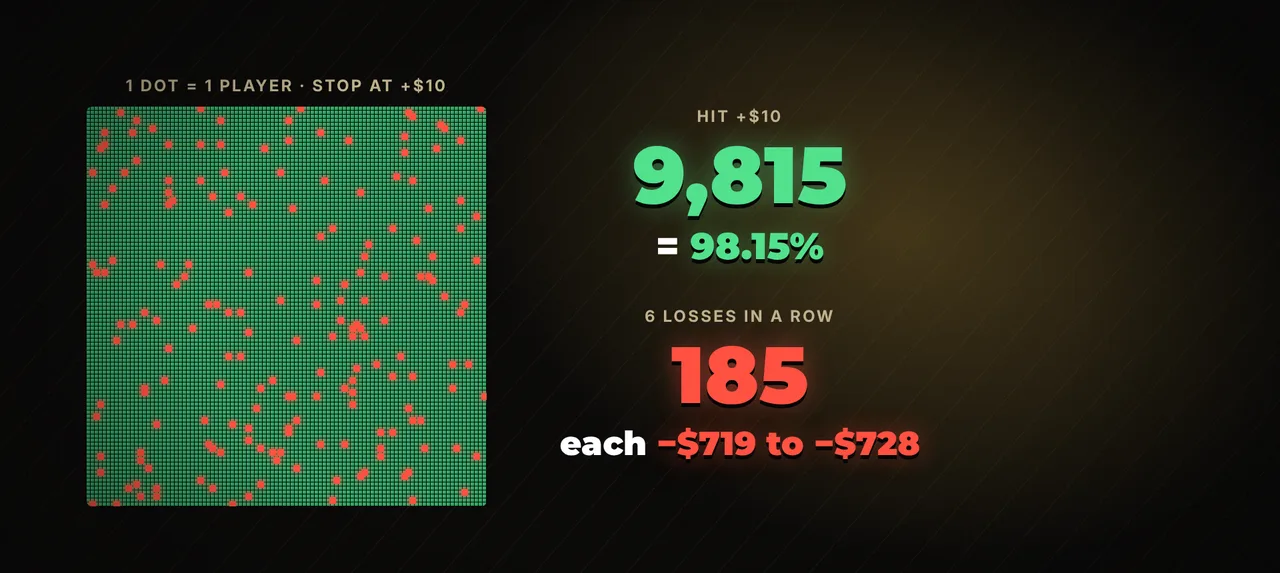
| Hit +$10 | 9,815 (98.15%) | +$10 |
| 6 losses in a row | 185 (1.85%) | −$719 to −$728 |
Now add it all up:
| Amount | |
|---|---|
| 9,815 small wins | +$98,150 |
| 185 busts | −$133,817 |
| Net, all players | −$35,667 |
| Median player | +$10 |
| Average player | −$3.57 |
One bust erases about 72 winning sessions. To break even the plan would need about 98.6% winning sessions; it gets 98.1%. That small gap is the house edge.
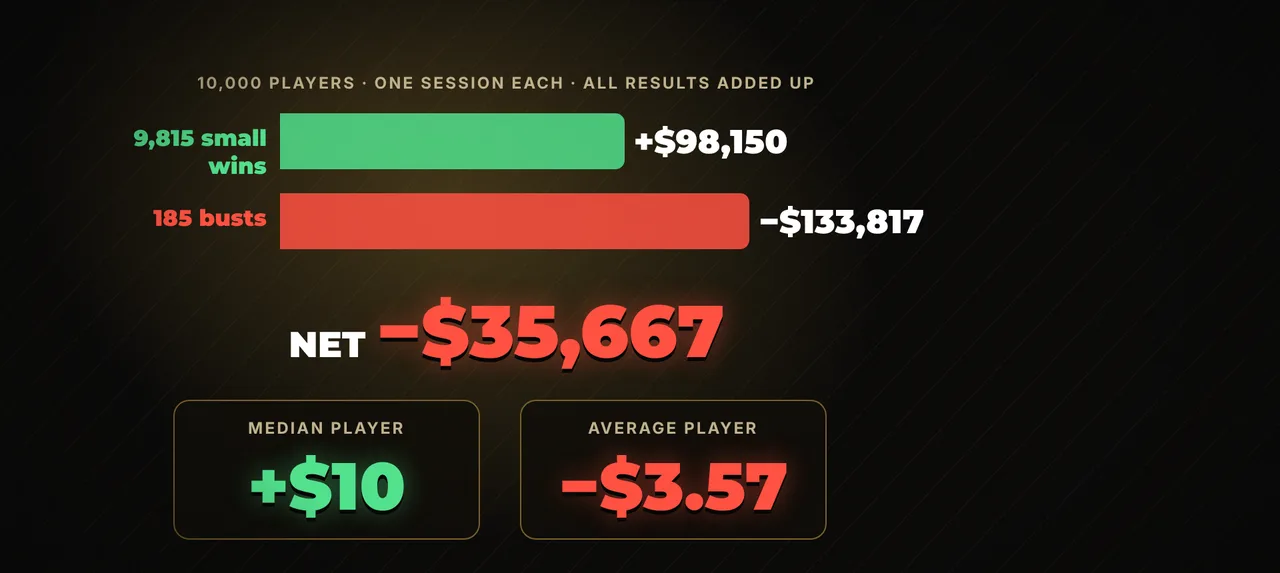
The players wagered $1,362,006 in total and lost 2.62% of it. The expected loss on any bet on this wheel is 1/37 = 2.70% per $1. Tripling doesn’t change that number. It only changes how much is bet.
”+$10 a day” for a year
$10 a day sounds like $3,650 a year. So every one of the 10,000 players ran the plan once a day for 365 days, with a fresh $1,000 each day.
| After a year | Result |
|---|---|
| Promised | +$3,650 |
| Busts per player (average) | 6.8 |
| Players who never busted | 12 of 10,000 |
| Median result | −$1,476 |
| Average result | −$1,343 |
| Finished the year down | 81% |
What a real 99.999% would cost
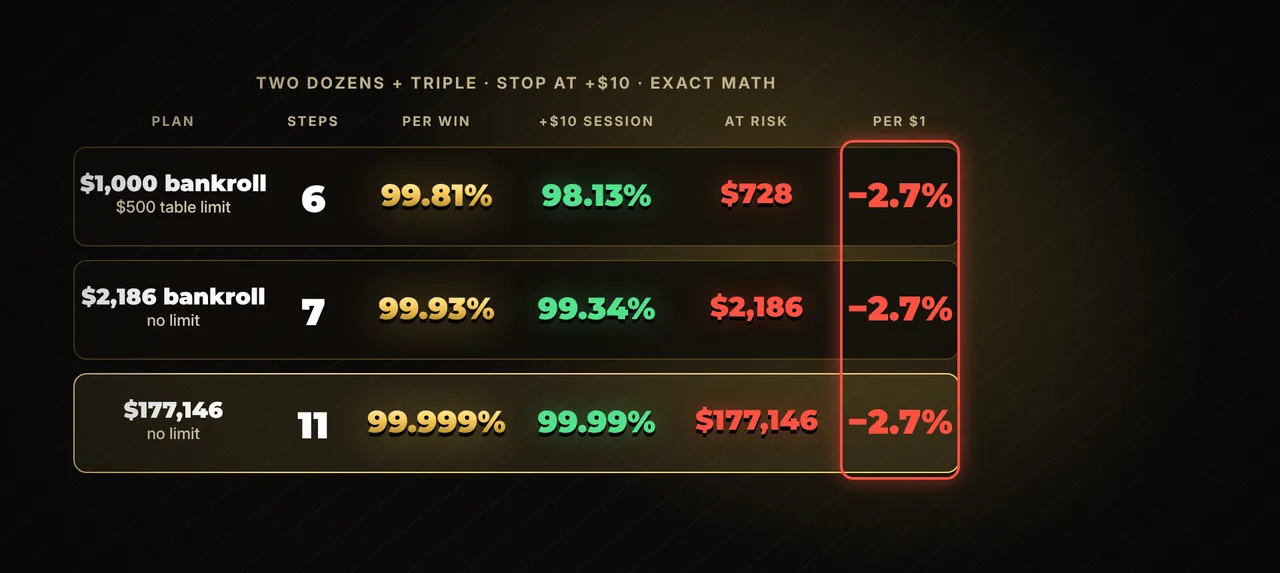
You can push the per-win success rate higher, but only with a much bigger bankroll and no table limit:
| Plan | Steps survived | Per win cycle | Per +$10 session | At risk | Per $1 bet |
|---|---|---|---|---|---|
| $1,000, $500 limit | 6 | 99.81% | 98.13% | $728 | −2.7% |
| $2,186, no limit | 7 | 99.93% | 99.34% | $2,186 | −2.7% |
| $177,146, no limit | 11 | 99.999% | 99.99% | $177,146 | −2.7% |
The same plan with a +$100 target ($1,000, $500 limit) hits its goal only 82.8% of the time (83.35% in a separate 10,000-player run). And even the $177,146 version still loses 2.7% of every dollar on average: it just risks $177,146 to win $10.
Limits of this model
This is one generic single-zero wheel with a $500 maximum bet and our exact stop rules. Real tables set their own limits, and some players would keep betting after a broken streak instead of stopping. None of that changes the 1/37 edge on each spin. On a double-zero wheel the edge is higher; see our European vs American roulette test.
What this means for you
- Covering more numbers buys win rate, not edge. 24 of 37 numbers won 64.9% of spins and still lost 2.7% per $1.
- Progressions trade many small wins for one huge loss. 98% of sessions won $10; the other 2% lost about $723 each.
- Any plan on this wheel loses 2.7% on average. Our 10,000 players lost 2.62% of $1,362,006, right where the math says.
Roulette is a game of chance, and no betting pattern turns the edge around. Set a budget you can afford to lose and stop when it’s gone. If gambling stops being fun, our responsible gambling page has tools and support.
Did you guess up or down? For the classic double-after-a-loss version, see our Martingale strategy test on 10,000 players.
FAQ
Is there a roulette strategy that wins 99% of the time?
Yes, you can win most sessions: covering 24 numbers and tripling after a loss hit a +$10 target in 98.15% of our 10,000 simulated sessions. But the rare failure costs about $723, so the plan still loses on average. Winning often is not the same as winning money.
Where does the 99.999% number come from?
On a single-zero wheel, a two-dozens bet loses with probability 13/37. Losing 11 spins in a row has a chance of (13/37)^11, about 0.001%, so '99.999%' of win cycles end before that. The catch is the 11th bet: with a $2 start it is $118,098, and the whole ladder costs $177,146.
What is the two-dozens roulette strategy?
You bet the same amount on two of the three dozens, covering 24 numbers out of 37. A win (64.9% of spins) pays one dozen at 2:1 and loses the other, for a net profit of half the stake. A zero or a number from the third dozen loses both bets.
Does tripling the bet after a loss beat the house edge?
No. Every bet on a single-zero wheel loses 1/37 (2.70%) of the stake on average, and a progression is just a series of such bets. Our 10,000 players wagered $1,362,006 and lost 2.62%, in line with the expected 2.70%.
How much bankroll do you need for a 99.9% roulette system?
With $1 on each dozen, 99.9% per win cycle needs 7 steps of tripling: $2,186 and a table that accepts $729 per dozen. 99.999% needs 11 steps and $177,146. Even then the expected loss stays 2.7% of everything you bet.
Related
Simulations use generic models, not any real game or casino. Results show long-run math, not predictions for one session. 18+ only. If gambling stops being fun, take a break: responsible gambling.
Sources
- Martingale (betting system) — Wikipedia
- Roulette — Wikipedia
- Gambler's ruin — Wikipedia
- Expected value — Wikipedia
Next experiment: How Slot Machines Work: The Hidden Reel Strip (5 Billion Spins Tested)